
You applied on Monday. By the following Tuesday there is still no reply, and you are wondering whether to follow up after applying for a job or whether that will make you look pushy. Short answer: a single, brief, well-timed message is normal, and it can be useful. A daily "any news?" is not.
This guide covers when to send it, who to send it to, three short templates you can adapt, and when to stop. The timing advice comes from published career guides, which we name and link below. None of it guarantees a reply, because the decision is not in your hands. What you control is the quality of the nudge and keeping your search moving while you wait.
Key takeaways
- Wait about one to two weeks after applying before you follow up, or one to two days after the posted closing date.
- Write to a named recruiter or hiring manager, not a general HR inbox, and keep it to a few lines.
- Send one follow-up, at most one more, then move on to other roles.
- Skip it entirely if the posting says "no contact" or "no phone calls."
- Log the date you applied so you know when a role is due for a nudge.
Does following up after applying actually help?
It can, mostly because of how applications are handled. Greenhouse, one of the common applicant tracking systems, explains on its candidate site that a submitted application goes into a queue on a recruiter's dashboard, and many recruiters send an automated email confirming receipt. In other words, your application is probably sitting in a pile, not being ignored on purpose. A short message from a real person can bring yours back to the top of someone's mind.
It will not rescue a weak application, and it will not work every time. Recruiters are busy, some roles are on hold, and some are already filled. Treat a follow-up as a low-cost extra step on applications you care about, not as a strategy on its own. If you are sending many applications, your time is better spent on tailoring each resume to the posting first.
When to follow up after applying: the timing
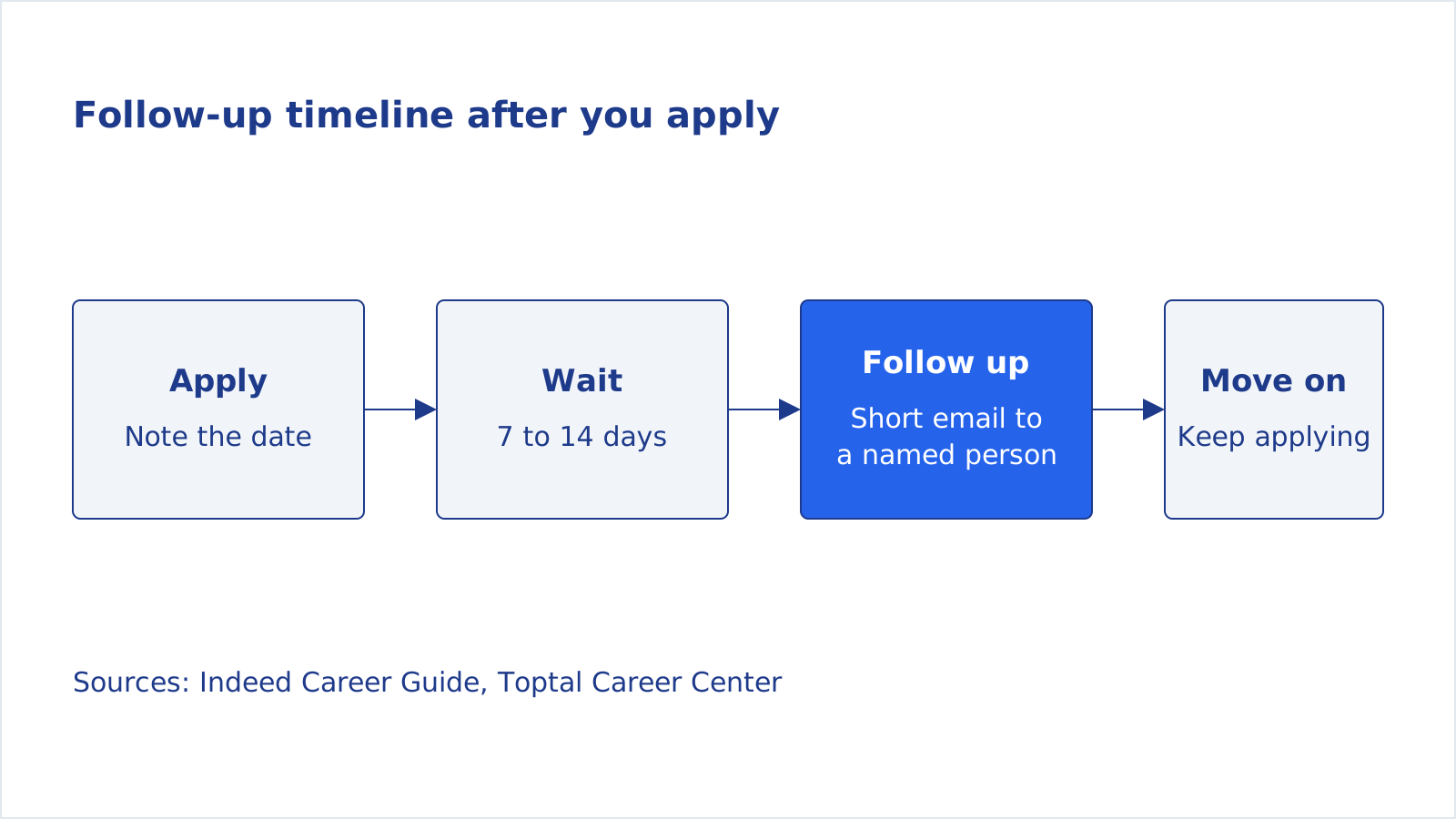
Career guides agree on a window of roughly one to two weeks. Here is what the named sources say:
- Indeed Career Guide: wait seven to 14 days after applying, or one to two days after the posted deadline has passed. If the posting says "no contact" or "no phone calls," skip the follow-up.
- Indeed, on follow-up emails: in its guide to follow-up emails it gives five to seven business days for an application follow-up, a little earlier than its other advice.
- Toptal Career Center: wait one to two weeks, send a short email to a named person, and follow up at most once more if there is no reply.
- LinkedIn's expert advice articles: wait at least a week unless the employer says otherwise.
The sources differ by a few days, so a practical rule is this: if the posting gives a closing date, wait until it has passed, then give it a day or two. If there is no date, count seven days from the day you applied and send your note between day seven and day fourteen.

Who to send it to
Indeed's guidance is to aim for the hiring manager or recruiter rather than a general HR inbox, and to prefer email over phone calls. Toptal makes the same point about writing to a named person. Here is where to find one:
- The posting itself. Many postings name a recruiter or a contact address. Check the bottom of the page and the confirmation email you received after applying.
- The company's careers page or a recruiter's public profile. Search the company name plus "recruiter" or "talent acquisition" on LinkedIn. The University of Illinois Chicago's career center suggests finding recruiters or hiring professionals at your target company and sending them a follow-up message after you apply.
- The likely hiring manager. If the team is small, the person who would be your manager is sometimes easy to identify. Contact them only when you cannot find a recruiter, and keep the message even shorter.
Do not guess email addresses or send the same message to five people at one company. One recipient, one message.
What a good follow-up says
Indeed's step-by-step advice reduces to a small checklist: be brief, confirm your interest, restate your value, say thank you and ask about next steps. Its sample email is 90 words or fewer. That is a good ceiling. A recruiter should be able to read it in ten seconds.
- A clear subject line. Include the job title and your name, for example "Following up: Product Analyst application, Jordan Lee."
- The role and the date. Name the job and when you applied so they can find you in the system.
- One specific reason you fit. One concrete line from your resume that matches the posting, not a restatement of your whole career. Only claim what is true and what your resume already shows.
- One easy ask. "Could you tell me where the process stands?" is easy to answer. "Please call me" is not.
Indeed's example includes quantified achievements. If you have real numbers from your work, use one. If you do not, do not invent any: a plain, accurate line beats a made-up figure that falls apart in an interview.
Three follow-up templates you can adapt
Replace the brackets with your details and cut anything that does not apply. US spelling is used here; switch to UK spelling if you are applying in the UK or Europe.
Template 1: the first follow-up email (about 70 words)
Subject: Following up: [Job title] application, [Your name]
Hi [Recruiter first name],
I applied for the [Job title] role on [date] and wanted to confirm my interest. My [specific experience from your resume, e.g. "three years running customer onboarding for a B2B product"] lines up with what the posting asks for in [skill or responsibility].
Could you let me know where the process stands, or if there is anything else you need from me?
Thank you for your time,
[Your name] · [email] · [phone]
Template 2: a short LinkedIn message (under 200 characters)
Indeed's sample note for a professional networking site is 200 characters or less. Use it when you cannot find an email address.
Hi [Name], I applied for the [Job title] role at [Company] on [date] and would love to be considered. Happy to share anything that helps. Thanks for your time!
Template 3: the last nudge (one more week, then stop)
Subject: Re: [Job title] application, [Your name]
Hi [Recruiter first name],
A quick check-in on my application for [Job title], sent on [date]. I am still very interested. If the role has been filled or the timeline has changed, I would appreciate knowing so I can plan accordingly, and I would be glad to be considered for future openings.
Thank you,
[Your name]
This one gives the reader a graceful way to say "no." That is useful, because a clear answer helps you more than silence does.
Keep track so nothing slips
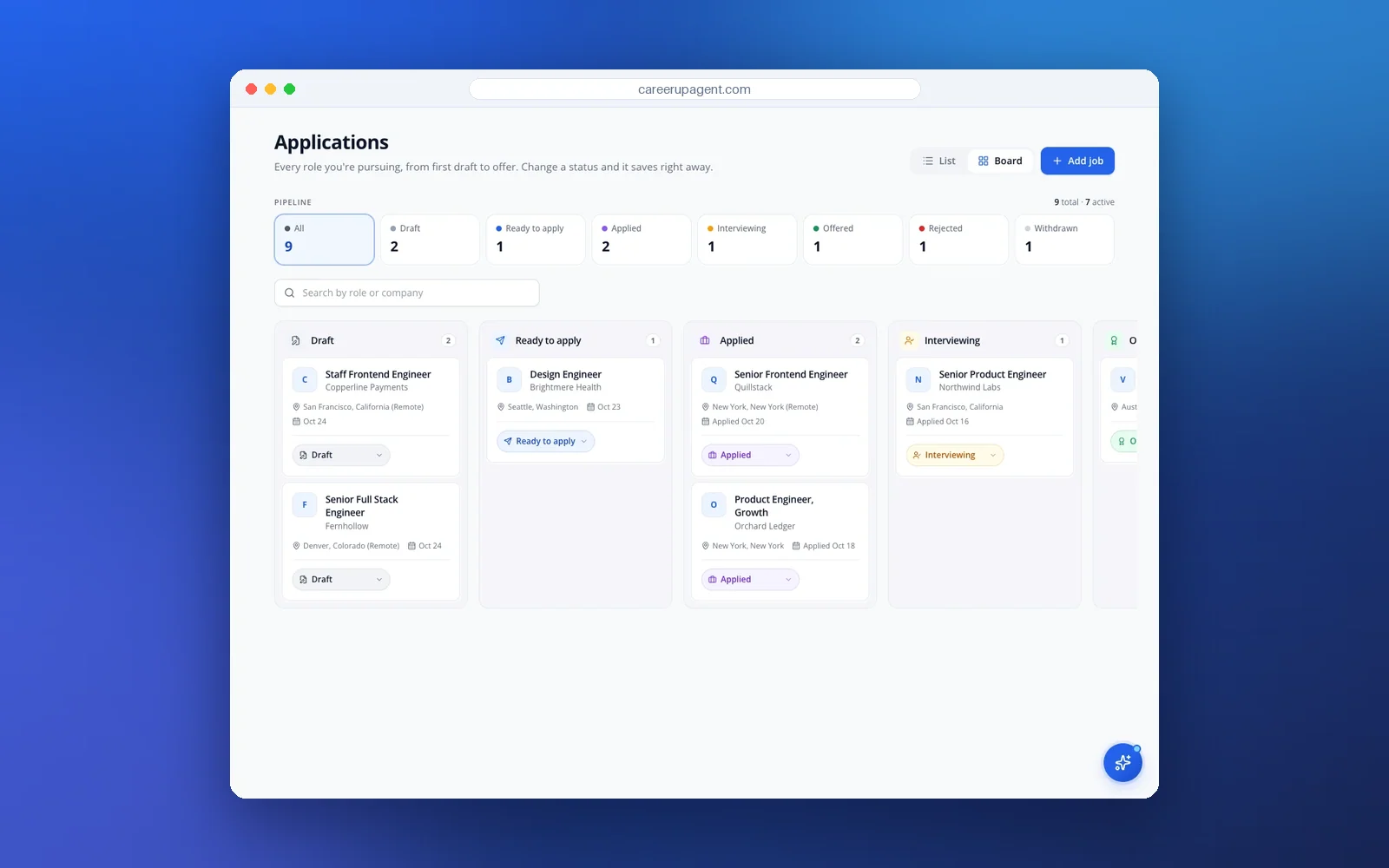
The most common reason people fail to follow up is simply losing track of when they applied. A spreadsheet works. So does the application tracker in CareerUpAgent, where you move each role through statuses such as Draft, Ready to apply, Applied and Interviewing and see the applied and updated dates next to it. When a role has been in "Applied" for a week or two, it is due for a nudge. If you want a deeper look at planning your weekly volume, see how many jobs to apply to a week.
A simple routine: once a week, look through your applied roles, pick the ones that crossed the one-to-two-week mark, and send one message each. Then record the date you sent it. That takes less than half an hour and keeps you from either forgetting or over-contacting.
When not to follow up, and when to stop
- The posting says not to. "No contact" or "no phone calls" means exactly that. Skip it and move on.
- You already got a rejection or a scheduled interview. Do not nudge. In the second case, reply to the thread you are in.
- It has been less than a week. You will mostly add noise.
- You have sent two messages. Toptal's advice is a follow-up and at most one more. After that, assume the answer is no for now and put your energy into new applications. You can always reapply when a similar role opens.
Tip: Silence is not a verdict on you. Hiring pauses, internal candidates and budget changes all produce silence. Keep a steady flow of new, well-matched applications going, so no single reply decides your week.
What to do while you wait
The best follow-up is another application. While your earlier ones sit in a queue, use the time on things you do control:
- Tailor and send your next application, starting with the roles that fit best.
- Practice answers for likely questions, such as "tell me about yourself", so you are ready if a call is scheduled at short notice.
- Check that your resume reads cleanly for both people and software. Our free ATS resume checker is one quick way to do that.
CareerUpAgent can help with the repetitive parts: it scores how well each job fits your resume and writes a tailored resume and cover letter for each application, and you review and send everything yourself. You can try it free at careerupagent.com.
Sources
- Indeed Career Guide, How To Follow Up on a Job Application, and How To Write a Follow-Up Email
- Toptal Career Center, Follow-up Email After Applying for a Job: Templates and Tips
- LinkedIn advice, How soon after applying should you follow up on a job application?
- Greenhouse, What really happens after you apply for a job?
- University of Illinois Chicago Career Center, Following Up & Thank You Messages