
"Tell me about yourself" is usually the first real question in an interview, and it is the one candidates over-prepare and still get wrong. Some recite their resume in order. Others start at high school and run out of time before they reach the job. A good answer to tell me about yourself is shorter and more deliberate than either: a 60–90 second story that shows why you fit this role.
This guide gives you a simple three-part structure, a time budget for each part, three sample answers you can adapt, the mistakes that waste the question, and a way to practice until it sounds like you.
Key takeaways
- Use three parts: present, past, future. Each one has a job, and the answer ends by pointing at the role.
- Aim for 60–90 seconds, which is roughly 150–250 spoken words.
- Pick two or three past experiences that prove you can do this job. Leave out the rest.
- Write it, say it out loud, record it once, then trim. Do not memorize it word for word.
What the interviewer wants when they ask "tell me about yourself"
The question sounds personal, but it works as a filter. A career coach quoted by Tufts University's alumni site says hiring managers use it to check four things: your professional experience related to the job, your skills, your educational background, and how well you fit the company culture (Tufts Alumni, December 2025). They are not asking for your life story. They are asking you to connect your background to their open role, in your own words.
That is why the same answer does not work everywhere. In a networking or informational conversation, the same source says the goal shifts to explaining why you are talking, what you can offer, and building the relationship. In a job interview, the audience is a person trying to decide whether to move you forward. Write for that person.
The present-past-future structure
The most common structure is simple enough to remember under pressure. Career sites describe it as past-present-future or present-past-future; the parts are the same, and only the order of the first two changes (Novoresume uses the first order, Capstone Workforce the second). We suggest starting with the present, because it answers the question the interviewer actually asked ("who are you?") in your first sentence.
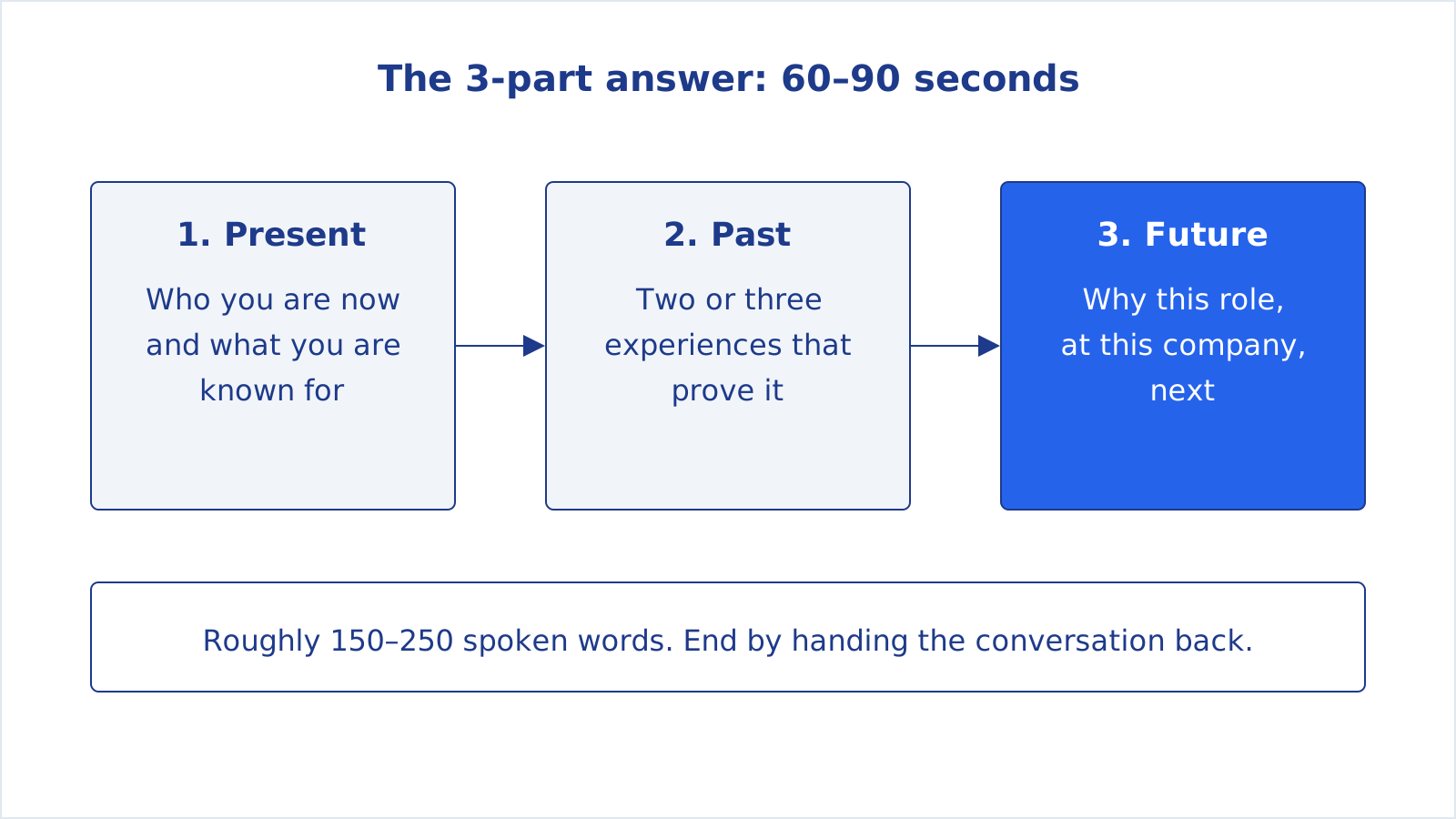
1. Present: who you are and what you are known for (about 20–30 seconds)
Start with your current role or situation and one thing you do well. Use a concrete verb, not a list of adjectives. "I run onboarding for a 12-person customer team" tells the interviewer more than "I am a motivated, detail-oriented professional." If you are a student or between jobs, start with what you have been doing most recently: a degree, a project, a freelance engagement.
2. Past: the evidence (about 30 seconds)
This is a highlight reel, not a timeline. The Tufts guide puts it as selecting only the two or three past experiences that prove you can handle the role you are applying for. Choose them from the job description: if the posting stresses stakeholder communication, pick the project where you managed stakeholders. Name what you did and what changed because of it.
3. Future: why this role, and why now (about 20–30 seconds)
This is the pivot, and the part most candidates skip. Say what you are looking for next and connect it to this job. The same Tufts guide notes that ending on the future hands the conversation back to the interviewer so you can talk about the open position. One sentence naming something specific about the team, product or problem is enough. Do not name a generic reason that fits any company.

How long should the answer be?
Most guides land in the same range. Extern's interview guide recommends 60 to 90 seconds, roughly 150 to 250 spoken words (Extern). The Tufts coach teaches a 90-second narrative. On a short recruiter screen, aim for the low end.
A practical way to hit the range: write the answer, read it aloud once with a timer, and cut anything that does not support the role. Most first drafts run long because the past section tries to carry too much.
Three sample answers you can adapt
These are fictional examples to show the shape. Swap in your own facts; do not copy the wording, and do not claim anything you cannot back up in a follow-up question.
Sample 1: Software engineer applying for a senior role
Present: "I'm a backend engineer on a payments team, where I mostly own the services that handle refunds and reconciliation. Past: Before that I spent three years at a logistics startup, where I rebuilt a slow reporting job into something the operations team could run on their own, and I mentored two junior engineers through their first on-call rotations. Future: I'm looking for a role where I can take on design decisions for a larger system, and your team's work on [specific system from the job post] is exactly that kind of problem."
Why it works: the present line states scope, the past line gives two proofs (a delivery and a leadership signal), and the future line points at the actual posting.
Sample 2: Recent graduate with limited experience
Present: "I just finished a master's in data analytics, and my main project was a dashboard for a local nonprofit that tracked volunteer hours. Past: That project taught me to start from the question the client was asking. Before the degree, I worked two years in retail operations, so I'm used to explaining numbers to people who don't read spreadsheets. Future: I want to work as an analyst where I'm close to the business team, which is why this role's mix of reporting and stakeholder work caught my eye."
Why it works: with a short work history, the evidence comes from a project and a prior job that taught a transferable skill. It is honest about being early-career.
Sample 3: Career changer
Present: "I'm a high-school teacher moving into customer success, and over the past year I've been supporting new users at a small education software company on a part-time basis. Past: Teaching gave me eight years of explaining complicated things to people who are stuck, and the part-time role showed me that I enjoy the same work with software. Future: I'm applying here because your customers are teachers, and I understand their day from the inside."
Why it works: it names the change in the first sentence instead of hiding it, then turns the old career into the reason you are a fit.
Common mistakes to avoid
- Reciting the resume. The interviewer has it in front of them. Add the story behind two lines of it.
- Starting too early. "I was born in…" or a walk through every job since college uses your time on the wrong part.
- No future part. If the answer stops at the present, the interviewer still doesn't know why you applied.
- Sharing personal details to fill time. A brief, relevant interest can humanize you. Family, health or politics usually do not belong in this answer.
- Running past two minutes. If you notice you are still on your second job at the one-minute mark, cut.
- Using the same answer for every job. Keep the present line and change the rest per posting.
Tip: Keep a "master" answer with five or six past experiences, then pick two or three for each interview. It is the same idea as tailoring your resume: one honest source, a different cut for each job. Our guide on resume summary examples uses the same three-part thinking in writing, and the answer you give here should not contradict it.
How to practice until it sounds natural
- Write it in plain sentences. Write the way you would talk, with short sentences and no jargon you would not say to a friend.
- Cut it to three keywords per part. Put them on index cards. You will remember the sequence and say it differently each time, which sounds more natural than a script.
- Time it once. Read it aloud with a timer. Stay near 90 seconds.
- Record yourself. Listen once for filler words and for places where you rush.
- Rehearse the handoff. End on the future part, then stop. Silence after a clean finish is fine.
CareerUpAgent includes mock interviews built around a specific job. You answer each question by typing or dictating, ask for feedback, and when the session ends you get a debrief with an overall score, a written summary, and lists of strengths, things to improve and what to practice next. On the Free plan you can run one mock interview a day, which is enough to rehearse the same opening answer on several days in a row.
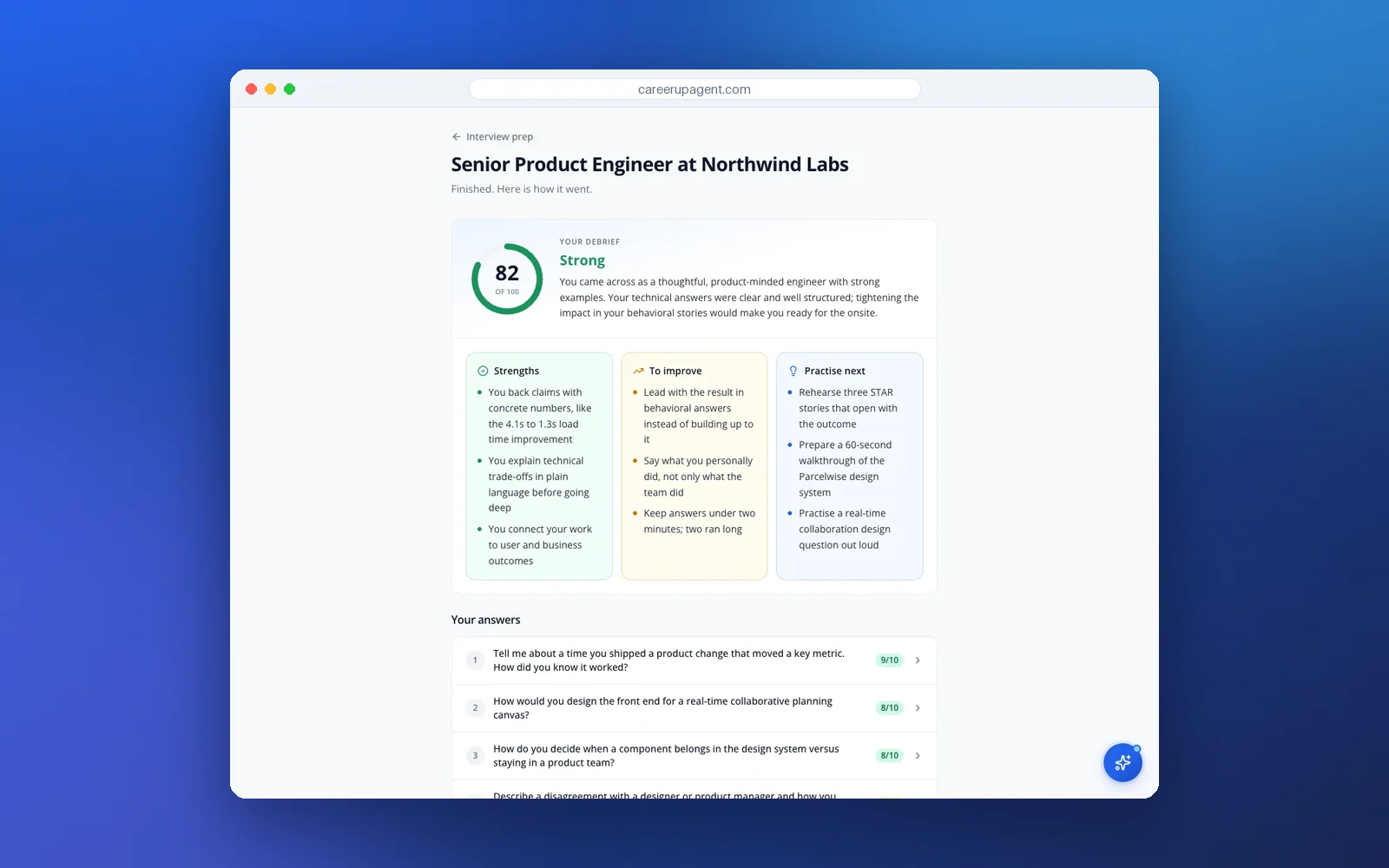
Use the debrief as a checklist, not a verdict. A score tells you how one practice run went, and it does not predict how a real interview will go. The useful part is the "to improve" column: if it keeps saying your answers are long, cut your past section.
Match the answer to the job before every interview
The strongest answers are tailored. Before each interview, read the posting once more and underline the two or three things it asks for most. Those become your past section. A tailored resume and cover letter already give you this list: the cover letter structure guide shows how to pick the same evidence for a one-page letter. For a faster read on which parts of a posting you match, the free resume-to-job match checker lists skills it found and what appears to be missing.
Interviewers follow up on whatever you say, so every line has to be something you can talk about for another two minutes.
Next step
Write your three parts today, time them, and book one practice run before your next interview. If you want a job-specific rehearsal, you can start free on CareerUpAgent and run a mock interview for a role you are actually applying to. You still review and send every application yourself.