
If you are staring at a blank page wondering how to write a cover letter that someone will actually read, the answer is shorter than you think. A good letter is one page, four short paragraphs, and every sentence is about the job in front of you, not about your whole career.
This guide gives you a structure you can reuse for every application, the details that make each paragraph work, what to cut, and a quick way to tailor the letter in about ten minutes without starting over.
Key takeaways
- Keep it to one page, roughly 250 to 400 words, in three or four short paragraphs.
- Use four blocks: open, proof, fit, close. Each one has a single job.
- Tailor the first and third paragraphs for every role; the proof story can often stay.
- Do not repeat your resume. Pick one result and explain it.
- An AI draft is a starting point: check every claim and put it in your own voice before you send it.
Do hiring managers still read cover letters?
Often, yes. Resume Genius surveyed 625 US hiring managers in 2022 and reported that 83% read most of the cover letters they receive, even at companies where one is not required. In the same survey, 49% said a strong cover letter can secure an interview, and 41% pointed to the introduction as the most impactful part of the letter.
That is one survey run by a resume-builder company, so treat the exact percentages as a signal rather than a law. The practical point holds: when a letter is read, the opening decides whether the rest gets a fair look. It also means a generic letter costs you something. It tells the reader you sent the same page to everyone.
Some postings say a cover letter is optional. If you have a real reason to write one, such as a career change, a gap, a move to another country or a role you care about, send it. If the form has no place for it, a short note in the application message or a PDF attached with your resume does the same job.
How long should a cover letter be?
Career advice is consistent on this. Indeed recommends a half page to one full page, about 250 to 400 words, in three or four short paragraphs. UC Santa Barbara's career services sets a maximum of one page and three to five paragraphs, and MIT's career office asks for no more than one page in a 10 to 12 point font.
Aim for the middle: four paragraphs, 250 to 350 words. If you cannot say it in that space, you have not yet decided what the one important point is.
The 4-paragraph structure
Think of the letter as four blocks. Each has one job, and if a sentence does not serve that job, it goes.
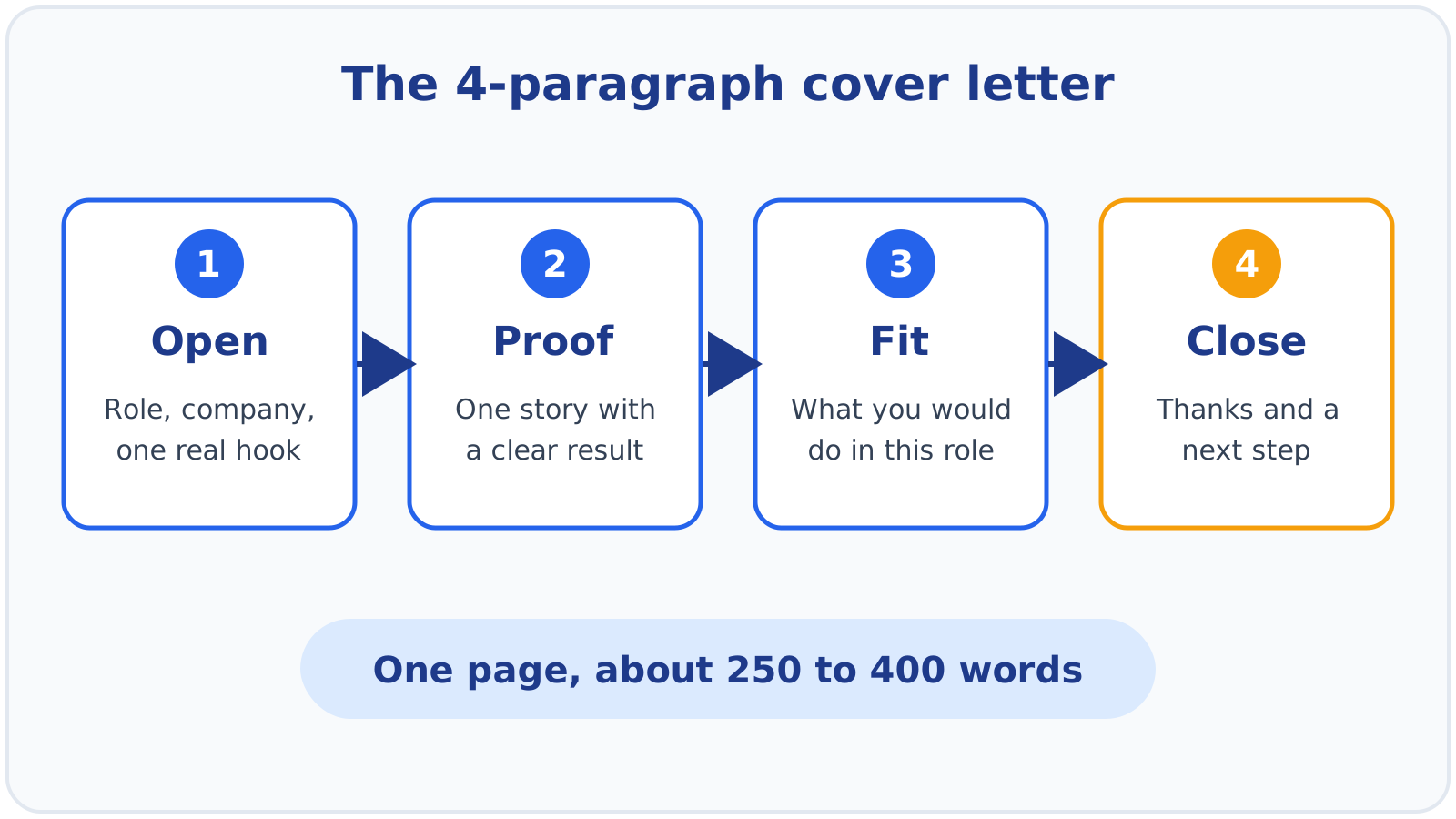
1. Open: the role, the company and one real hook
Name the role in the first sentence, then give the reader a reason you are writing to this company. The hook can be a product you use, a recent launch, a problem the team is solving, or a person who referred you. Skip "I am writing to apply for" and "I am a hard-working professional". The reader already knows you are applying.
If the posting names a hiring manager, address the letter to them. If it does not, MIT's guidance is to write "Dear Hiring Manager" rather than guess. Include a reference number if the posting has one, so the application can be tracked.
2. Proof: one story with a result
This is the paragraph most letters get wrong, because they list duties. Pick one achievement that matches what the job asks for and tell it in four sentences: the situation, what you did, what changed, and a number if you have a real one. Do not invent a number to sound impressive.
A good test: could this paragraph appear in a letter from another candidate? If yes, add the specific detail only you would know, such as the tool, the team size or the deadline.
3. Fit: what you would do in this role
Now turn toward the employer. Read the job description and choose the one or two requirements that matter most. Say how your experience applies to them in the first months of the job. Texas State's career services puts it simply: tailor the letter to the reader and industry, and focus on what you offer rather than what you want.
This paragraph is also the right place to explain anything the resume cannot, like a career change or a relocation. Keep it factual and forward-looking.
4. Close: thanks and a next step
Two or three sentences. Thank the reader, say you would welcome a conversation, and mention anything practical, such as your availability or your work authorization if it is relevant. End with your name. You do not need to apologize for taking their time or to repeat your qualifications one more time.

What to cut from a cover letter
- A retelling of your resume. The resume is attached. Use the letter for the story behind one line of it.
- Empty adjectives. "Passionate", "motivated" and "team player" prove nothing. A specific project does.
- Salary history and personal details the form did not ask for.
- Negativity about a past employer or the reason you left.
- Anything about what the job would do for you. Keep the focus on what you would contribute.
Tip: Read the letter aloud. Where you run out of breath or lose interest, cut the sentence. Most letters improve when they lose a quarter of their words.
How to tailor a cover letter in about ten minutes
You do not have to write from scratch for every job. Keep a master version with two or three proof stories you have already polished, then adapt it each time:
- Read the posting and highlight three requirements. Ignore the long wish list. The first few responsibilities and the "must have" lines usually matter most.
- Rewrite the opening. One sentence on the role, one on why this company.
- Choose the proof story that best matches the requirements and trim it to four sentences.
- Rewrite the fit paragraph around the requirements you highlighted, using the posting's own words where they are accurate for your experience.
- Check the resume and letter agree. Titles, dates and tools should match. Our guide to tailoring your resume to a job description covers the resume side, and the ATS resume guide explains what the systems actually read.
If you want a quick read on how well your resume fits the job before you write a word, the free resume-to-job match checker shows which skills the posting asks for that your resume does not mention yet. That tells you what the fit paragraph should address.
Where an AI draft helps, and where it does not
Drafting is the slow part, and it is where a tool can help. In CareerUpAgent, the apply flow has a cover letter step: it writes a letter from your resume and the job description, shows it in an editable box next to a live PDF preview, and lets you copy the text, download the PDF or save it. The public cover letter generator does the same on a pasted resume and job description, without an account.
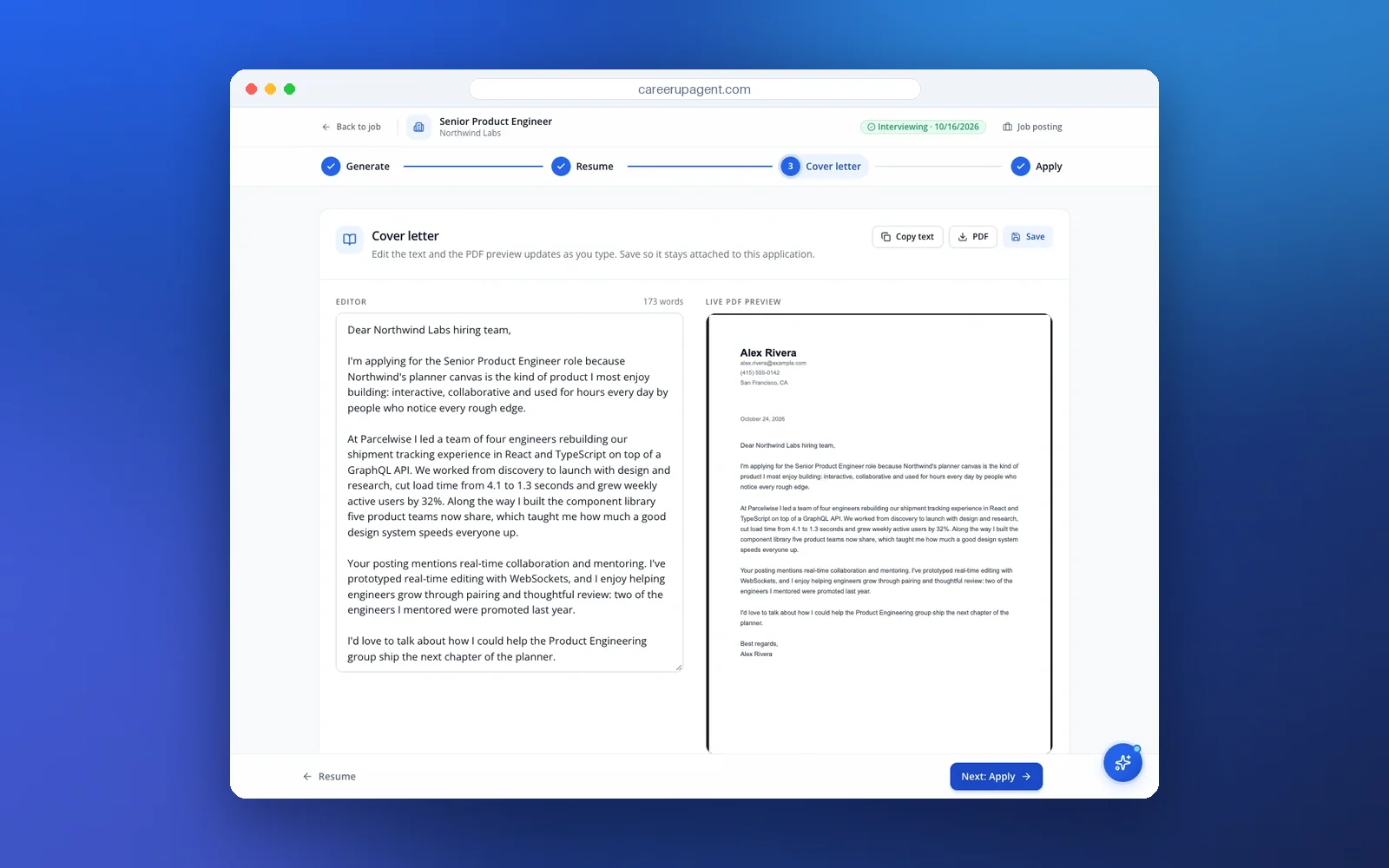
Treat the output as a first draft. You are the one who knows whether the story is true, whether the tone sounds like you and whether the hook is real. Read it against the four blocks above, replace anything generic with a detail only you could write, and review it before you send. Nothing is sent for you.
A quick checklist before you send
- One page, about 250 to 400 words, three or four paragraphs.
- The role and company are named correctly, and nothing is left over from a previous application.
- The opening has a real reason for this company.
- One proof story, with facts you can defend in an interview.
- The fit paragraph answers the top requirements in the posting.
- The close has a clear, polite next step.
- File saved as a PDF with a clear name, such as your name and the role, unless the employer asks for another format.
Write the next one faster
The structure is the same every time; only the opening and the fit paragraph change. Try the free cover letter generator on a job you are considering, or create a free CareerUpAgent account to match jobs to your resume and draft a tailored resume and cover letter for each one, which you review before sending.