
You can find a job in Germany from abroad by applying to vacancies before you move. The search is the easy part. The harder part is the package: in Germany a "complete application" means a cover letter, a CV and your certificates, and the language of that package matters more than many applicants expect. This guide goes through where to look, how to read an ad, what goes in the documents and where to check the visa side. Visa and recognition rules come only from the official pages we link, and they change, so check them on the day you apply.
Key takeaways
- Start with the official "Make it in Germany" job listings, which show vacancies where international specialists are explicitly wanted, then widen to the Federal Employment Agency, the big job boards and company sites.
- A complete German application is a cover letter, a CV and certificates. Most employers expect it in German unless the ad is written in English.
- Take the ad's own language as your guide, and have a native speaker read your documents before you send them.
- Whether you may work in your profession at all depends on whether it is regulated in Germany. Check that before you spend weeks applying.
Check your route before you start applying
Before you write a single cover letter, find out which way into the country applies to you. The German government's guidance on finding work puts a "Quick Check" on the Make it in Germany website as the first step, to give you an idea of your chances of working in Germany (deutschland.de, "The steps to getting a job in Germany"). If you have no job offer yet, the Opportunity Card is one route that lets you enter to look for qualified work. Make it in Germany says so on its job search and application page. We explain how it works, from official sources, in our post on the Germany Opportunity Card.
We are not a visa service and do not say who qualifies; rules and fees sit on the official pages.
Check whether your profession is regulated
The official recognition portal, Anerkennung in Deutschland, says that recognition of a foreign professional qualification is essential if you want to practise a regulated profession, and that without it you may not work in that profession. For non-regulated professions, the same FAQ says you can work in Germany without it. Read that page once, so you know which side you are on.
Where to find a job in Germany from abroad
The step-by-step guide on deutschland.de names four kinds of place to search: the Make it in Germany listings, the Federal Employment Agency website, large job exchanges such as Stepstone, Indeed and Monster, and business networks like LinkedIn or Xing. It adds that if you have specific companies in mind, you should look at vacancies on their own websites (deutschland.de).
| Place | What it is useful for |
|---|---|
| Make it in Germany job listings | Vacancies where international specialists are explicitly sought; the official starting point |
| Federal Employment Agency (Bundesagentur für Arbeit) | The public employment service's own job search |
| Stepstone, Indeed, Monster | Large job exchanges with a wide range of employers |
| LinkedIn, Xing | Postings on business networks, and a way to see who works at a company you like |
| Company career pages | The employer's own listing, often with the exact application route |
The same job often appears on several of these, so keep one list of what you applied to, with date and link. A spreadsheet works, and so does the application tracker in CareerUpAgent, which has a list view and a board view with statuses from Draft to Offered.
Read the language of the ad. Make it in Germany tells applicants to use the language of the job advertisement as their guide, and to state their language skills in the CV. An English ad is an invitation to apply in English. A German ad is not.
What a complete German application contains
The government's own guidance is consistent here. A complete application consists of a cover letter, a CV and certificates (Make it in Germany). You usually either upload the documents on the employer's site or send them as a PDF to an email address. Deutschland.de adds that references or testimonials from former employers, and diplomas or course records, strengthen an application, but only when they are relevant to the vacancy (deutschland.de, "How to apply for a job in Germany").

The CV (Lebenslauf)
According to deutschland.de, a German CV is usually set out in a clear tabular format. It begins with personal data, then work experience with the current position first, followed by earlier jobs, training or higher education, school education, further training, and language and IT skills. An application photo is not mandatory, but it is still widely used, and if you include one it should be professional. The same guidance warns against holiday snaps and photo-booth portraits (deutschland.de, "Common mistakes in job applications").
Two more details from that page are easy to miss. You should be able to explain gaps in your CV of more than two months, and the CV, like the cover letter, should be signed. If you want a template, the guidance points to Europass, which explains how to put a CV together to European standards.
If your current resume is an American one, a lot changes. Our post on the UK CV versus the US resume covers the length and photo differences for the UK, and the German layout described above differs again.
The cover letter (Anschreiben)
Deutschland.de says the covering letter has to show why you are applying and why you are the right person, that it should name specialist knowledge and languages, and that it should be easy to read, with paragraphs, highlights and short sentences. A mass mailing does badly: the "common mistakes" page says only a personal letter aimed at the respective company offers good chances.
Write it for one company at a time. If you use a generator for the first draft, treat it as a draft. The free cover letter generator works from the resume and job description you paste in, and you should still rewrite it in your own words and check every claim in it.
Certificates and references
For a recent graduate, employers will want the degree certificate and school-leaving certificate. With several years of experience, meaningful employer references are expected. The guidance says to send copies rather than originals, and that they do not normally need to be officially certified unless the ad asks for it. It also decodes two phrases you will see in German ads: "übliche Bewerbungsunterlagen" (usual application documents) and "aussagekräftige Bewerbung" (an informative application) both mean cover letter, CV and certificates or testimonials.
Language: do you have to write in German?
Make it in Germany says that in most cases you must write your application documents in German. Deutschland.de puts it the other way round: write in German, unless the job advertisement was written in English. The two agree on the practical rule, which is to follow the ad. Deutschland.de also says to have your documents checked by a native speaker, and is blunt about why: a cover letter with mistakes makes a bad impression and is usually rejected. On the "common mistakes" page the line is drawn at more than three spelling mistakes, after which the application will almost certainly be rejected. A misspelt company name or contact person is also a reason for immediate rejection.
If the ad is in German, a machine translation of your CV is only a first pass. Ask someone who writes German every day to read it.
Match your CV to each ad
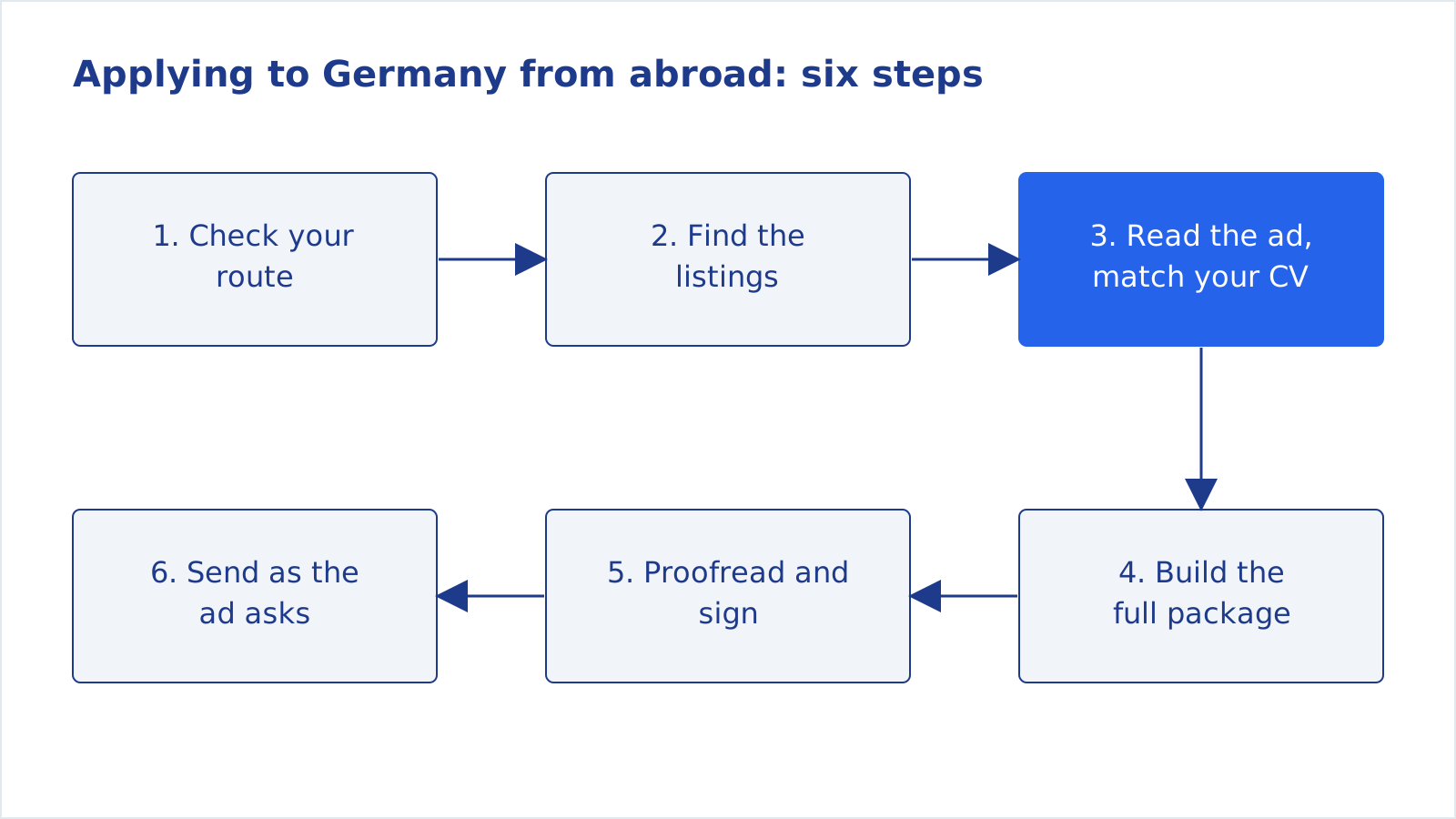
This is the step that shows up as highlighted in the diagram. Read the ad's requirements, then check your CV against them line by line. Which do you meet, and does your CV say so in the words the ad uses?
That is the check the free resume-to-job match checker does. You paste a resume and a job description and it returns a score, a short summary, the skills it found, the ones it thinks are missing and suggestions for improving the match. It needs no account.
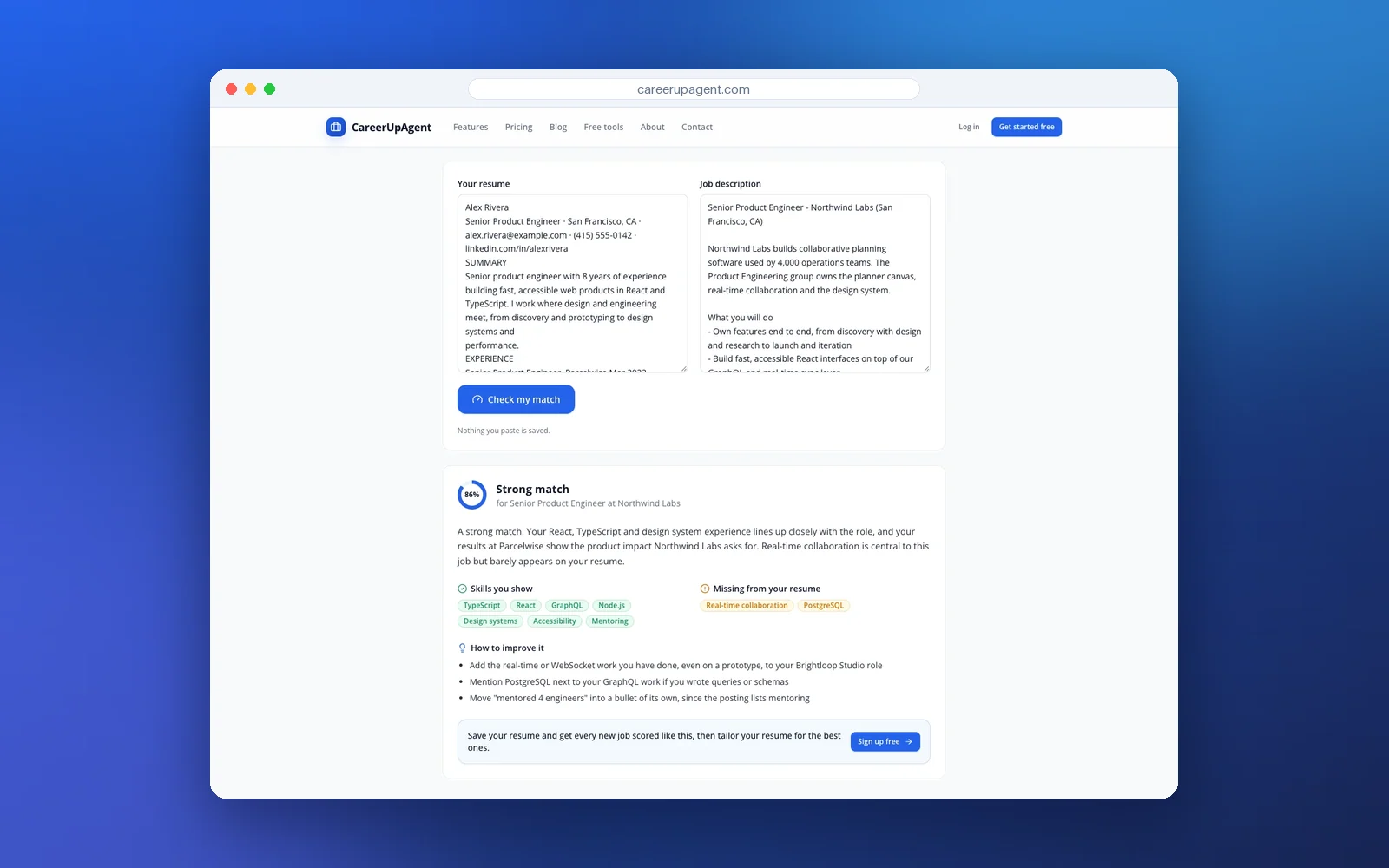
If you have an account, the same score appears for each job in your matched list, and the tailored resume editor rewrites bullets for a specific posting. You review and edit every change before you use it, and you send the application yourself. Nothing in CareerUpAgent applies for you.
Where we stop. We can show you how well a CV text fits a job description. We cannot tell you whether your degree will be recognised, whether you qualify for a visa, or whether a German recruiter will like your photo. Those answers are on the official pages and with the employer.
A checklist before you press send
- The ad's language and the language of your documents match, and a native speaker has read them.
- The company name and the contact person's name are spelt correctly.
- The cover letter is written for this company, not a mailshot.
- Every document the ad asks for is there. If it says "übliche Bewerbungsunterlagen", that means letter, CV and certificates.
- Gaps of more than two months in the CV are explained.
- The CV and the letter are signed, and the photo, if there is one, is professional.
- Copies of certificates, not originals, in the format the ad prefers.
Keep applying while you wait
Keep a list of what you sent and when, and follow up politely if the ad gave a contact. Our thank-you email guide helps once you reach an interview. For the Dutch and British markets, we have separate guides to finding a job in the Netherlands from abroad and applying for UK jobs from abroad.
If you want to try the match check on your own CV and a real German ad, the free tools are at the match checker and the ATS resume checker, and you can create a free account if you want the rest.
Sources
- Make it in Germany: Job Search & Application in Germany
- deutschland.de: The steps to getting a job in Germany
- deutschland.de: How to apply for a job in Germany
- deutschland.de: Common mistakes in job applications
- Anerkennung in Deutschland: FAQ on recognition of foreign professional qualifications
- Europass: europass.eu