A thank you email after an interview takes about ten minutes to write, and most candidates still skip it. This guide covers when to send it, who should get one, what goes in the message and what to leave out, with two short templates you can rewrite in your own words.
Key takeaways
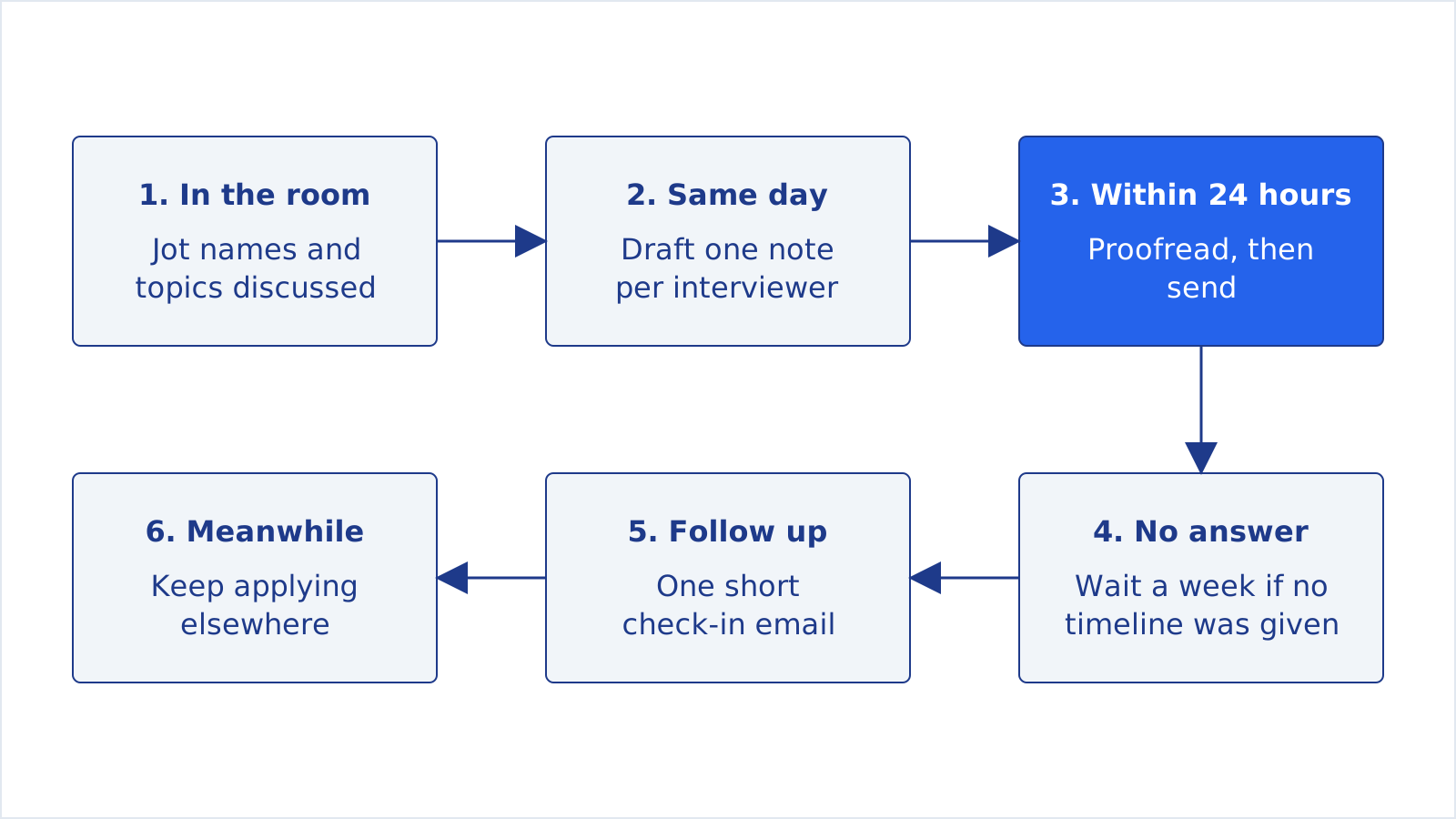
- Send the email within 24 hours of the interview, one per person you spoke with.
- Keep it to three or four sentences: thanks, one specific thing from the conversation, and a line that says you're still interested.
- Don't re-answer questions, add new asks or send the same text to everyone on a panel.
- If nobody gave you a timeline, wait about a week before you follow up.
Is a thank you email after an interview worth sending?
Yes, and the case for it is fairly plain. Northeastern University's career office reports that 80% of hiring managers find a thank-you message somewhat or very helpful after an interview, with a simple email preferred. The same page says most candidates never send one. Northeastern doesn't name the survey behind the 80% figure, so read it as a career office's summary, not a guarantee about any single employer.
The University of Virginia Career Center recommends a note after every interview, even when your interest in the company is low, because it keeps the door open for later. A thank-you won't rescue a weak interview. What it does is show that you pay attention and that you're easy to work with.

When to send a thank you email after interview day
Within 24 hours. Both the University of Virginia and Ohio State's Career Resource Guide give that window, and Ohio State adds the reason for choosing email: the interviewer gets it quickly. Virginia allows up to a week only when you mail a paper letter.
A practical rhythm is to write the draft that evening and send it the next morning. You get a night to catch awkward phrasing, and the message still lands inside the window. If the final decision is due tomorrow, send it the same day.
Northeastern also suggests taking a pen and paper into the interview. Write down who you met and how they asked to be addressed, the main topics, and anything that stood out. Those notes are what make the email specific afterward.
Who should get one
Everyone who interviewed you. Virginia's guide says to thank each person you spoke with, and if you met more than six to eight people it's fine to thank just the coordinator, though it says an individual email to each interviewer is always preferred.
Send separate messages and don't paste one text into several emails. Northeastern warns that interviewers often compare notes, and identical wording makes that obvious.
The recruiter or coordinator who scheduled you counts too. Their note can be shorter: thanks for arranging the day, and that you're happy to help with anything they need. If you are not sure whom to write to, reply to the latest email in the thread and keep the subject line.
What to put in the email
Northeastern's guidance breaks the message into four pieces:
- Subject line. Keep it plain, such as "Thank you – [Role] interview on [Date]."
- Opening. Thank them for their time and name the role. Match their tone: if they wrote "Hi" and "Thanks," don't answer with "Dear" and "Sincerely."
- Body, two or three sentences. Mention one specific thing from your conversation, such as a project, a problem the team is working on or a detail about how they work, and connect it to your background or a real interest. Northeastern calls this the only part that separates your note from everyone else's.
- Close. Offer to answer anything else, then sign off with your name.
The specific detail is the part people struggle with, and it's why the notes you took matter. "I enjoyed learning about the company" could be sent by anyone. "You said the team still reconciles shipment data by hand on Fridays, and I've built a script for a similar problem" can only be sent by you.

Two templates to rewrite
These are shapes, not scripts. Change the wording until it sounds like you, because a reader can tell when a template went out untouched.
One interviewer
Subject: Thank you – [Role] interview on [Day]
Hi [First name],
Thanks for taking the time to talk with me on [day] about the [role]. I liked hearing how your team [specific thing they said], since it's close to [one real piece of your experience]. I'm still very interested, and I'm glad to send anything that would help.
[Your name]
A panel of several people
Write one email per person and change the middle sentence each time. A small grid helps you plan it before you start:
| Interviewer | What you talked about | Line for their note |
|---|---|---|
| Hiring manager | First-90-days priorities | Refer to the priority you'd start with and why it interested you |
| Teammate | How the team works day to day | Mention a working habit they described that fits you |
| Recruiter | Scheduling and next steps | Thank them for the logistics and confirm you're available for the next round |
What to leave out
Northeastern's list of things not to do is short and worth repeating. Don't use the email to re-interview yourself by adding everything you wish you'd said, because that can make you look anxious or unprepared. Don't make requests that create work for the interviewer. Don't apologize for how the interview went. And keep it to three or four sentences, since longer notes read as trying too hard.
Proofread before sending. Read it aloud once. In a four-sentence email, a misspelled name or the wrong company is the first thing a reader sees.
A handwritten card is an option in formal fields. Northeastern says handwritten notes stand out in areas like law, executive roles and some parts of finance, and that you should mail one the same day. Send the email as well, so something arrives inside 24 hours.
Using a tool to draft it
Using AI for a first draft is fine if you finish the job yourself. Harvard's Mignone Center for Career Success shares an article from The Muse that treats an AI-written note as a starting point: add details only you know, adjust the tone so it sounds like you, and don't hand the whole message over. If you paste in your notes from the interview, the draft will have something real to work with.
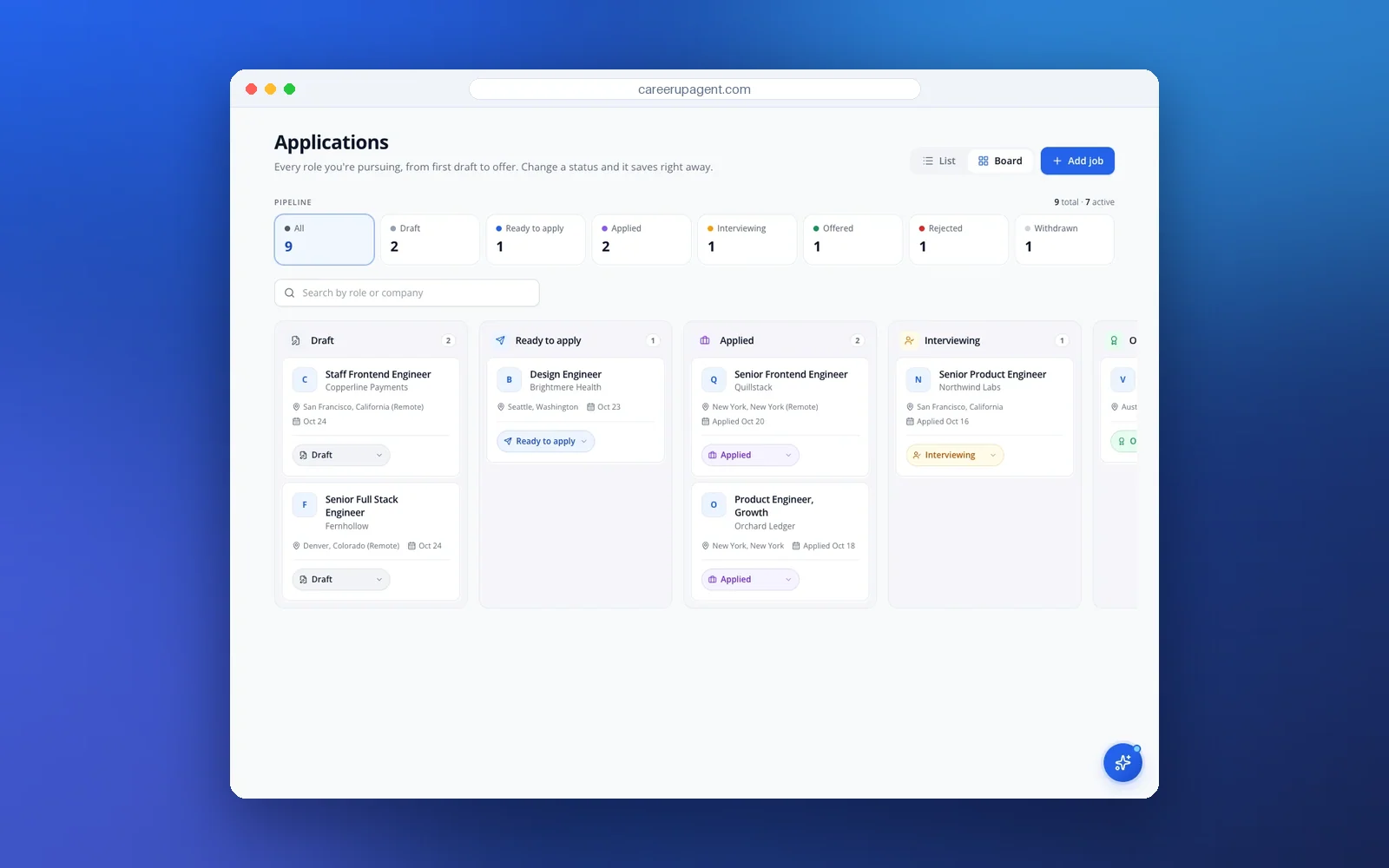
Keeping track of who you spoke with and when is the other half of this. In CareerUpAgent, the Applications page has a board view that groups your roles by status, including Interviewing, so you can see at a glance which conversations are live. It doesn't write the thank-you for you. It simply shows where each application stands, and the interviewer names and topics stay in your own notes. More on the product is on the features page, and the job search tracker guide covers what to record by hand.
If you hear nothing
A thank-you isn't a follow-up, and a quiet week after it is normal. Indeed says most candidates hear back within one to two weeks of an interview, and that if no timeline was given you should plan to wait at least a week before following up. Use that time to keep applying, not to refresh your inbox.
When the week is up, send one short check-in on the same thread: you remain interested, and you'd like to know whether there's an update on the timeline. Our guides on following up after applying and on questions to ask at the end of an interview cover the neighboring steps. If the thank-you is part of a bigger prep routine, our post on "why do you want to work here" helps with the next round.
Make the note easy to write. In the last five minutes of the interview, ask yourself which moment you'd mention in the email and jot one line about it as you walk out.
Sources
- Northeastern University, Experiential Education and Career Development: Thank You Notes
- University of Virginia Career Center: Post-interview Thank-you
- Ohio State University Career Resource Guide: After the Interview
- Harvard FAS Mignone Center for Career Success, republishing The Muse: How to Use AI to Write a Thank-you Note After an Interview
- Indeed Career Advice: How Long Should You Wait to Hear Back About a Job?