If you are moving between the two markets, the UK CV vs US resume question comes up fast: same job, same experience, and two documents that are expected to look different. The gap is smaller than people fear. It comes down to a handful of conventions on length, photos, personal details and wording, and most of them can be checked in ten minutes. This guide sets them side by side, using university career-service guides and one UK study of graduate employers, and ends with a short routine for converting one document into the other.
Key takeaways
- In the UK, "CV" is the everyday word for the document Americans call a resume. In the US, a CV usually means a long academic document.
- UK graduate employers in one study put the ideal length at two sides; US university guides say one page is typical.
- Leave the photo off in both countries, and leave out age and similar personal details.
- Use one spelling variant all the way through, matching the country you are applying to.
- Follow any format the employer asks for. These are conventions, not rules.

Is a CV the same as a resume?
In the UK, yes, for almost every job application. In the US, no. The University of Missouri's career center describes a resume as a summary document for industry jobs and internships, one or two pages, and a CV as a comprehensive document of unlimited length for research and academic careers and graduate admissions.
So when a UK posting asks for a CV, it wants what a US recruiter would call a resume. When a US university posting asks for a CV, it often wants the long academic version. Read the posting, and if it is unclear, ask the recruiter which one they mean.
UK CV vs US resume: the differences in one table
The table only lists points that the sources at the end of this post state directly. Each is a convention, and you will meet exceptions.
| Point | UK CV | US resume |
|---|---|---|
| What the word means | The standard job-application document | A resume is the job document; a CV is academic and research-focused (Missouri) |
| Typical length | Two sides (Keele study; Prospects) | One page typically (Princeton, Alabama); two acceptable with enough experience (Missouri) |
| Photo | Uncommon; most employers in the Keele study reacted badly to one | Avoid unless the profession requires it (Alabama, Missouri) |
| Personal details | Leave out date of birth, nationality and photo (Prospects) | Leave out age, race, marital status (Alabama, Princeton) |
Length: two sides or one page
A study from Keele University, published through the Prospects Luminate site, interviewed 41 UK graduate employers about what makes a CV shortlist or reject. The researchers report that it confirmed an ideal length of two sides and no photo. Prospects' own guidance for law applicants says the same, "around two pages". Some employers in the study felt one page was enough, and one described a scan of about 15 seconds before deciding whether to read on.
US university guides lean shorter. Princeton's Center for Career Development says resumes should typically be one page, and the University of Alabama career center says the same in general. Missouri allows two pages when your experience warrants it.
In practice, moving from a US resume to a UK CV rarely means padding. It means deciding what earns its place on a second side, such as an older role you had cut or a project that matches the posting. Going the other way, you cut: keep the roles and results that match this job, and drop the rest.
Photo and personal details
Both countries point the same way here. In the Keele study, the majority of employers did not respond positively to a photograph and some raised the risk of bias and discrimination. Prospects tells law applicants not to include a date of birth, nationality or photo. On the US side, Alabama's career center says to leave out personal information such as age, race and marital status, and to skip the photo unless your profession requires it. Princeton's guide also says to leave out age and Social Security details. Missouri adds that companies may discard a resume with a picture or digitally remove the image, citing federal non-discrimination law.
One caution if you come from a country where a photo, date of birth or marital status is routine: the sources above describe what UK and US employers expect, so a CV written for your home market needs these lines removed.

Address, profile and references on a UK CV
The Keele study found details that surprise people used to US resumes.
- Address. Employers often use it to judge whether you can commute or would need to relocate. The guidance offers a full address, just a postcode or town with email and phone, or email and phone only. If you are applying from abroad or planning a move, a short line on your location and willingness to relocate belongs near the top.
- Personal profile. Many employers like a short summary under the contact details. The study's guidance keeps it to a maximum of two or three sentences.
- References. A line such as "Available on request" is enough, so you do not spend space on referee contact details.
- Person. The researchers list a preference for the first person as one of their surprises. It does not mean you have to write "I" everywhere, only that a plain first-person profile is not a problem.
The study also notes that a handful of employers use applicant tracking systems that search for keywords, and that spelling mistakes can signal a lack of attention to detail. Both are reasons to proofread, and to mirror the posting's own terms where they are true for you.
Spelling tip. Pick the variant that matches the employer: organisation, programme and CV in the UK; organization, program and resume in the US. Set your word processor's language to match, so the spellchecker works for you rather than against you.
A six-step way to convert one into the other
The same six checks work in either direction. The one that matters most is the second, because it removes the details that can count against you.
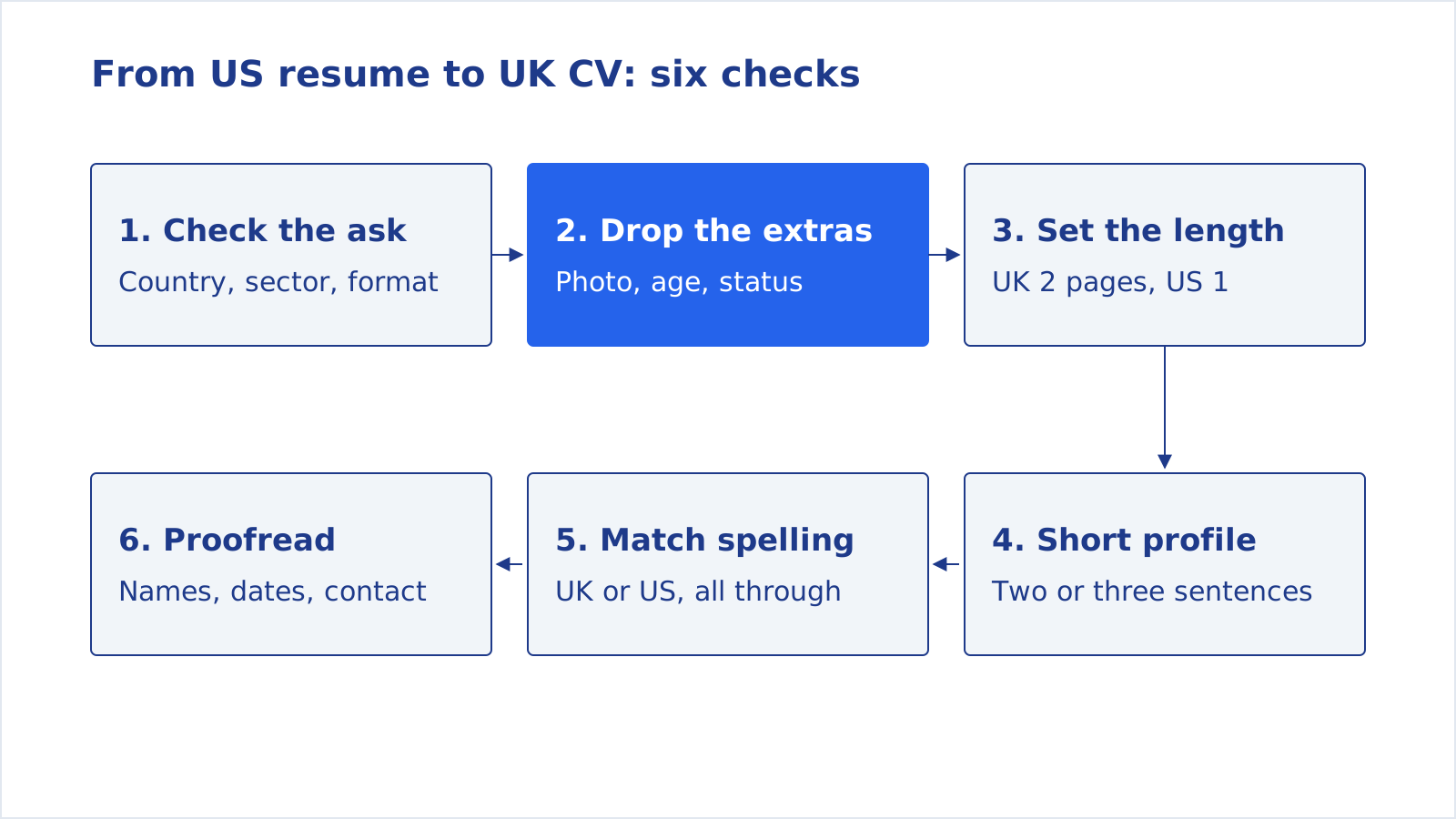
- Check the ask. Country, sector and any format the employer specifies. A law, academic or research role can have its own rules.
- Drop the extras. Photo, age, date of birth, marital status, nationality.
- Set the length. Two sides for a UK CV, one page for a US resume, unless your experience justifies two.
- Add or trim the profile. Two or three sentences on who you are and what you are looking for.
- Match the spelling to the country, in every section.
- Proofread names, dates and contact details, then read it once more as the recruiter would.
Tailor it to the job, then check it
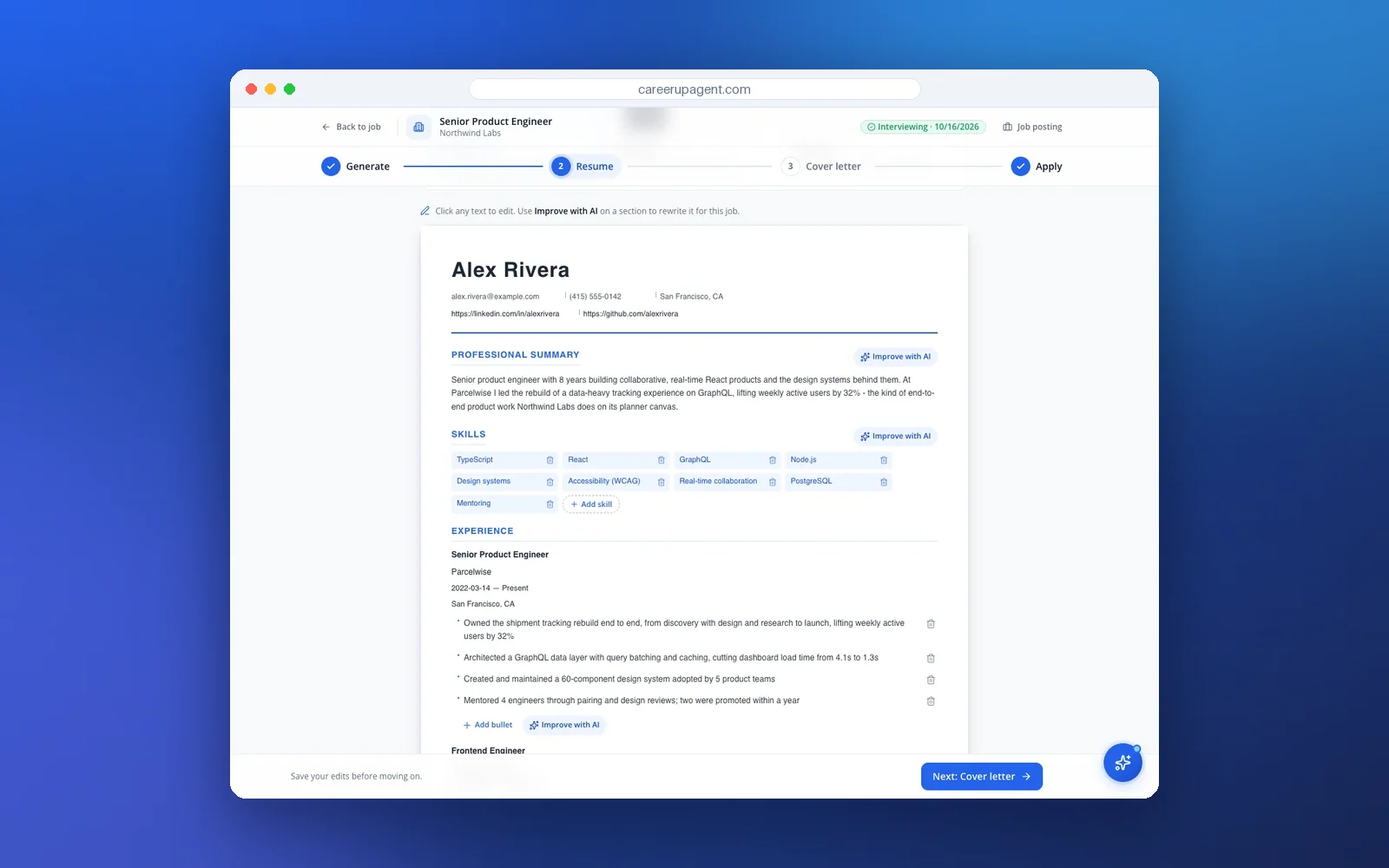
Whichever convention you follow, the document still has to fit the posting. CareerUpAgent's tailored resume step shows a job-specific summary, tailored skills and rewritten experience bullets, each in an editable section. The country-specific choices above, such as length, spelling and which personal details to leave out, stay yours to decide before anything is sent.
For a quick check before you apply, the free ATS resume checker reviews things like page count, contact details and section headings, and the resume and job match checker compares your resume with a pasted job description. Both are free to try without an account. You can find the rest on the features page, or create a free account.
What these sources do not cover. The Keele study interviewed graduate employers, so it describes graduate hiring more than senior roles. The US guides come from university career centers and are aimed at students and early-career applicants. Industries differ, so when an employer or recruiter tells you what they want, follow that over any general guide.
If you are applying to the UK from abroad
A well-formed CV is one step. Your right to work is another, and it is worth settling early. Our guide to applying for UK jobs from abroad covers the order to do things in, including checking your route on GOV.UK before you invest time in applications.
Sources
- Simkins, B. and Coney, K., Keele University, What do graduate employers want in a Curriculum Vitae? (Prospects Luminate, 41 employer interviews).
- Prospects, Writing a legal CV and cover letter.
- Princeton University Center for Career Development, Resume Guide.
- University of Alabama Career Center, Resume Development.
- University of Missouri Career Center, Resumes & CVs.