A recruiter calls to schedule a first chat, and somewhere in the first five minutes comes the question: "What are your salary expectations?" Your salary expectations answer needs to be ready before that call, because a number blurted out on the spot tends to land too low, and a refusal to say anything can stall the process. This guide covers what to say at each stage, with word-for-word examples, where to find a defensible range, and the pay-transparency rules in the US and the EU that now work in your favor.
Key takeaways
- Recruiters ask to check that your expectations fit their budget, so a calm range or a polite "what range do you have for this role?" are both normal answers.
- Build your range from named data (job postings, government wage statistics) before the call, and adjust it for location and level.
- Match the answer to the stage: skip or give a range on a form, ask for theirs on a first call, give a narrow range with reasons later.
- Many US states and the EU now limit pay-history questions and push employers to share pay ranges early. Check the rules where the job is based.

Why recruiters ask about salary expectations
According to Indeed's career guide, employers ask to see whether your expectations line up with their budget and how you value yourself. It also helps them decide whether to move you forward or adjust an offer. Nothing about the question is a trap. The recruiter does not want to spend three interview rounds on someone whose range sits far above the budget, and you do not want that either.
What matters is who names a number first. If you say something below the budget, the employer has no reason to pay more. If you say something far above it, the call may end politely. A prepared range with reasons, or a question back about their range, gets you out of both problems.
Build your range before the call
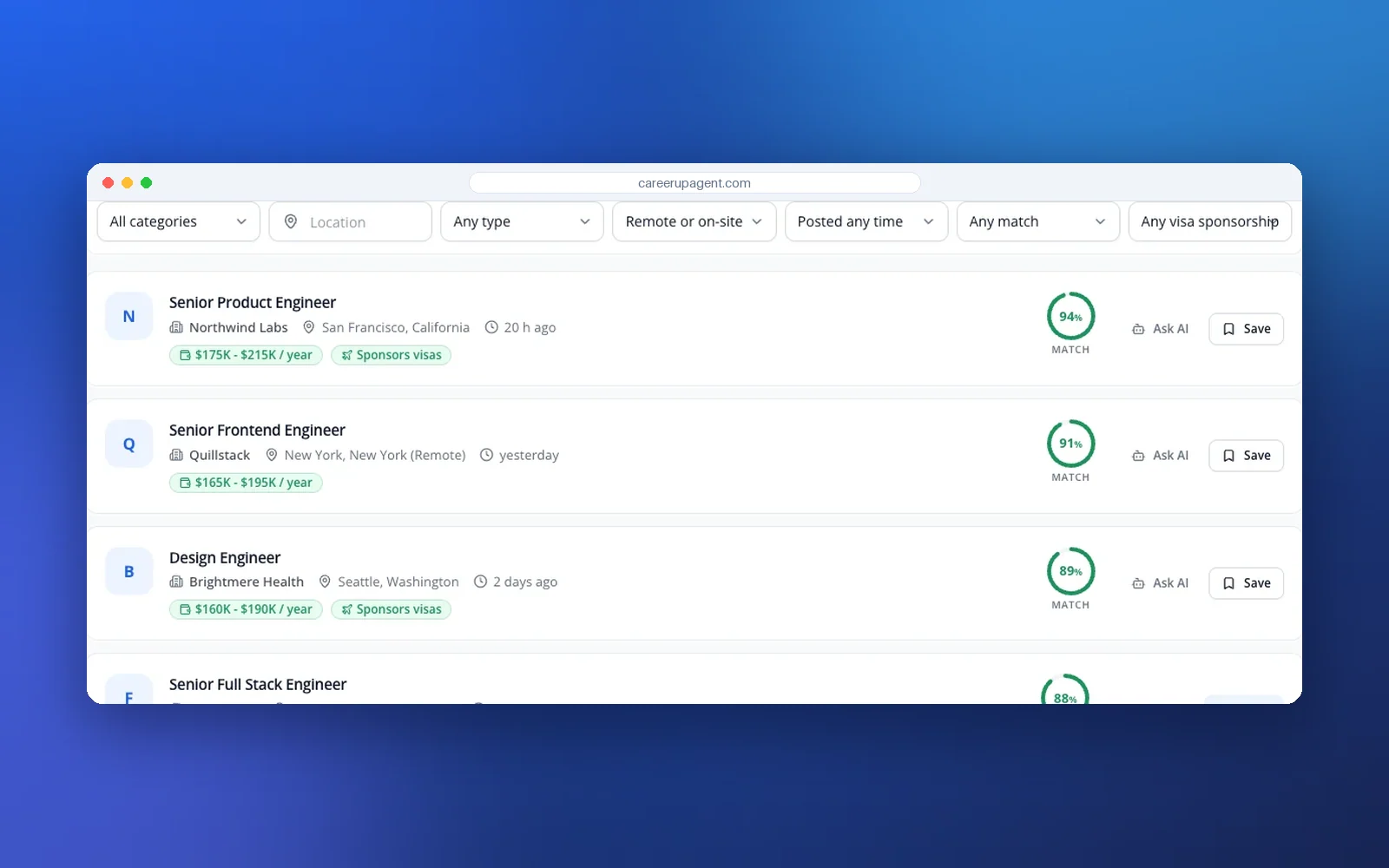
Start with the job itself. Many postings show pay, especially in the states and countries covered below, so the jobs you are tracking probably include a few comparable ones. Then add a second source. In the US, the Bureau of Labor Statistics publishes wage data by occupation. Take editors as an example: the BLS Occupational Outlook Handbook lists a median annual wage of $77,920 for May 2025, and notes that the median is the point where half of the workers earned more and half earned less. The same page says the lowest 10 percent earned less than $41,250 and the highest 10 percent more than $153,700. For comparison, the median for all workers in the US was $50,980.
That spread is the point. A single occupation covers entry-level people in cheap regions and senior people in expensive ones, so a median is a starting line and never your answer. Indeed suggests adjusting for location and cost of living, your qualifications and achievements, and total compensation such as benefits, stock options and bonuses.
A practical way to set the numbers:
- Collect five to ten postings or data points for the same title, level and region.
- Decide the lowest figure you would accept (your floor) and a realistic best case.
- Pick a range whose bottom is a number you would be content to receive, because an employer may well anchor on the bottom of your range.
- Write down one sentence of reasoning, such as your years in the field or a skill the posting asks for.
If the postings you find do not match your experience closely, the resume-to-job match checker is a free way to see how your resume lines up with a specific posting before you decide how high to aim.
A salary expectations answer for each stage
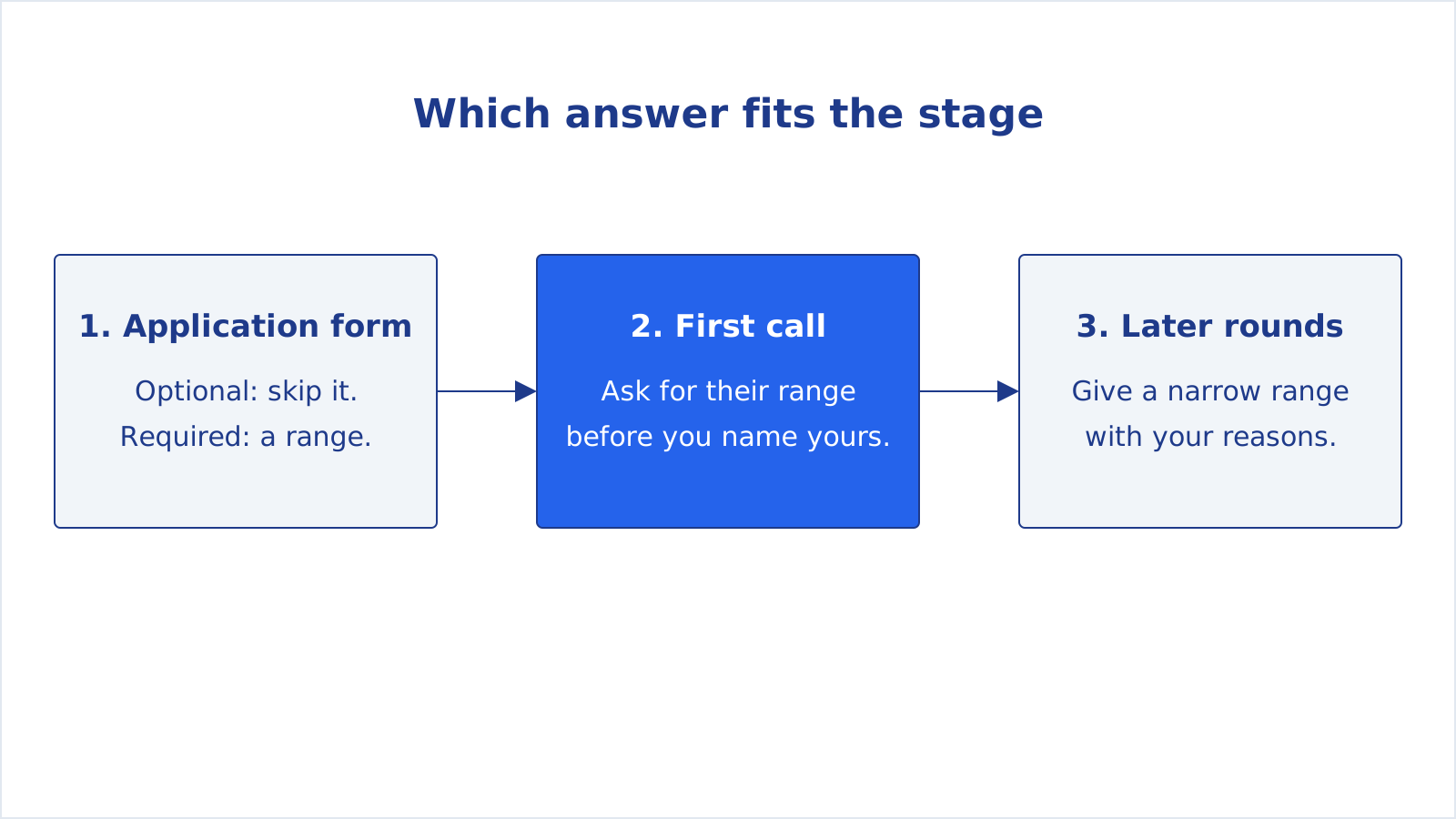
The right answer changes as the process moves along. Indeed notes that early on, when the role is unclear, deflecting or asking for the employer's range is practical, and that committing to a specific range becomes more expected as the process advances.
On the application form
Indeed says that if the salary field is optional you can leave it blank, and if it is required you should enter a range based on market research. A range keeps more options open than a single figure does.
On the first recruiter call
You usually know the least about the job here, so asking for their range is fair. Indeed calls it widely accepted. Examples you can adapt:
- "I'd like to understand the scope a bit better first. What range have you budgeted for this role?"
- "I've looked at similar roles and I'm happy to be flexible. What are you hoping to pay for this position?"
If the recruiter declines to share it, Indeed advises acknowledging that and then giving your own range from your research. That is the moment to use your prepared sentence:
- "Based on what I'm seeing for this role in Chicago, I'm looking at $88,000 to $95,000, depending on the scope and the benefits."
The figures here are made-up examples, not market data. Swap in your own numbers, and say whether you mean gross or net, per year or per month, because in many countries those are quoted differently.

In later rounds, once you know the scope
By the second or third interview you know the team, the responsibilities and the level. Now a narrow range with a reason is expected. Indeed suggests keeping the range narrow, with the figure you really want toward the lower end. In practice that means a spread of a few thousand dollars, and a sentence that ties it to something concrete: "Given that the role includes managing the vendor budget, which I did at my last company, I'd expect $92,000 to $97,000."
When they ask about your current salary
This question is a different one, and in a growing number of places it is not allowed. FindLaw's state-by-state list names states with statewide salary history bans, including California, Colorado, New York and Washington, and says many of them also require pay information in job postings. The details differ: for example, FindLaw lists New York's job-posting rule as covering employers with four or more employees, and Washington's as covering employers with 15 or more.
In the EU, EUR-Lex's summary of the Pay Transparency Directive says applicants have the right to information on the initial pay or its range before an interview, and that employers may not ask about current or previous pay. Member states had to turn this into national law by 7 June 2026, but Lockton's tracker describes implementation as uneven, with only a small number of countries finished by the deadline as of 23 September 2026. So whether the rule binds your employer today depends on the country.
Not legal advice. Pay laws differ by state, country and employer size, and they change. If a recruiter asks about your pay history and you are unsure of your rights, check your state's labor department or the national equality body before you answer.
Where the question is legal and you would rather not answer, Indeed's suggestion is to redirect to what you are targeting for this role. For example: "I'd rather focus on the range I'm targeting for this role, which is $85,000 to $90,000 based on my research."
Talk about total compensation when base pay is fixed
Base salary is one part of the offer. Indeed recommends asking about the full package: bonuses, paid time off, medical benefits, and stock options where they exist. If the offer comes in under your range, those items give the employer other ways to close the gap. A response you could use once you have an offer: "Thanks, I'm excited about the role. The base is a bit under what I was aiming for. Is there flexibility on base, or on a signing bonus or extra vacation days?"
Mistakes that cost people money
- Naming a number before you know the scope. Ask what the role covers first.
- Giving one figure. A single number leaves no room to move up and invites a quick yes or no.
- Quoting only your last salary. Your next job is priced on the role and the market.
- Apologizing for the number. Say it plainly and stop talking.
- Forgetting the location. A range for Austin is not a range for Amsterdam.
Practice the answer out loud
Reading your range in your head is easy. Saying it to a person who might push back is harder. Say the sentence aloud three or four times until it sounds like something you would actually say. CareerUpAgent's mock interview builds questions from a real job posting and scores each of your answers, which makes a handy way to rehearse the interview as a whole. The salary line is one you will still need to write and practice yourself.
For the other questions in the same call, see our guides to answering "Tell me about yourself" and the questions to ask at the end of an interview. If you are still deciding which roles are worth your time at all, CareerUpAgent ranks jobs by how well they match your resume, and you decide which ones to apply to.