
The interviewer says, "Do you have any questions for us?" and your mind goes blank. It is one of the most predictable moments in any hiring process, and one of the easiest to prepare for. Good questions to ask at the end of an interview show that you listened, help you decide whether you want the job, and leave a last, specific impression.
This guide gives you a short method, question lists sorted by who is interviewing you, a list of questions to skip, and a five-minute routine to prepare. The advice draws on university career centers and published career guides, named below.
Key takeaways
- Prepare 6–8 questions, expect to ask 2–4. Some will be answered during the conversation.
- Match the question to the person: recruiter, hiring manager, teammate or senior leader.
- Leave salary and benefits for later in the process unless the employer raises them first.
- Do not ask what a quick look at the company website would answer.
- End by asking about next steps, so you leave knowing what happens and when.
Why the last five minutes matter
A job interview is a two-way conversation. The University of Alabama Career Center puts it this way: think about what you want to know to judge fit, while showing the interviewer that you are serious about the position (University of Alabama Career Center). Your questions are your half of that conversation.
They also tell the interviewer something. A question about how success is measured in the first quarter sounds like someone who is already thinking about the work. A question about vacation days in a first call sounds like someone who is thinking about something else. Neither is a crime, but the first one helps you more.
How many questions should you ask?
Sources differ a little. The University of Alabama Career Center says you will likely have time for between two and five questions, and advises preparing more in case several get answered (University of Alabama Career Center). A Fast Company piece on the best and worst closing questions suggests asking one or two thoughtful ones (Fast Company). The sensible reading: ask fewer than you prepare, and let the time left decide.
Our rule of thumb is to prepare 6–8 and ask 2–4. Interviews cover a lot of ground, so some of your questions will be answered before you get the chance. If you walk in with only two, you may end up with none.
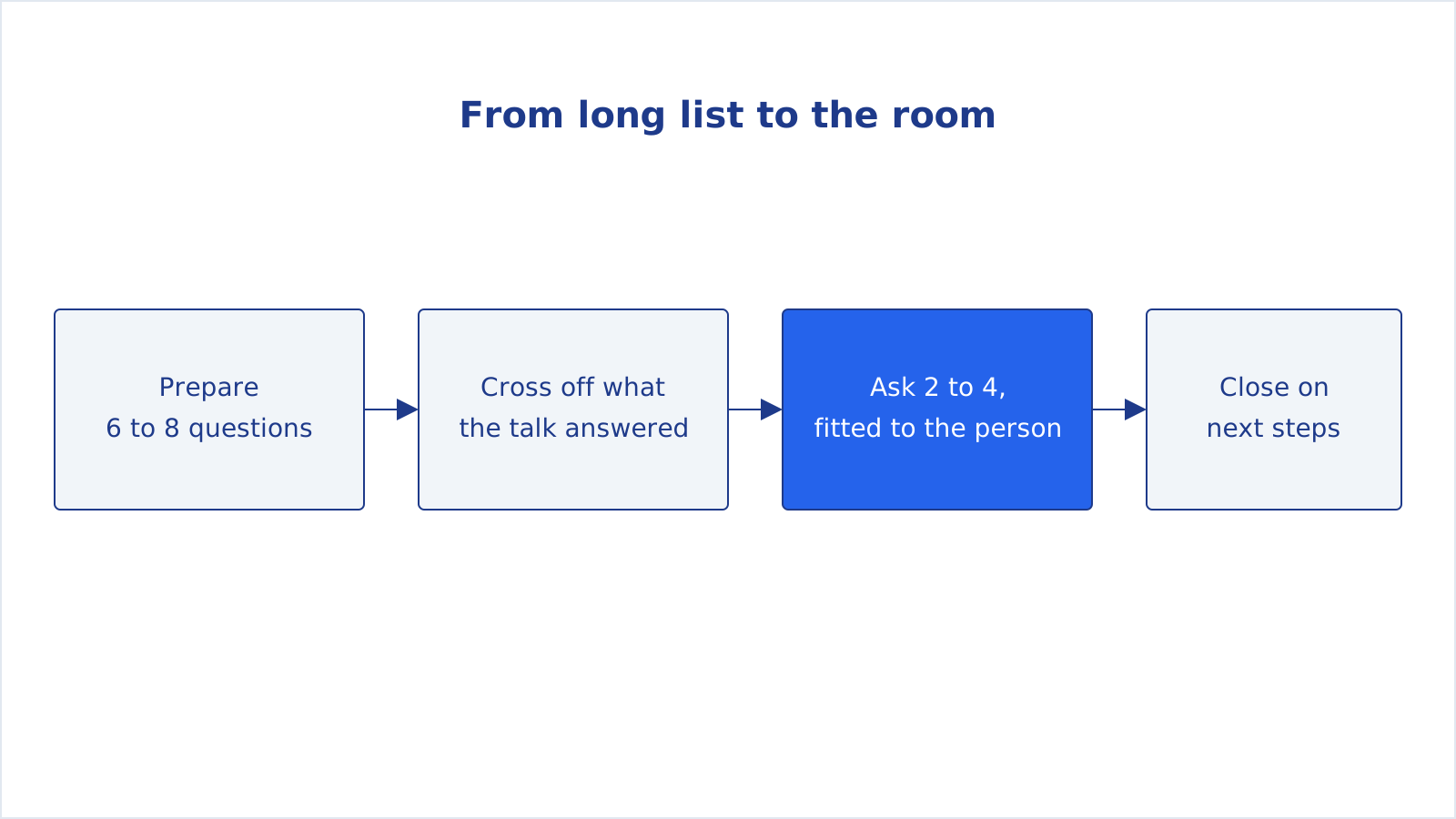
Write the questions down. The University of Alabama guide suggests keeping your list in a padfolio so it is handy when the moment comes. It reads as preparation, not as a lack of memory.
Questions to ask at the end of an interview, by interviewer
If you meet several people, ask each one something suited to their role. The University of Alabama guide points out that each person will notice the questions you ask, so do not stop just because someone earlier already answered a few.
Recruiter or HR screen
Recruiters know the process and the logistics. Use them for those.
- What does the rest of the interview process look like, and how long does it usually take?
- Who will I speak with next, and what will they focus on?
- How would you describe the team and the way it works?
- Is there anything in my background you would like me to clarify before the next step?
Hiring manager
The manager owns the outcome of the role. This is the best person for questions about expectations.
- What would a successful first 60–90 days look like in this role? (The University of Alabama guide lists a similar question about the most important contribution in the first 60 to 90 days.)
- What is the most important problem this role needs to solve this year?
- Is this a new position, or am I replacing someone? (MIT's Career Advising & Professional Development office lists this one: MIT CAPD.)
- How do you give feedback, and how often do you check in with the team?
Teammate or peer
Peers can tell you what the day-to-day is really like. Ask about the work, not about the company's strategy.
- What does a typical week look like for you?
- What do you wish you had known before you joined?
- How does the team handle disagreements or a tight deadline?
- What distinguishes people who really thrive here? (A version of this question appears in the Fast Company piece.)
Senior leader
Leaders see the bigger picture. Keep questions about direction, not about the details of a single role.
- Where do you want this team or function to be in a year or two?
- What is the biggest challenge the company faces in the next year?
- How does this role connect to the company's goals?
Use your preparation to be specific
The strongest questions are the ones only you could ask, because they connect to the posting, the company's recent news or something the interviewer said ten minutes earlier. "What are the biggest challenges?" works anywhere. "The posting mentions migrating the reporting stack, how far along is that?" works only here.
One way to build those questions is to read the posting and underline what is unclear: the scope, the tools, the team, the first project. In the AI Copilot inside CareerUpAgent, you can open a conversation about a saved job and ask it to suggest questions to put to the interviewer. It is a starting point to edit, not a script to read out.
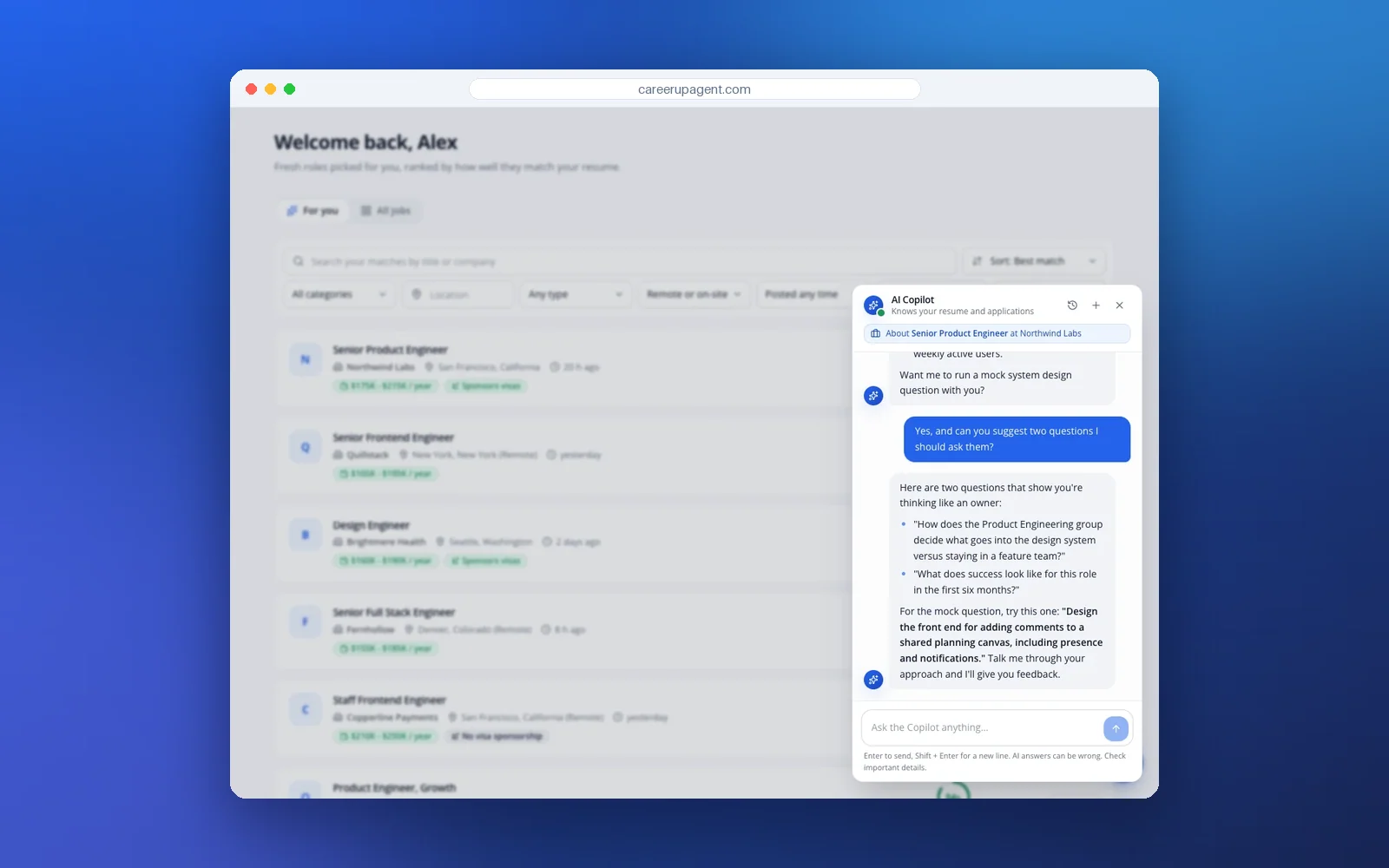
If you want to rehearse the answers you will give before you get to your questions, the mock interview takes typed or dictated answers and returns a score, feedback and a stronger version of your answer. It does not film you or simulate a video call. For the earlier part of the conversation, see our guides to "tell me about yourself" and video interview tips.
Questions to skip, and what to ask instead
Most "bad" questions are not bad in themselves. They are badly timed, or they are questions you could have answered yourself. The sources agree on a few patterns: avoid questions about salary and benefits in a first interview, and avoid questions the organization's website already answers (both from the University of Alabama guide); do not ask for instant feedback on how you did, because it puts the interviewer on the spot (University of Washington PCE). Other guides, such as this Illinois Eastern Community Colleges PDF on questions not to ask, list similar pitfalls.
| Instead of | Why it backfires | Try |
|---|---|---|
| "What does your company do?" | The website answers it, and it shows you did not look. | "I read about your latest product update. How has it changed what this team works on?" |
| "How much vacation do I get?" | It puts benefits before the work in a first conversation. | "What does the rest of the process look like, and when would we talk about the offer?" |
| "Did I get the job?" | It puts the interviewer on the spot. | "Is there anything about my background you would like me to expand on?" |
| A question the interviewer just answered | It signals you were not listening. | "You mentioned the team is growing. What are you hiring for next?" |
Salary is not forbidden forever. It simply belongs later, once the employer is clearly interested, or earlier if the recruiter asks you for your expectations. When it comes up, ask in a neutral way, such as "Can you share the range for this role?"
End with next steps
Your last question should be practical. Indeed's career advice lists closing questions of this kind in its guide to good questions to ask at the end of an interview. For example: "What are the next steps, and when should I expect to hear from you?" You leave knowing the timeline, and you know when it is fine to follow up. Our guide on how to follow up after applying for a job covers the wording.
Then close with one sentence that sums up your interest, for example: "Thanks, this made me more excited about the role, especially the work on the onboarding project." Short, specific and true.
A five-minute prep routine
- Read the posting again. Underline anything unclear about scope, team or tools.
- Write 6–8 questions. Mix the types: role, team, expectations, next steps.
- Tag each one with the person it suits: recruiter, manager, peer or leader.
- Cross off anything the company website or the job posting already answers.
- Put them in your notebook and bring a pen, so you can note the answers as you hear them.

Tip: For a video interview, keep your list on a sheet beside the screen rather than in another window. Glancing down at paper looks natural; a second window can look like distraction.
Note: Take a minute after the call to write down what you heard. The answers help you compare roles later, and they give you something concrete to mention in a thank-you or follow-up message.
Bring it together
You do not need clever questions. You need honest ones, fitted to the person across from you, asked at the right moment and backed by a short list in your notebook. Prepare more than you will use, skip what a web search would answer, and finish on next steps.
If you would like help turning a posting into specific questions, the AI Copilot and the mock interview are part of CareerUpAgent's features. Whatever tools you use, the final decision on what to ask stays with you.