
"Why do you want to work here?" sounds like small talk, and it is usually the question where an interview changes direction. A good why do you want to work here answer is short, specific to this employer and backed by one thing you have done. The question that often follows, "Why are you leaving your current job?", is the same test from the other side, so this guide covers both.
Key takeaways
- Interviewers ask it to see how much you researched the company and how well the role fits your goals.
- A strong answer has three parts: why this company, why this role, why you will do well in it.
- Fifteen minutes of research, split between the posting, the company and recent news, is enough to find one real detail.
- For "why are you leaving", talk about what you are moving toward and keep it short. Don't criticize your employer.
- Prepare the two answers together so they point in the same direction.
Why interviewers ask it
Indeed's career guide says one reason hiring managers ask is to see how much you've researched the company. The Texas A&M Mays Business School career blog adds that the question also gauges how well you prepare for meetings and work situations, and that interviewers are listening for how interested you are in the company's work.
The wording changes, the question doesn't. MIT Sloan's Career Development Office, drawing on Big Interview, lists the same question as "Why are you interested in this position?", "Why do you want this job?" and "Why are you applying for this position?". In the UK and Europe you will also hear it as a motivation question. The University of Bath's careers team groups it with prompts like "What made you apply for this role?" and questions about the company's culture and sector.
Research the company in 15 minutes
You don't need a deep dive. You need one or two details that are true, specific and that you actually care about. Here is a split that fits in a coffee break (the timing is our suggestion, not a rule from a source):
- Minutes 1–5, the posting. Indeed advises you to review the job posting again for the responsibilities and think about how the role fits your skills and career goals. Underline the two duties you would enjoy most.
- Minutes 6–10, the company itself. Read the About page and the product or services pages. Indeed suggests learning about the products or services, the customers, and any awards or accomplishments.
- Minutes 11–13, what employees say. Indeed points to the company page for photos, benefits and reviews from current or past employees. Treat reviews as one input, not a verdict.
- Minutes 14–15, pick one. The Texas A&M post recommends taking notes on things that genuinely excite and impress you while you research. Circle the one that does.

One more source is easy to overlook: the people you have already met. The Muse suggests that if you have no internal contact, a personal interaction with the team during the hiring process can be part of your answer, as long as you are specific. If the recruiter call or an earlier interviewer said something that made you more interested, say that.
The three-part structure
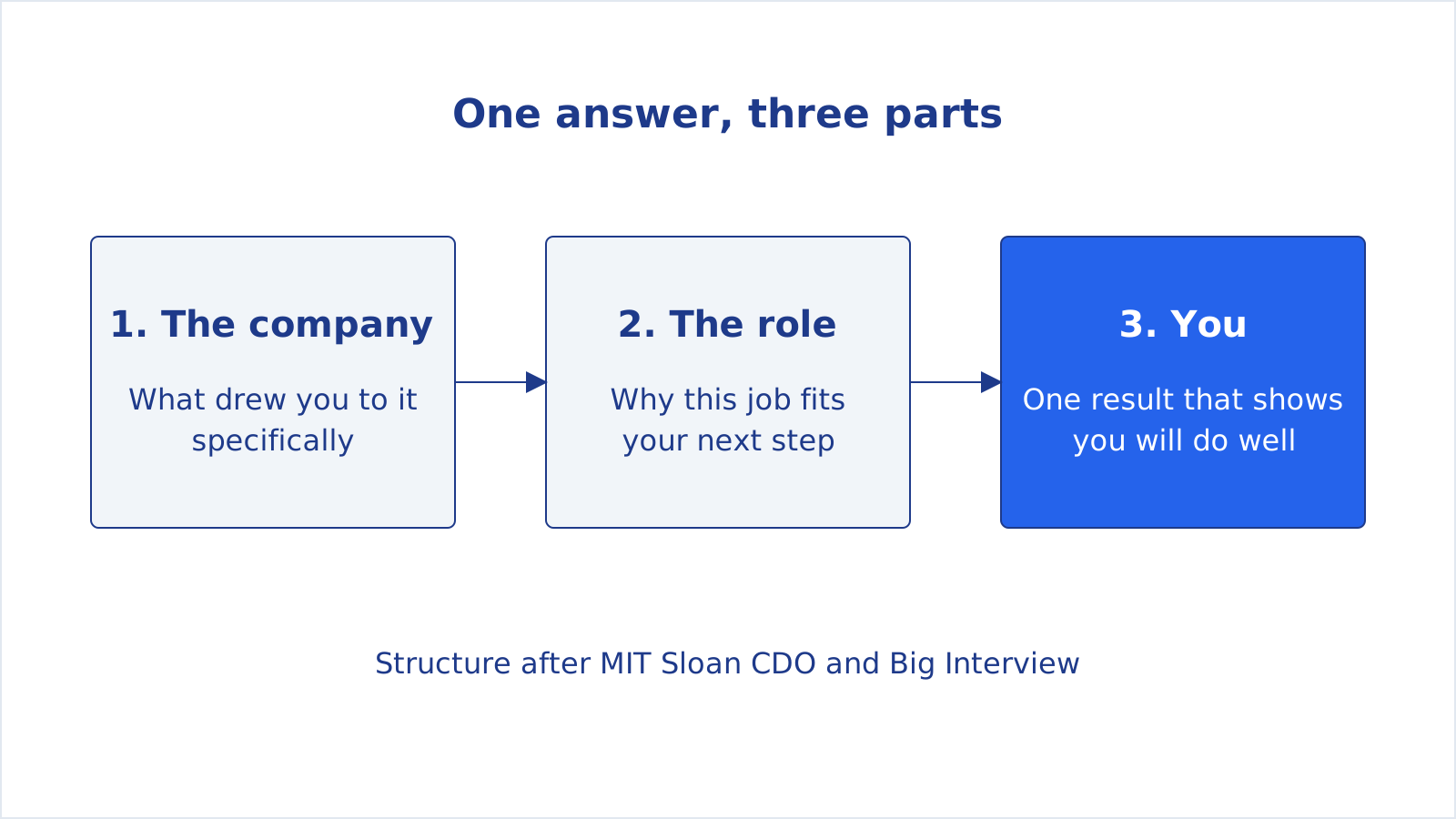
MIT Sloan's career office says the answer should cover three things: why you want to work at this company, why this particular position interests you, and why you will be successful in it. It also says the strongest answers combine all three, and that you can lean on one if the question is narrower, such as "why this position, specifically?"
A fill-in template
This is a template, not a script. Replace every bracket with something true about you.
"I've been following [a specific thing: a product, a project, a market the company works in], and [what you liked about it]. When I saw the [role] opening, the [duty from the posting] stood out, because that's the part of my work I do best. At [current or last employer] I [one result, with a number only if you have a real one]. I'd like to do more of that here."
That runs about 15 seconds out loud. Add one sentence about the team if you have a real one, and stop there.
If you are early in your career, MIT Sloan's advice is to mention transferable skills and school or university achievements when you lack direct experience. For a career change, say what draws you to the new field and which skills carry over. Our career change resume guide has the same transferable-skills approach for the written version.
Answers that fall flat
- Praise that fits any employer. "Great culture" and "industry leader" could be said about every company on the list.
- Only what the company can do for you. Salary, benefits and commute are fair things to care about. Bring them up when the interviewer asks about pay (our salary expectations guide covers that conversation).
- Reading the careers page back. The interviewer wrote some of it. Add something you noticed that is not in the first paragraph.
- Skipping the third part. Enthusiasm without evidence is easy to forget. One result from your own work is what makes the answer yours.
Tip: write three bullet points, not a paragraph. Say each in your own words in practice runs. A memorized paragraph is hard to recover if the interviewer cuts in with a question, and MIT Sloan's advice is simply to be honest.
Prepare it inside the same job page
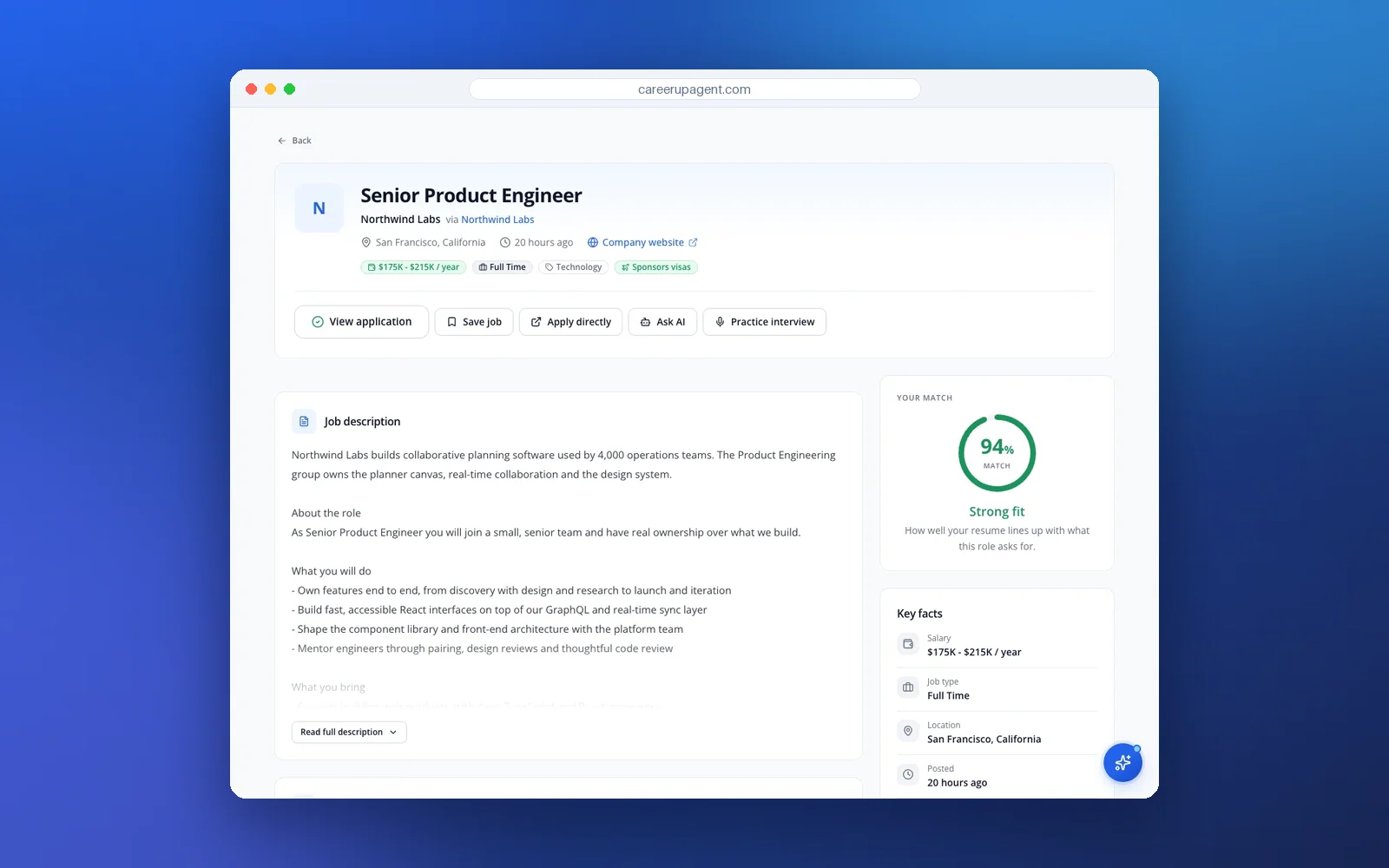
If you track your applications in CareerUpAgent, the job page keeps the posting, the match score and the key facts together, so the posting you underline in minutes 1–5 sits next to the score. It also has a Practice interview button, which starts a mock interview for that role: you type or dictate an answer and ask for feedback.
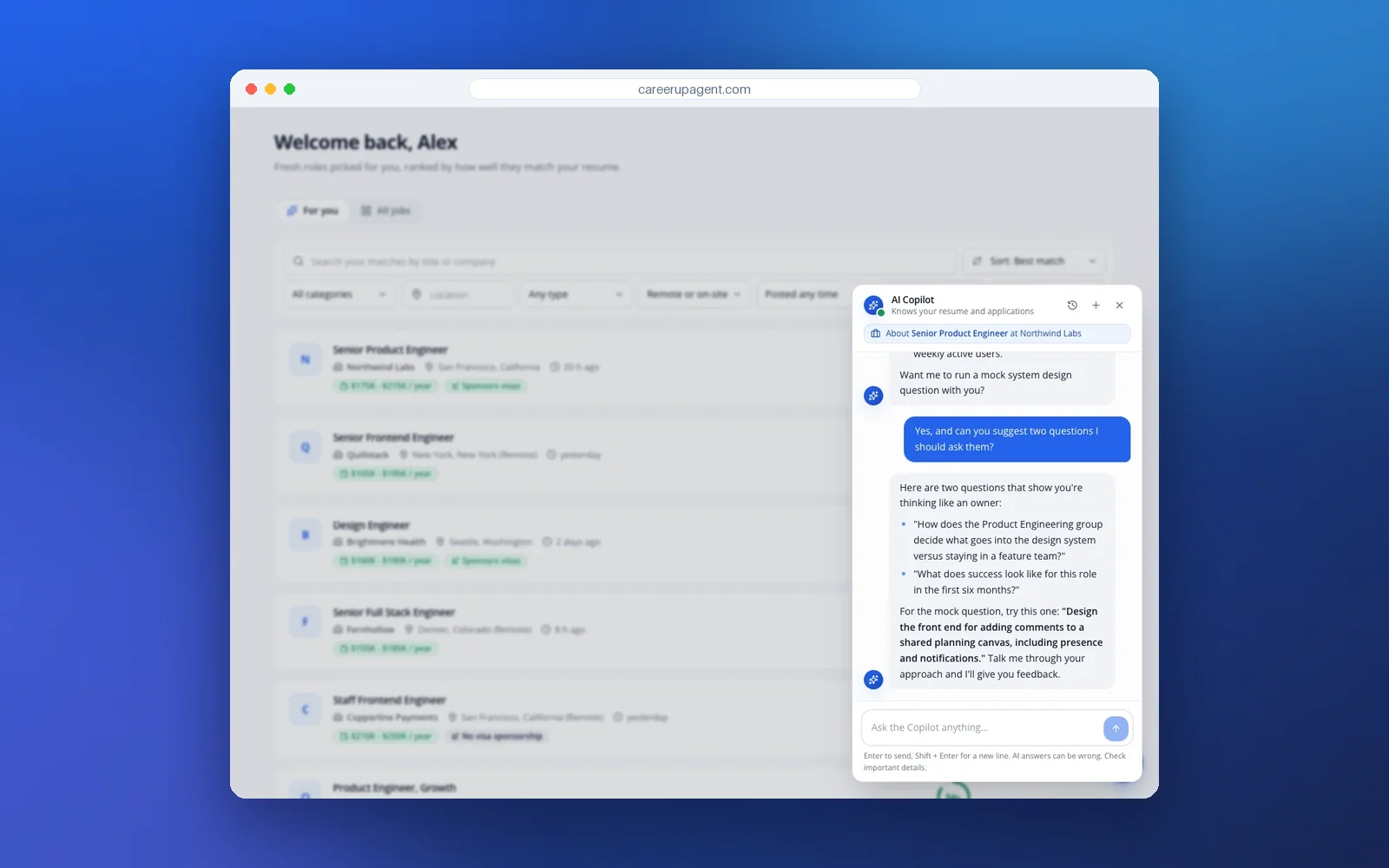
The AI Copilot can be opened over a job as well. In the demo account it is shown answering about a specific role and suggesting questions to ask the interviewer. Use it to rehearse, but write the answer yourself: the detail that makes it believable has to come from you. More on the closing questions in our guide to questions to ask at the end of an interview. You can see everything the app does on the features page.
"Why are you leaving your current job?"
This question usually comes right after, or instead of, the one above. Indeed's guidance on explaining why you're leaving boils down to focusing on the future, keeping it brief, reframing negatives and being honest. Hays, a UK recruiter, gives similar advice: focus on the skills you gained and how they suit the new role instead of dwelling on what was wrong with the old one.
On criticism, Indeed is direct: saying you don't get along with your boss or colleagues can suggest you may not like your future boss or team either. Seattle Central College's career center gives the same rule: don't badmouth your boss.
Reframing is not the same as inventing a reason. Pick the true reason that is also fair to say out loud. Here is how that looks for common situations, in wording you can adapt:
| Your situation | A way to say it | Leave out |
|---|---|---|
| No room to grow | "I've learned [skill] here and taken on [scope]. The next step I want, [scope], isn't available on my team, and this role includes it." | "Dead end", "bored" |
| Laid off | "My team was cut in a reorganization in [month]. Since then I've [one useful thing]. I'm looking for [type of role]." | Blame, a long story about the company |
| Moving | "I'm relocating to [city] in [month], and this role is in the work I do." | Details you'd rather not discuss |
| Management or culture | "I'm looking for a team that works in [a positive you value, such as open communication]." | Names, complaints |
| Changing field | "I've been moving toward [field] through [project or course], and this role lets me use [skill]." | Apologizing for the switch |
Indeed's own list of common reasons includes moving to a new city, changing careers, being laid off or let go, and wanting higher compensation, so interviewers have heard all of them. If your reason is pay, you can say you are looking for a role with more scope and responsibility, as long as that is also true.
Note: if you already left, the question becomes "why did you leave?" and the same approach applies. If there is a gap on your resume, our guide to explaining a resume gap gives the one-line wording.
Make the two answers agree
The two answers are one story told in two parts. "Why leaving" ends on what you want next, and "why here" starts with the reason this employer offers it. Say the first out loud, then the second, and listen for a seam. If the first ends with "more ownership of campaigns" and the second opens with "your collaborative culture", the interviewer hears two unrelated answers.

Do one full run-through with a timer, then use "Tell me about yourself" and the STAR method to line up the stories behind your result. For a video call, check the setup tips in our video interview guide. When you are ready to apply to more jobs, you can create a free CareerUpAgent account.
Sources
- Indeed Career Guide, Interview Question: Why Do You Want to Work Here? and its Australian edition
- Indeed Career Guide, How to Explain Why You're Leaving Your Job
- MIT Sloan Career Development Office, 3 Tips for Answering "Why Do You Want to Work Here"
- Texas A&M Mays Business School, How to Answer the "Why Do You Want to Work for Us?" Interview Question
- University of Bath Careers, How to answer the 'Why do you want to work for us' interview question
- The Muse, 4 Better Ways to Answer "Why Do You Want to Work at This Company?"
- Hays, How to answer "Why are you leaving your current job?"
- Seattle Central College Career Center, Job interview answer: why are you leaving your job?