The STAR method is a simple way to answer behavioral interview questions: you describe a Situation, the Task you owned, the Action you took and the Result. It exists because interviewers who ask "Tell me about a time when…" want a specific story, not a general claim about how great you are at teamwork. This guide shows what each part should contain, how long to spend on it, a worked example, and the mistakes that make good stories fall flat.
Key takeaways
- Behavioral questions ask for one real example from your past; STAR keeps it organized and short.
- Spend most of your time on the Action (about half) and finish with a clear Result (about a quarter).
- Prepare a handful of stories in advance and match them to the skills in the job posting.
- Say "I" for what you did, be honest about the outcome, and practice out loud, not only in your head.
What the STAR method interview format is for
Most employers use behavioral interviewing, which rests on the idea that past behavior predicts future performance. Northwestern University's career advancement office notes that these questions typically begin with "Tell me about a time when…" or "Give me an example of when…". Wikipedia's entry on the technique describes STAR as a method employers use to evaluate candidates by how they respond to behavioral and situational questions.
For you, the value is practical. Without a structure, answers tend to wander: two minutes of background, a vague middle and no ending. With STAR, the listener always knows where you are in the story, and you always know what to say next.

The four parts, one at a time
Situation: set the scene in a sentence or two
Give just enough context for the story to make sense: where you were, what was happening, what was at stake. The interviewer does not need the history of the company. A good test is whether someone outside your team could follow the first two sentences.
Task: say what was yours to do
This is your responsibility or goal in that situation. It separates "something went wrong at work" from "I was the person who had to fix it." Keep it short; the Task is often a single sentence.
Action: the part they are listening for
Describe the steps you personally took and why you chose them. Even when the work was a team effort, the University of Wisconsin's career guide on the STAR method says employers are most interested in what you did to help the team succeed. Name the decisions: what you considered, what you ruled out, who you talked to.
Result: finish the story
Say what happened because of your actions, and what you learned. The same Wisconsin guide points out that many people leave this part out, and that the result is often what employers are most interested in hearing more about. If you have a real number, use it. If you do not, describe the change in plain words: a faster process, a calmer customer, a decision that was made.
How long should each part be?
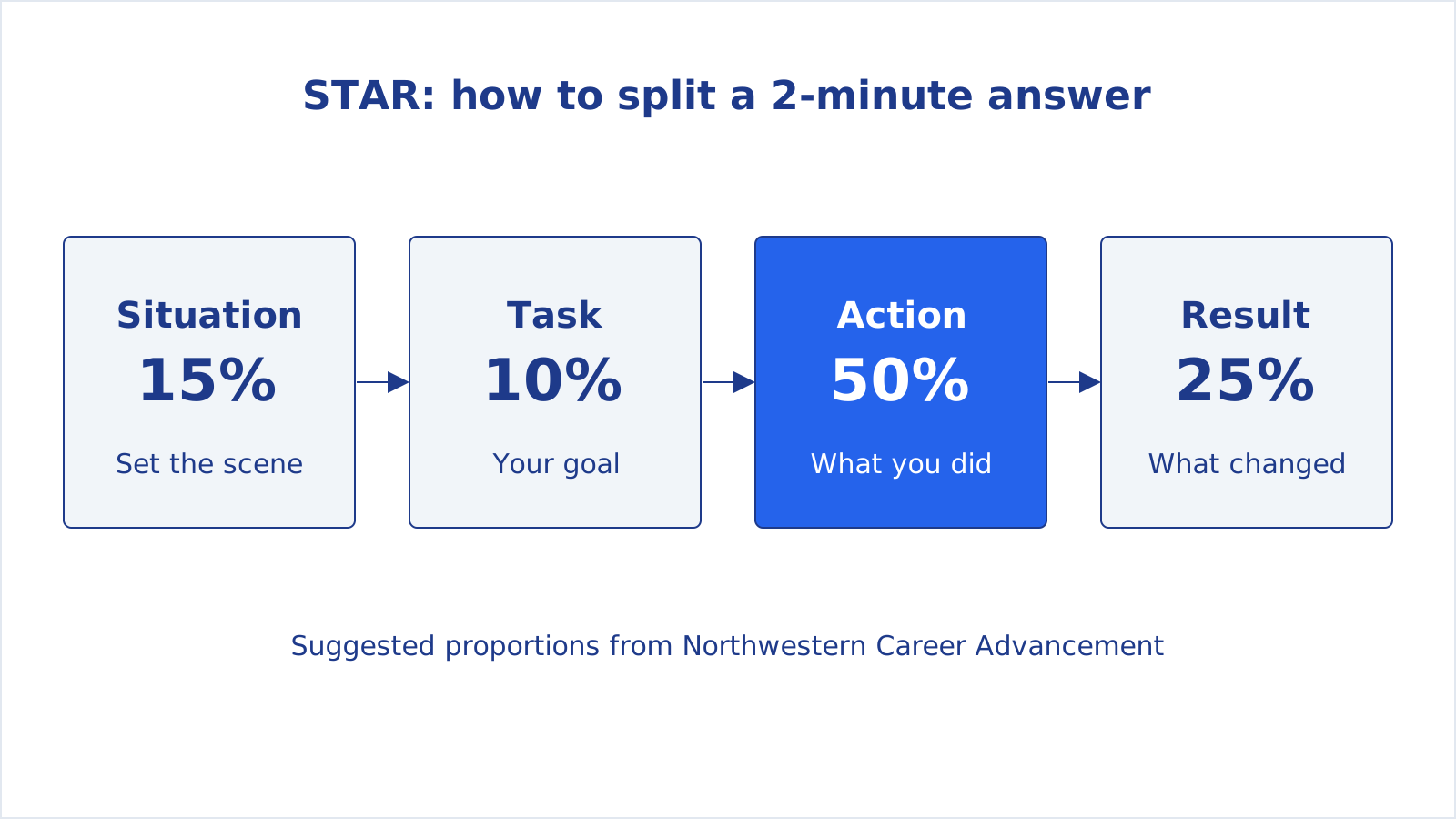
Northwestern suggests a rough split: Situation 15%, Task 10%, Action 50% and Result 25%, and it says the Action should always be the longest part. Treat these as proportions, not rules. For a two-minute answer, that is roughly 20 seconds of context, 10 to 15 seconds on your task, a full minute on what you did, and 30 seconds on the outcome.
A worked example (illustrative)
The question: "Tell me about a time you had to deal with a deadline that was at risk." The story below is made up to show the shape of an answer. Replace it with your own.
| Part | What you say |
|---|---|
| Situation | "At my last job, our team was preparing a quarterly customer report that went to leadership every Friday. Two days before the deadline, the data export we depended on broke." |
| Task | "I owned the report, so it was my job to get an accurate version out on time." |
| Action | "First I checked which sections depended on the broken export and which did not, and I finished those. Then I asked the data owner for a partial extract and compared it against last quarter's figures to check it made sense. I told my manager the same day that one section would be marked as preliminary, and I wrote down exactly what was missing." |
| Result | "The report went out on Friday with one section flagged. The full data arrived Monday and I sent the update that morning. Afterwards I added a simple check of the export to our Thursday routine so we would see a break earlier." |
Notice what the answer does. It is specific, it uses "I" for the actions, it admits that one section was preliminary, and it ends with something learned. It is about 150 words, which is roughly a minute of speaking.
Choose your stories before the interview
You will not know the exact question, but you can predict the themes. Northwestern recommends starting from the position description: identify the skills and qualifications the employer values, then reflect on experiences where you showed them. Our guide on tailoring your resume to a job description uses the same first step, reading the posting for what it actually asks for.
A practical way to build a story bank:
- List the themes. Typical ones are a conflict with a colleague, a mistake you made, a tight deadline, something you led, something you learned fast, and a time you disagreed with a decision.
- Pick five or six real experiences from work, school, volunteering or side projects. Recent graduates and career changers can use all of these.
- Write each in four lines, one per STAR part. Do not write a script; write the facts you want to hit.
- Tag each story with two or three skills, so one story can answer several questions.
- Keep your numbers honest. Only use figures you can explain if the interviewer asks a follow-up.
Tip: Write one extra story about something that went wrong. "Tell me about a failure" is common, and an honest account of a mistake, what you did about it and what you changed is a strong answer.

Common mistakes that weaken STAR answers
- Too much Situation. If you are still explaining the background after 30 seconds, cut it. The interviewer can ask for more.
- Using "we" for everything. Teams matter, but the question is about you. Say what the team did, then say what you did.
- No Result. A story that stops after the Action feels unfinished. End with an outcome and a lesson.
- Vague actions. "I helped" and "I got involved" say nothing. Use verbs that describe the step: "I mapped," "I asked," "I rewrote," "I escalated."
- Memorized recitation. A rehearsed monologue sounds flat. Know the beats, and let the words change each time.
- Telling a story that does not fit the question. If the question is about conflict, a story about a smooth project, however impressive, answers a different question.
- Inflating the outcome. Overstating results is risky, because follow-up questions are where details are tested. A modest, true result beats a big, fuzzy one.
What if you have no work experience?
The Wisconsin guide suggests drawing on classes, an internship, volunteer experience or a part-time job. The structure does not change. A group project where someone dropped out, an event you helped organize, or a shift where a customer was upset can all work, as long as the Action is yours and the Result is concrete.
Practice out loud, then get feedback
Reading your cards silently feels easy; speaking is different. Say each story out loud, time it, and aim for one to two minutes. Record yourself on your phone if you can stand it. Check three things: did you get to the Action quickly, did you say "I," and did you end on a Result?
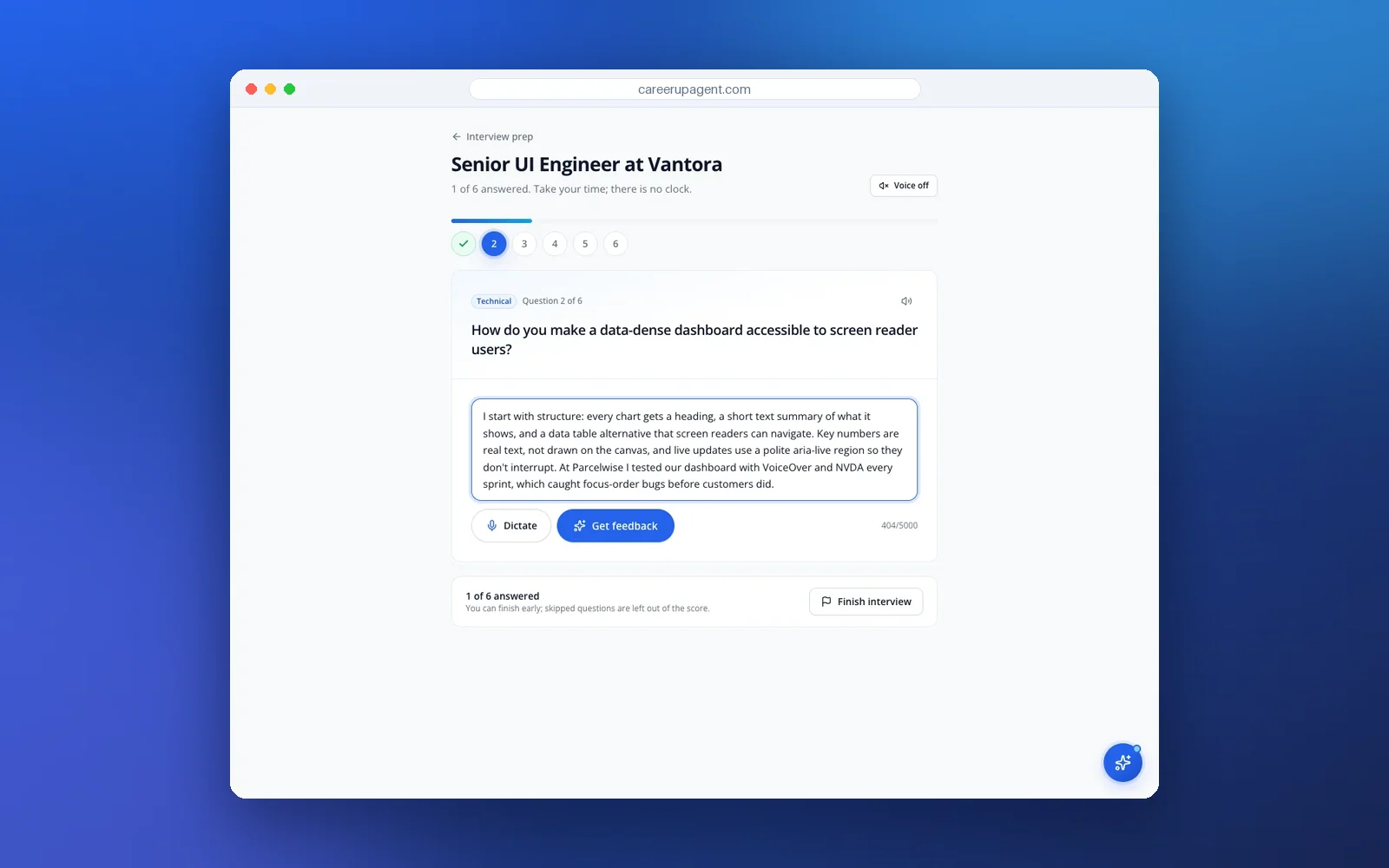
You can also practice inside CareerUpAgent. The mock interview gives you questions for a specific role, lets you type an answer or dictate it, and then lets you ask for feedback. When you finish, the debrief shows an overall score, a written summary, and columns for strengths, what to improve and what to practice next. It is a rehearsal space, not a prediction of how a real interviewer will react. The Free plan includes one mock interview a day; check the features page for what each plan includes.
If your opening answer is the one you worry about most, our guide to answering "tell me about yourself" covers a different structure for that question: present, past, future. STAR is for the "tell me about a time" questions that come after.
A quick checklist before the interview
- I have five or six stories, each written as four short lines.
- Each story is tagged with the skills it shows, and the skills match the job posting.
- Every story has a real Result and something I learned.
- I can tell each one in about two minutes, and in 30 seconds if asked for the short version.
- I have said them out loud at least twice.
- One story is about a mistake, told honestly.
Try it on your own stories
Pick one question from the themes above, write your four lines, and say it out loud. When you want a role-specific rehearsal with feedback, create a free CareerUpAgent account and run a mock interview for a job you are actually applying to.