
Most resume bullet points describe a duty: "Responsible for…", "Worked on…", "Helped with…". A hiring manager reads that and learns what your job title already told them. This guide gives you a simple formula and resume bullet points examples in 15 before/after rewrites, so you can turn duties into evidence without inventing a single number.
- A strong bullet starts with an action verb, says what you did and for whom, and ends with a result.
- Use a number only when it is real. A clear outcome in words beats a made-up percentage.
- Keep each bullet to one or two lines, and put the most relevant ones first.
- Rewrite your bullets for each posting, but only with things you actually did.
What resume bullet points are for
A bullet is a small piece of evidence. It answers one question for the reader: "What did this person do, and did it matter?" Career centers say much the same thing. MIT's Career Advising and Professional Development office tells students to focus on what they accomplished and the skills they developed, using strong action verbs and quantifying results where possible.
Length matters too. The Purdue Online Writing Lab suggests keeping bulleted information to a single line where you can, and MIT Sloan's career office advises limiting bullets to one or two lines and cutting unnecessary words. If a bullet wraps to a third line, it is usually two ideas.
A simple formula for resume bullet points
There are a few well-known formulas, and they are all variations on one idea: action, context, result.
- Action verb + context = results. The UC Davis Internship and Career Center teaches this formula for accomplishment statements.
- Project, Action, Result (PAR). MIT's career toolkit describes PAR statements: the project, what you did, and the outcome.
- "Accomplished X as measured by Y by doing Z." Laszlo Bock, Google's former head of people operations, shared this version in a LinkedIn article. It works best when you have a measurable Y.
You do not need to pick a side. Use the four parts below as a checklist, and drop the ones you cannot support.
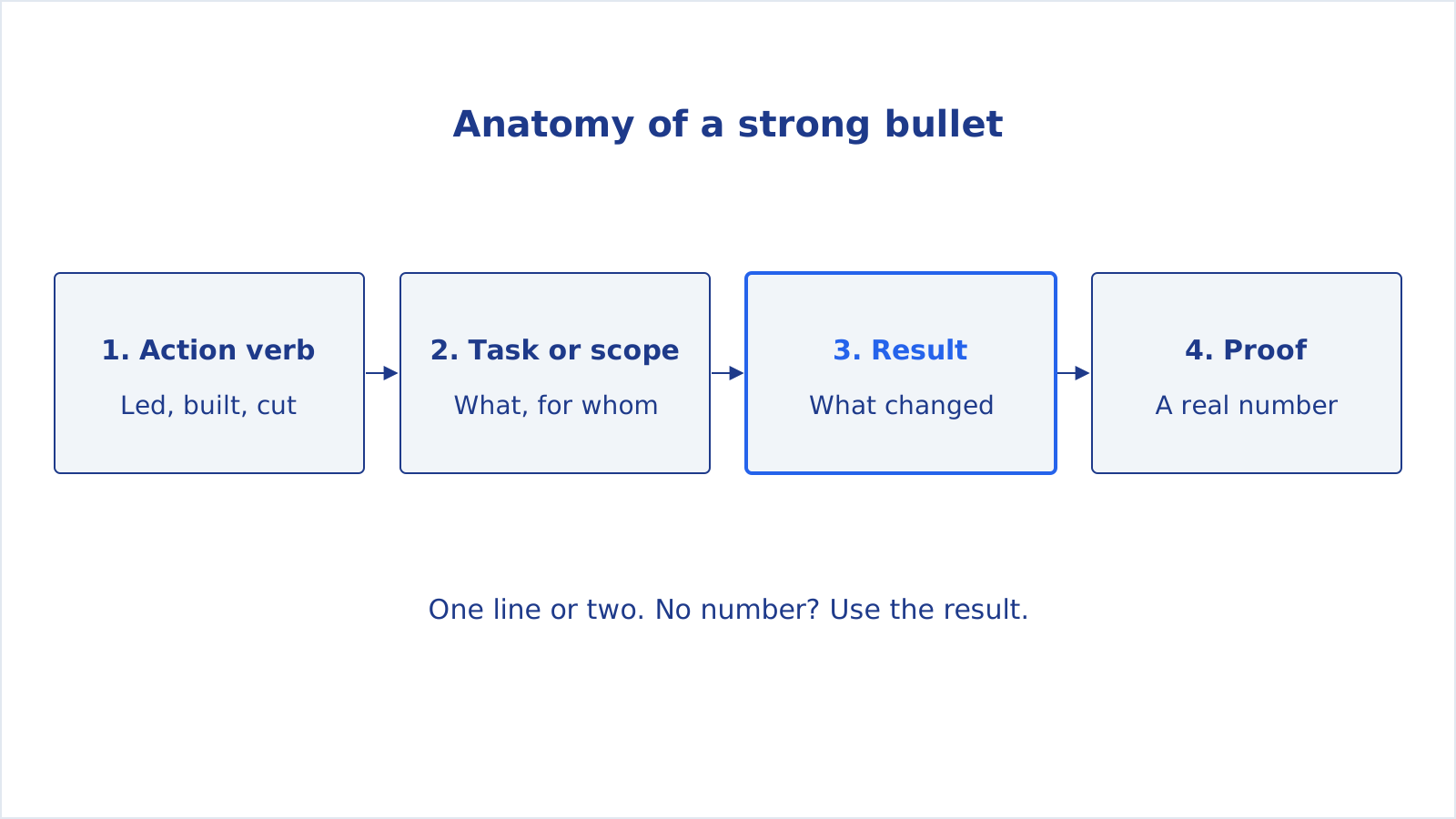
A worked example, with a sample number: "Handled customer complaints" becomes "Resolved 40+ customer complaints a week and flagged the three most common causes to the product team, who fixed two of them." The second version says what changed because you were there.
Resume bullet points examples: 15 before and after rewrites
Below are five groups of three. Every number in these rows is a made-up sample to show the shape of a good bullet. Replace it with a real figure from your own work, or leave the number out.
Customer support
| Before | After | What changed |
|---|---|---|
| Answered customer emails. | Resolved 40+ customer emails a day and kept first replies under two hours. | Volume plus a speed result |
| Responsible for updating the help center. | Rewrote 30 help-center articles based on recurring ticket themes, so fewer customers asked the same question twice. | Action, scope, outcome |
| Helped train new team members. | Trained six new hires on the ticketing tool; all handled live chats alone by week three. | Who, how many, when |
Marketing
| Before | After | What changed |
|---|---|---|
| Managed social media accounts. | Grew the newsletter list from 1,200 to 2,100 subscribers in six months with a monthly guide and two partner swaps. | Start and end numbers |
| Wrote blog posts. | Wrote 24 posts aimed at buyer questions; three reached page one for their target keywords. | Names the goal |
| Responsible for email campaigns. | Rebuilt the welcome email series and lifted its open rate from 38% to 46%. | Starts with a verb |
Software and data
| Before | After | What changed |
|---|---|---|
| Worked on the checkout page. | Rebuilt the checkout form in React and cut page load from 4.1 to 2.3 seconds. | Tool plus measured change |
| Fixed bugs in the API. | Fixed 35 bugs in the billing API, which cut invoice-related support tickets by about a third. | Links work to a business effect |
| Did code reviews. | Reviewed about 10 pull requests a week for a team of five and shortened average merge time from three days to one. | Shows pace and impact |
Operations and project work
| Before | After | What changed |
|---|---|---|
| Managed projects. | Ran six vendor-onboarding projects at once and delivered all of them on schedule and under budget. | Scale of the work |
| Handled scheduling for the team. | Built a shared scheduling sheet for 14 staff that ended double-bookings. | A problem removed |
| Tracked inventory. | Reconciled inventory weekly across two sites and brought stock discrepancies under 1%. | Frequency plus accuracy |
Teaching, volunteering and early-career roles
| Before | After | What changed |
|---|---|---|
| Taught eighth grade math. | Taught math to 120 eighth graders across five sections and raised the class pass rate on the district exam from 71% to 84%. | Audience size and result |
| Volunteered at a food bank. | Coordinated 15 weekend volunteers and packed 600 boxes a month. | Leadership, made concrete |
| Worked at a cafe. | Served about 200 customers a shift in a high-volume cafe and trained two new baristas on the espresso machine. | Pace and responsibility |
Notice what the "after" column has in common. Each bullet starts with a verb in the past tense (present tense for your current job), names the task, and ends on something a reader can picture: a faster reply, a fixed problem, a bigger audience. None of them uses "responsible for."
What to do when you have no numbers
Many good bullets have no figure. Teachers, nurses, assistants and engineers on internal tools often cannot measure their impact, and a guessed percentage is worse than none. A recruiter may ask you about it in the interview, and "I estimated it" is a weak answer.
Instead, use one of these anchors:
- Scale: how many people, accounts, tickets, stores or sites you covered.
- Frequency: daily, weekly, every release.
- A before and after in words: "replaced a paper sign-in sheet with a shared form, so check-in no longer needed a second person."
- Who noticed: only if you can say it truthfully, such as "adopted by the other two teams."

Mistakes that weaken a bullet
- Starting with "responsible for." It describes a job description, not your work. Harvard's career services lists passive language instead of action words among the top resume mistakes.
- Repeating the same verb. Three "managed" bullets in a row read as one. Vary the verb to fit the work: led, built, trained, reduced, negotiated.
- Burying the result. If the outcome is the strongest part, lead with it: "Cut onboarding time from two weeks to one by…".
- Keyword stuffing. Matching the posting's language is smart; pasting a skills list into a sentence is not. Our guide to what applicant tracking systems read explains why it rarely helps.
- Too many bullets. Five or six per recent role is plenty. Older roles can have two or three.
Tailor bullets to the job without stretching the truth
You do not need a new resume for every posting, but you should reorder and reword your bullets so the most relevant evidence comes first. Read the posting, find the two or three things it stresses, and move the bullet that proves each one to the top of the relevant role. Then borrow the posting's own words where they honestly describe what you did. Our step-by-step guide on how to tailor your resume to a job description covers this in detail, and the resume skills section and resume summary guides cover the parts around your bullets.
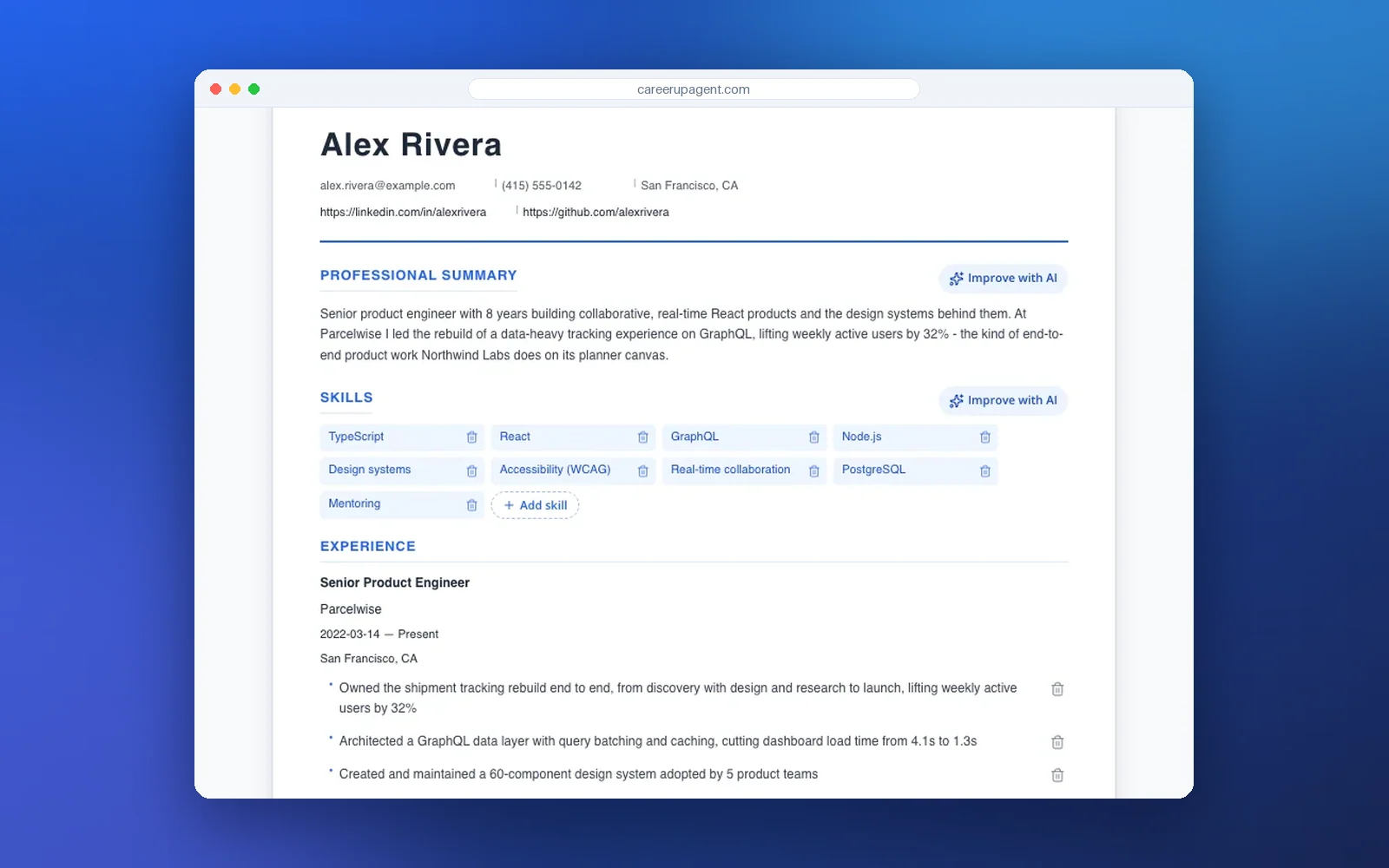
Tools can speed this up, but they should not write your story. Harvard's career services says generative AI can help you brainstorm revisions to bullet points and incorporate keywords from a job description, but should not be the primary author, because its output will likely be generic. That matches how we built CareerUpAgent: when you apply to a job, its tailoring step drafts job-specific wording from the resume you already uploaded, and you read, edit and approve every line before anything is sent.
A 10-minute routine to rewrite your bullets
- Brainstorm (3 minutes). For one role, write down every project, task and problem you handled, without polishing. MIT's toolkit also suggests starting with brainstorming before you shape the statements.
- Pick the strongest five (2 minutes). Choose the ones closest to the job you want next.
- Apply the formula (3 minutes). Verb first, then scope, then result. Add a number only if you can defend it.
- Trim (2 minutes). Cut filler words until each bullet fits in one or two lines.
If you want a second opinion on how a rewrite fits a specific job, CareerUpAgent scores how well a resume matches a posting and drafts tailored wording you can edit. Start with your three weakest bullets and see how they change.
Frequently asked questions
How many bullet points should each job have?
Five or six for your most recent or most relevant role is a good ceiling, and two or three for older roles. If every bullet is strong, fewer is fine.
Should every bullet include a number?
No. Use a number when you have a real one. Otherwise show scale, frequency or a clear before and after in words.
Should I use past or present tense?
Use present tense for your current role and past tense for earlier ones, and keep it consistent within each role.
How long should a resume bullet be?
One or two lines. Sources such as Purdue OWL and MIT Sloan recommend keeping bullets short; if one runs to a third line, split it.
Can I use the same bullets for every application?
You can reuse the facts, but reorder and reword the bullets for each posting so the most relevant evidence is first.