A resume gap explanation comes in two parts: one line on paper and one sentence you can say out loud. Most of the stress people feel about a gap comes from not having either of them ready. This guide gives you both, with sample wording for four common reasons: a layoff, caring for someone, study and health.
Key takeaways
- A short gap rarely decides anything on its own. A long, recent, unexplained one is what makes reviewers ask questions.
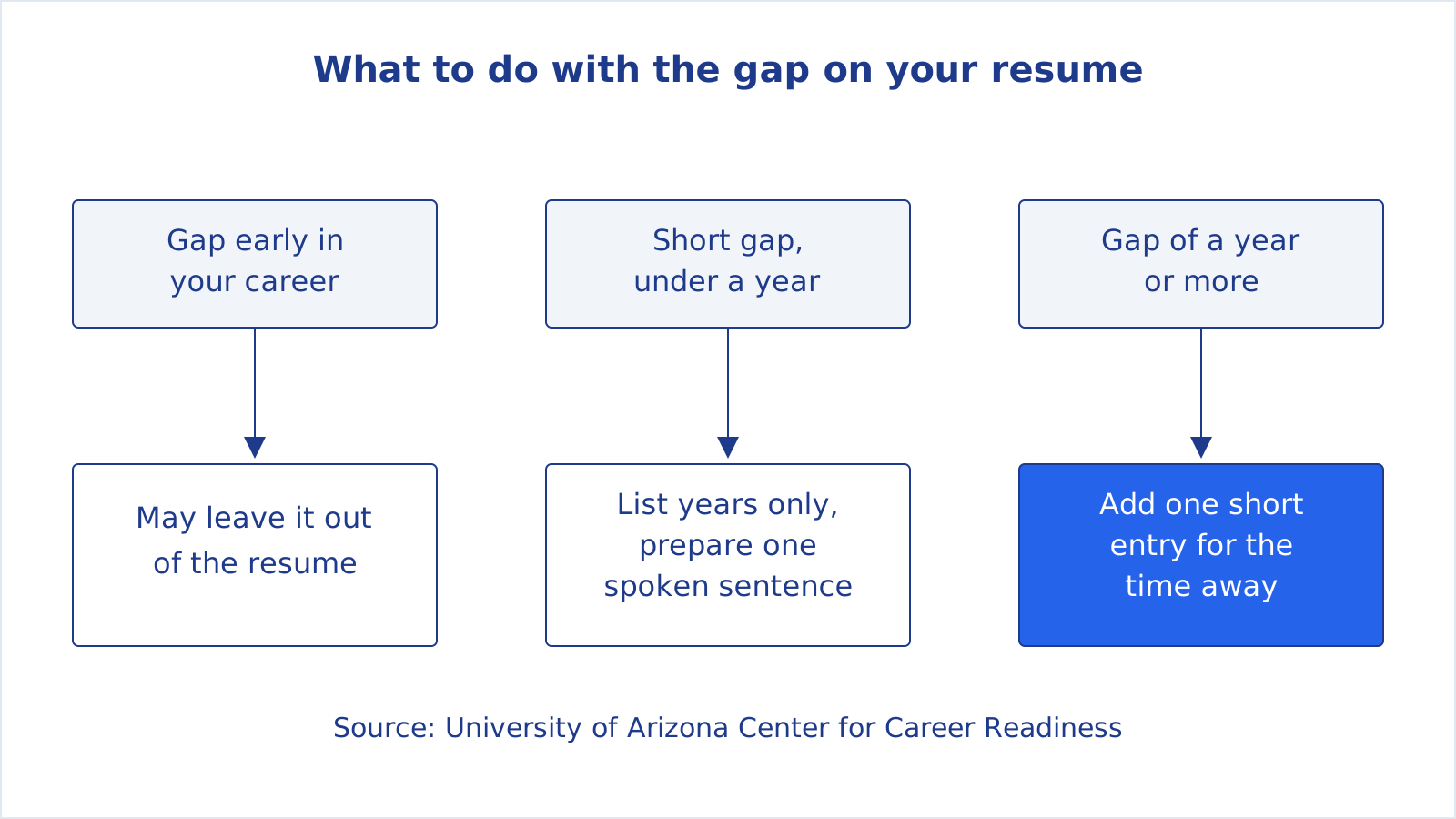
- For gaps under a year between jobs, list years only. For a year or more, add one short entry for the time away.
- In an interview, give the reason, say what you did, then say you are ready to work. Keep it under a minute.
- You decide how much detail to share about health or family. "Medical reasons" or "family caregiving" is enough.
- Never change the dates of a real job to hide a gap.

Does a gap on your resume need explaining?
Sometimes, and the sources disagree on how much it matters. Resume Genius reports that 69% of employers in its Hiring Trends Survey say resume gaps have some influence on their hiring decisions. Indeed, on the other hand, says a gap alone does not typically determine hiring decisions and that employers often look at skills, experience and how you explain your career path.
Length and timing seem to matter more than the existence of a gap. Resume Genius says a gap of a few months won't raise concerns for employers, and that they are mainly worried about recent, lengthy gaps. Monster's guide puts rough numbers on it: gaps of up to six months are relatively common, and past nine months employers may want more detail. Those are one site's rules of thumb, not a standard, but they match what the other sources say.
So the working rule is simple. A few months between two jobs needs a good formatting choice and a ready sentence. A year or more needs a line on the page.
Fix the dates first
The quickest change is to list years instead of months. Indeed's example: instead of January 2024 – October 2025, write 2024 – 2025. The University of Arizona's career center says this works when gaps are short and fall between jobs, and adds that you should still be ready to discuss them in interviews.
Two cautions. Use the same date format on every line, because a mix of month-and-year and year-only entries looks odd and inconsistent date formatting tends to surface anyway, as one career site puts it. And years-only is a formatting choice, not a way to bend the truth. If an application form asks for months, give the real months.
If the gap came early in your career, the same Arizona page says that depending on the length and your level of experience you may not need to include it at all. A seven-month break fifteen years ago has nothing to say about a candidate with a long record since.
A resume gap explanation that fits on one line
For a gap of a year or more, Arizona's advice is to treat the time as if it were a job: explain what you were doing in the experience section and keep the entry very brief. Their sample is a full-time parent entry with the city, the years and one bullet. A career-advice site on caregiving breaks suggests a label of two to six words, with any volunteer work, contract work or courses listed underneath.
Some guides recommend softer labels such as "Career Sabbatical." Plain wording is easier to read and harder to misread, so I'd write what actually happened. Here is sample wording for the common cases. It is ours, meant as a starting point, so change the details to fit your own situation.
| Reason | Line on the resume | Sentence for the interview |
|---|---|---|
| Layoff | Usually none. Years-only dates cover a short search. | "My team was cut in a reorganization in March. Since then I've been applying to roles like this one and finishing a data analysis course." |
| Caring for family | Family caregiver, 2022–2024 | "I took two years out to care for my father. He's settled now, and I'm ready to go back to full-time work." |
| Study | Part-time certificate, 2023–2024 (listed under Education) | "I used the time to finish a certificate in project management, and I've already applied it in a volunteer project." |
| Health | Career break (medical), 2021–2022 | "I took time off for a health issue that's now resolved. I'd rather not go into detail, but I'm fully ready for this role." |
On the health row: Resume Genius says you don't owe details and can use general terms like "medical reasons" or "family caretaking". If an interviewer pushes for more, "I'd prefer not to go into detail" is an acceptable answer, according to the same page.
Tip. Put anything real that happened during the gap under the entry: volunteering, freelance jobs, courses, certificates. Arizona suggests continuing education, certificates, volunteering and contract work as ways to add relevant experience. Only list what you did, with real dates.
Say it out loud: the interview answer
Indeed offers a template for the spoken version: say what the reason was, what you did during that time, and that returning to work was on your mind. It also recommends being truthful without unnecessary detail and giving specifics on how you spent the time, such as what you read to keep up with your industry or how you stayed in touch with colleagues.
Workable adds a point about timing. If the interviewer opens with "tell me about yourself," its advice is not to wait to be asked: mention the layoff right away, say what you learned, and don't spend more than a minute on it before moving on. We covered the structure of that opening answer in how to answer "tell me about yourself".

Here is what a layoff answer can sound like when it follows that shape (an invented example, for illustration):
"I was laid off in March when my company closed its Dublin office. Since then I've been applying for operations roles and I finished a supply chain course in September. I'm looking for a team that needs someone who can start quickly, and this role looks like that."
It gives the reason, one fact about the time since, and a turn back to the job. It doesn't apologize and it doesn't comment on the employer. It also doesn't run long: that is about twenty seconds of speech.
What about the cover letter?
This is where sources split. Arizona says there are three places to address a gap, your resume, your cover letter and the interview, and that the cover letter and interview let you give a more detailed explanation. Resume Genius takes the opposite view and says you shouldn't talk about employment gaps in your cover letter, because the letter should stay on skills, achievements and why you want the job.
A reasonable middle: leave it out when the gap is short or already explained by an entry on the resume, and add one sentence when the gap is long, recent or relevant to the role. If you do mention it, make it a single sentence near the end of a paragraph about what you can do. Our cover letter guide covers where it fits.
Should you use a functional resume to hide a gap?
Several guides suggest it. Indeed lists a functional resume format as one way to reduce the visual impact of gaps. The caregiving guide cited above disagrees: it says that format is distrusted by hiring managers and parses badly in applicant tracking systems. We can't settle that for you, but a skills-first layout that still lists jobs in order, the combination format, keeps your dates visible and your skills near the top. We explain it in the career change resume guide, and the ATS article shows what systems tend to read.
Returnships. If you left to provide care and want to return, some employers run programs for exactly that. Path Forward, a nonprofit that lists them, says that for returnships a gap is required and needs to be apparent on your resume. There the advice flips: show the break instead of working around it.
Where CareerUpAgent helps
Once the entry and the sentence are written, the rest is the usual job-search work, and a few of our tools cover parts of it. These are the features we have built, no more.
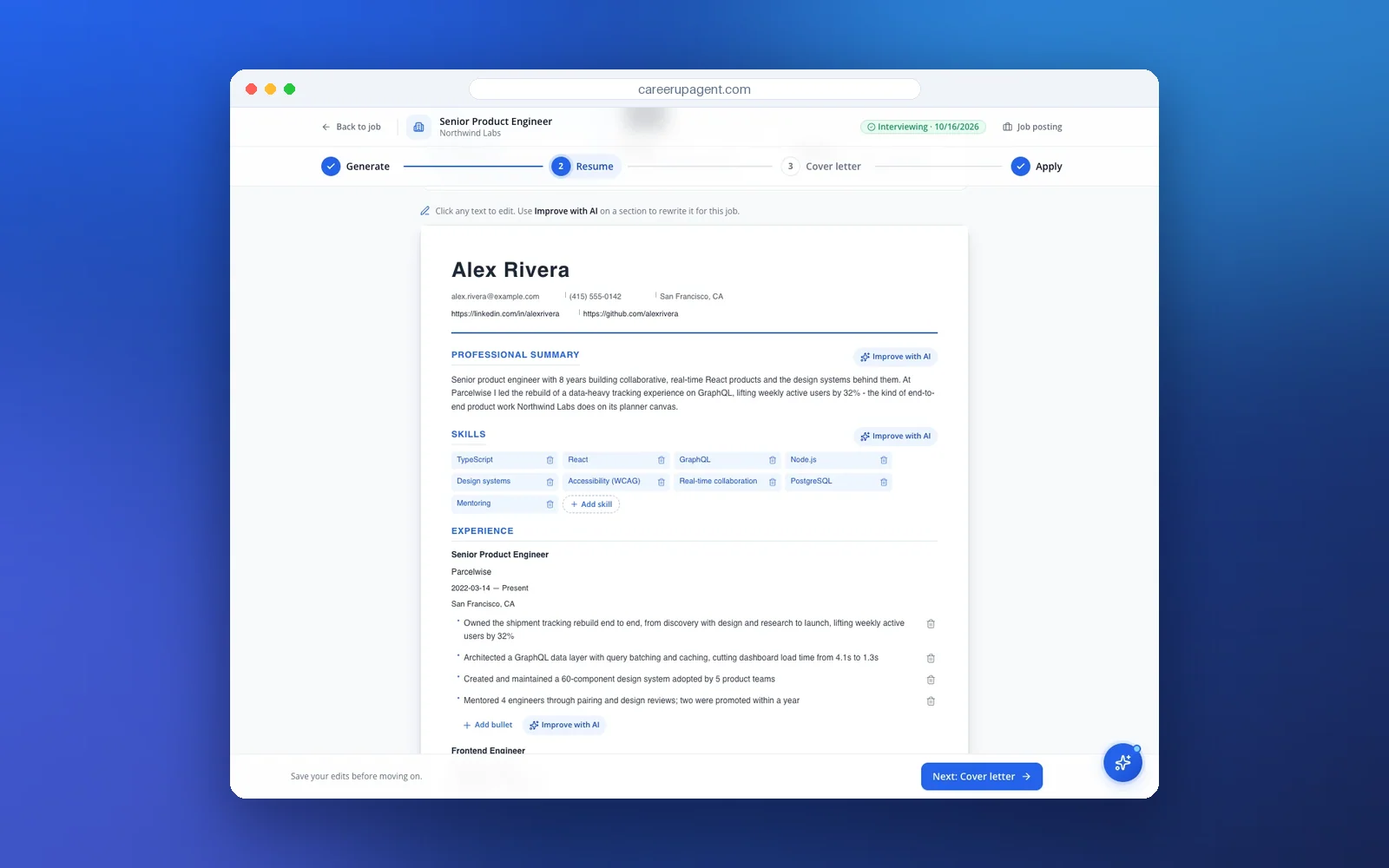
- The resume editor. When you apply with CareerUpAgent, the resume is an editable page with a job-specific summary, skills and rewritten bullets. You can edit every section by hand, so the wording of your gap entry stays yours. See the features page.
- The free ATS resume checker. It runs a set of checks on an uploaded resume, including dates and section headings. Try it at /ats-resume-checker after you've changed the format.
- The mock interview. You can type or dictate answers to questions built from a job posting and read feedback and a score. It is a place to say your gap sentence out loud before the real call.
Tailoring still matters more than the gap. A resume that clearly fits the posting leads the reader to your skills before the dates, and our tailoring guide shows how to do that. The free resume and job match checker will score a resume against a posting, and you can create a free account to try the rest.
Don't do this. Don't extend the end date of one job or move the start date of the next to close a gap. It is a different thing from leaving out months, and mismatched dates can come up when an employer checks your history.
A ten-minute exercise
Open your resume and find the longest stretch with no entry. Decide which box of the diagram it falls in. If it needs a line, write it in six words or fewer and put a date range beside it. Then write two sentences for the interview, using Indeed's order of reason, what you did, ready now. Read them aloud once. Then send the application you were holding back.