
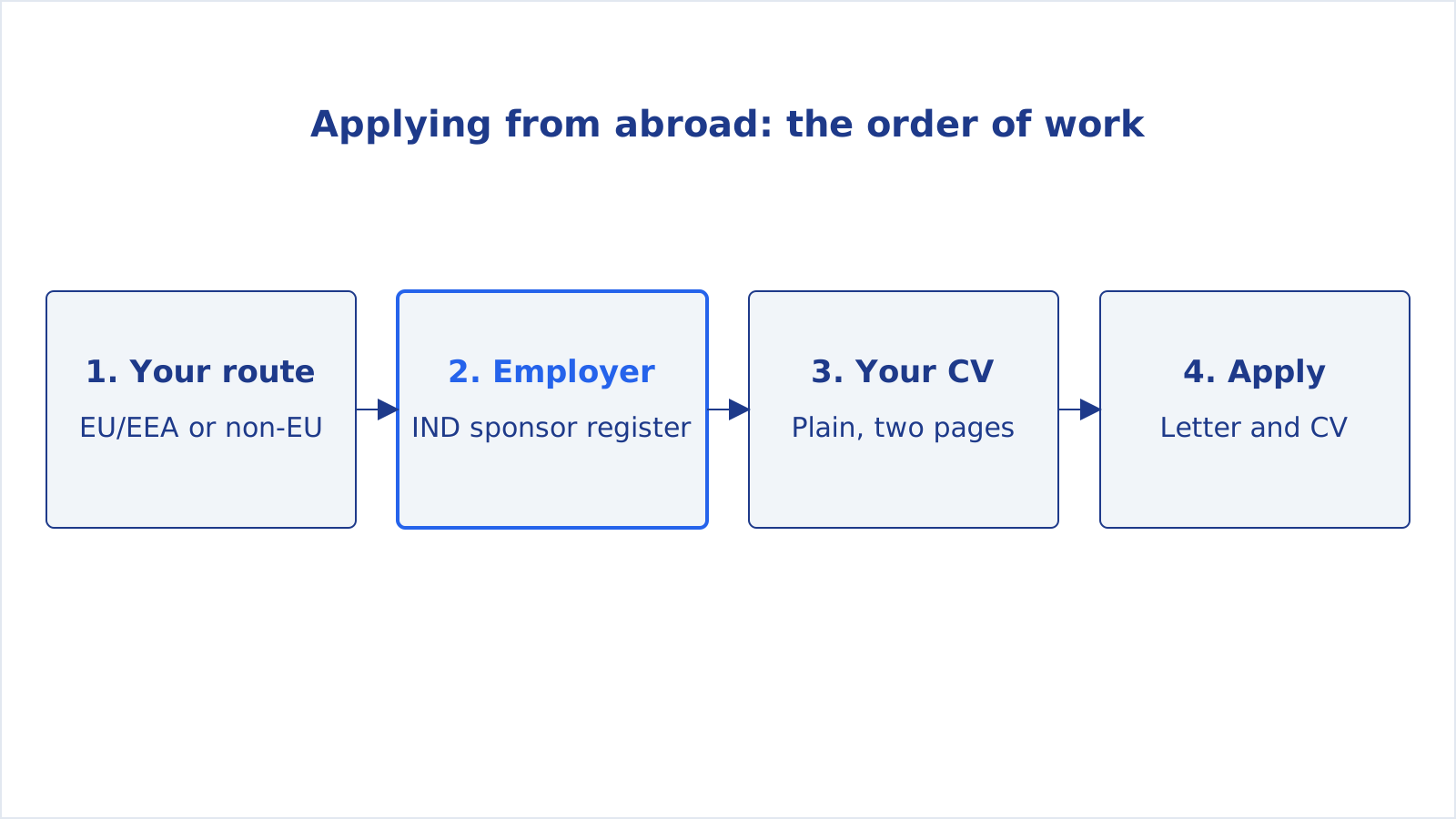
If you want to find a job in the Netherlands from abroad, the order matters more than the volume. First you work out whether you need an employer who can sponsor you, then you check that the employer can, and only then do you spend an evening tailoring a CV. People who start with fifty applications often find out in week three that half of those employers could never hire them.
This guide is for people applying from outside the Netherlands, whether you hold an EU passport or not. We stick to official and named sources for anything about visas and salaries, and we say where you need to check the current rule yourself, because these rules change.
Key takeaways
- EU/EEA citizens generally find work permission straightforward. For non-EU citizens, a job usually means an employer that is a recognised sponsor of the IND.
- Check every employer in the IND's public register of recognised sponsors before you tailor anything.
- The orientation year (zoekjaar) is a separate route for recent graduates, and your employer does not need to be a recognised sponsor during it.
- Dutch CVs are plain and short, and the motivation letter is read. Use a standard CV rather than a Europass form.
- Unsolicited applications are common in the Netherlands, so writing to a company without an open vacancy is not strange.
Step 1: Work out which route applies to you
The first question is about your passport, not your skills. Prospects says that to get a job you will generally need Dutch work permission, that this is usually straightforward for EU/EEA citizens, and that for non-EU/EEA citizens opportunities are limited, typically to cases where no suitable EU/EEA or Dutch candidate is available. The route most employers use to hire from outside the EU is the highly skilled migrant scheme.
Under that scheme the employer applies, not you. The IND (the Dutch immigration service) says recognition as a sponsor is required to employ highly skilled migrants, and that a salary requirement applies. Business.gov.nl adds that only a recognised sponsor may apply for the permit, and that in most cases this is the company where you will work. It also notes that the government announced plans in 2025 for stricter rules, so read the current IND page before you rely on any figure, including the ones below.
The 2026 salary criteria
The IND publishes the required gross monthly amounts each year. A summary on findlawyer.nl lists the 2026 figures below, excluding holiday allowance. We use it only for the numbers, so confirm them on the IND's own page for the date you apply.
| Situation | Gross a month, 2026 |
|---|---|
| Aged 30 or older | €5,942 |
| Under 30 | €4,357 |
| Reduced criterion (recent graduates, orientation-year situations) | €3,122 |
The practical use of these numbers is to filter your search. If you are 34 and a posting pays well under the first line, the job is probably not one that can sponsor you on this scheme, however much you like it.
Step 2: Check the employer before you tailor anything
The IND keeps a public register of recognised sponsors, and it is the place to look. Search the company's legal name, not just the brand. allrecognizedsponsors.nl, an independent checker built on that register, points out that groups often have several legal entities and only one of them may be listed. If the entity that will employ you is not on the register, ask the recruiter directly.
Not being listed is not the end of the conversation. The same checker mentions that, depending on your situation, the orientation year or an EU Blue Card can be alternatives. Findlawyer.nl adds that an agency or payroll company can act as the recognised sponsor and legal employer when it places you at another business. That is a question for the employer, and the IND decides what is possible.
Step 3: Look at the orientation year if you recently graduated
The orientation year for highly educated persons, known as the zoekjaar, lets you stay to look for work. A guide from Paying IT International explains that you are free to work during the year and that your employer does not need to be a recognised sponsor. A FAQ from Rotterdam University of Applied Sciences says you can apply until three years after you completed your degree.
Eligibility depends on your degree and on where you studied, and the same FAQ notes that foreign institutions have to appear on a ranking list. Whether you qualify is for the IND to say, so start from its page for the orientation year. The permit is valid for one year at most and cannot be extended, according to CollegeLife's zoekjaar guide, so a plan for those twelve months helps.
Be wary of anyone who sells a "guaranteed" Dutch visa job. Business.gov.nl says the employer pays the highly skilled migrant application fee, and the IND's register of sponsors is public, so you can check any employer yourself.
Step 4: Know where Dutch jobs are advertised
You will not find everything on one site. Prospects lists Indeed.nl, Nationale Vacaturebank, StepStone, Undutchables and Xpat Jobs as places to start, and says you can begin from home with job boards, direct contact with companies and LinkedIn. For EU/EEA citizens, UWV coordinates EURES in the Netherlands, the network that helps people find work across the EU/EEA and Switzerland. The Dutch government's Netherlands Worldwide site is the official gateway for information on working abroad and working in the Netherlands.
On networking, EURES says a good network improves your chances and that unsolicited applications are very common. That is useful when you are abroad: a short, specific message to a team you would like to join is normal there. EURES also notes that employers look at your social media, so check your public profile before you apply.
Step 5: Write a CV that looks Dutch
EURES describes an application letter with a CV as the standard procedure for qualified and highly qualified jobs, and says the Europass CV is not yet widely known among Dutch employers. It recommends the standard Dutch-style CV, especially for unsolicited applications.
Several career guides describe that style the same way. GLO Career Services calls it a factual CV of no more than two A4 pages, with exact dates and the most recent first, in English for international employers and in Dutch when the advert is in Dutch. The Tailor CV says a photo is optional and increasingly left off by international employers in Amsterdam, while some traditional firms still expect one. Sources disagree a little on photos, which tells you it depends on the employer. Look at how the company presents its own people and follow that.
- Put name, city, phone, email and LinkedIn at the top. Add nationality only if it matters for your permit.
- Write two or three plain lines of profile, then work experience with exact dates.
- List languages with a level you could defend in an interview.
- Keep the motivation letter to one page and say why this role at this company.
The tailoring is the slow part, and it is where we built CareerUpAgent to help. The free resume-to-job match checker compares a resume with a posting you paste in, and the ATS resume checker tells you whether a system can read the file. For ideas on rewriting the content itself, our posts on tailoring a resume to a job description and resume bullet points cover it.
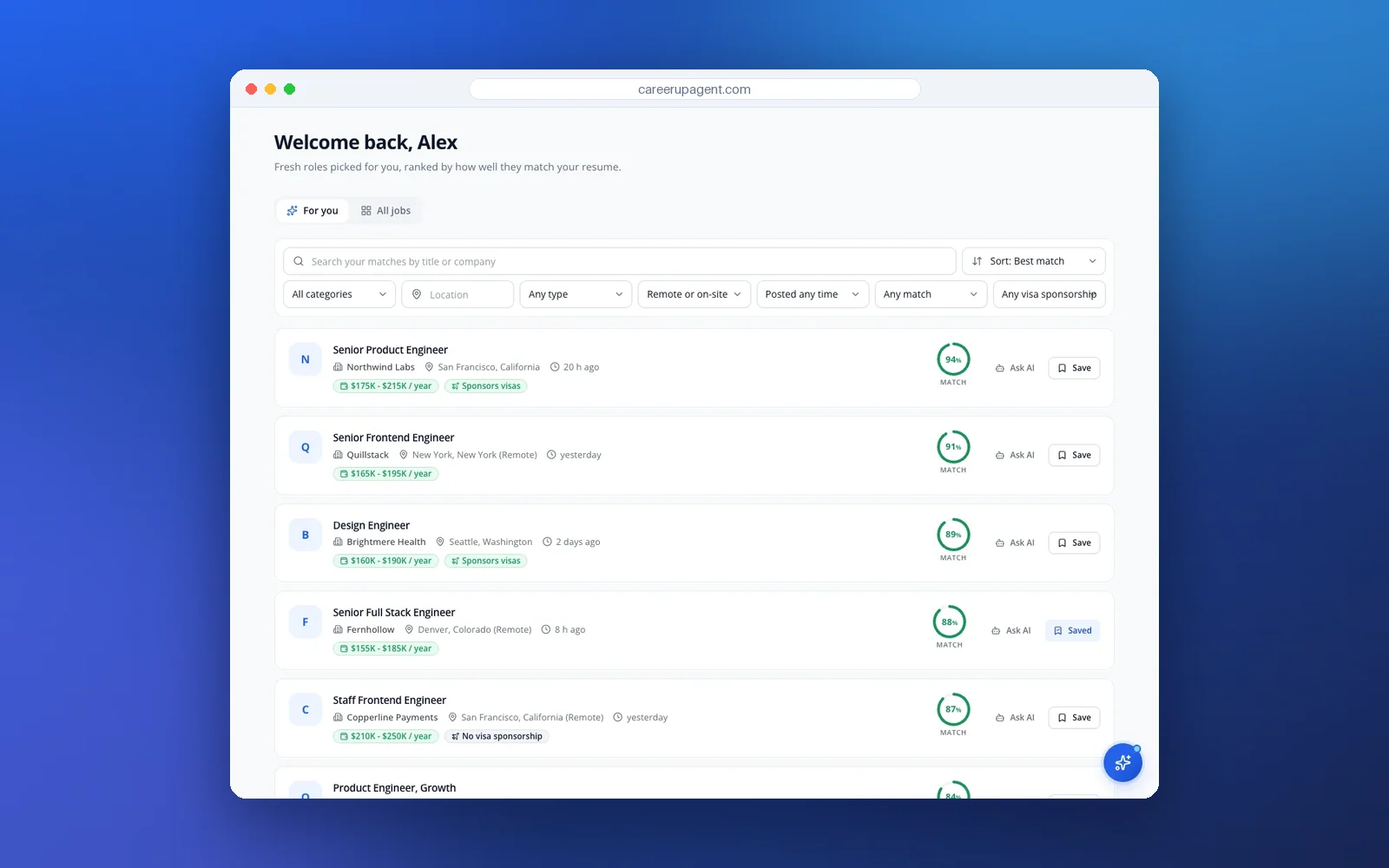
Inside the app, the Jobs page ranks postings by match score and shows a visa-sponsorship badge, so you can sort a long list quickly. It then writes a tailored resume and cover letter for the job you pick. You read and edit both and send the application yourself. A badge is a starting point only, so confirm sponsorship with the employer and against the IND register.
Step 6: Apply, follow up and prepare for a call
Apply to fewer, better-checked jobs. Our post on how many jobs to apply to a week explains why. After you apply, a short follow-up in one to two weeks is normal, and our follow-up guide has templates.
EURES notes that interviews can be held online, and for a candidate abroad the first round almost always will be. Test your setup first with our video interview tips.

Keep a simple list of every employer you contact with three columns: legal entity name, whether it is on the IND register, and the date you last wrote. It takes a minute per company and saves you from chasing employers that cannot hire you. Our application tracker does the same job if you prefer to keep it in one place.
Where to go next
If Germany is also on your list, read our guide to the Germany Opportunity Card, which follows the same official-sources approach. When you are ready to try the tools on a real posting, you can create a free account.