
The Germany Opportunity Card, called the Chancenkarte in German, lets some non-EU professionals enter Germany to look for work without a job offer in hand. That is a big change for anyone who has been applying from abroad and hearing nothing back. It is also easy to misunderstand: it is a job-search permit with its own conditions, not a promise of a job and not employer sponsorship.
This guide sticks to what official sources say, links to them so you can check the current rules yourself, and then covers the part you control: a CV and application that read well to German employers. We are a job-search tool, not a law firm, so nothing here is immigration advice.
Key takeaways
- The Opportunity Card is a job-search residence option. According to the Federal Foreign Office, it has been available since 1 June 2024 and is issued for a maximum of one year.
- There are two routes: a fully recognised qualification, or a points route that needs at least six points.
- You must show proof of financial means and health insurance for your stay, and the card allows up to 20 hours a week of work trials or secondary employment.
- Rules, fees and processing times change and differ by embassy, so confirm everything on the official pages before you act.
- Whatever route you take, a clear, tailored application is what turns the card into interviews.
What the Germany Opportunity Card is
The Federal Foreign Office describes the Opportunity Card (Chancenkarte) as a way for foreign nationals with a German or other recognised university degree or a foreign qualification to enter Germany to seek employment. Its information page says this has been possible since 1 June 2024, that cards are issued for a maximum of one year, and that the holder must submit proof of financial means for the intended duration of the stay.
Two things follow from that. First, the card is about searching: you arrive, look for a role and interview in person. Second, it is time-limited. A year goes quickly when you are also settling into a new city, so it pays to have your application materials ready before you land.
The German government's portal for skilled workers, Make it in Germany, has the overview and the official eligibility self-check. Treat it as your reference point and this article as a companion.
Who can apply: two routes
The Federal Foreign Office page lists two options. If you have a German or a fully recognised foreign qualification, you can apply without further special requirements. If you have a foreign university degree or a vocational qualification of at least two years that is not, or only partly, recognised in Germany, you may need to score at least six points in the points system.
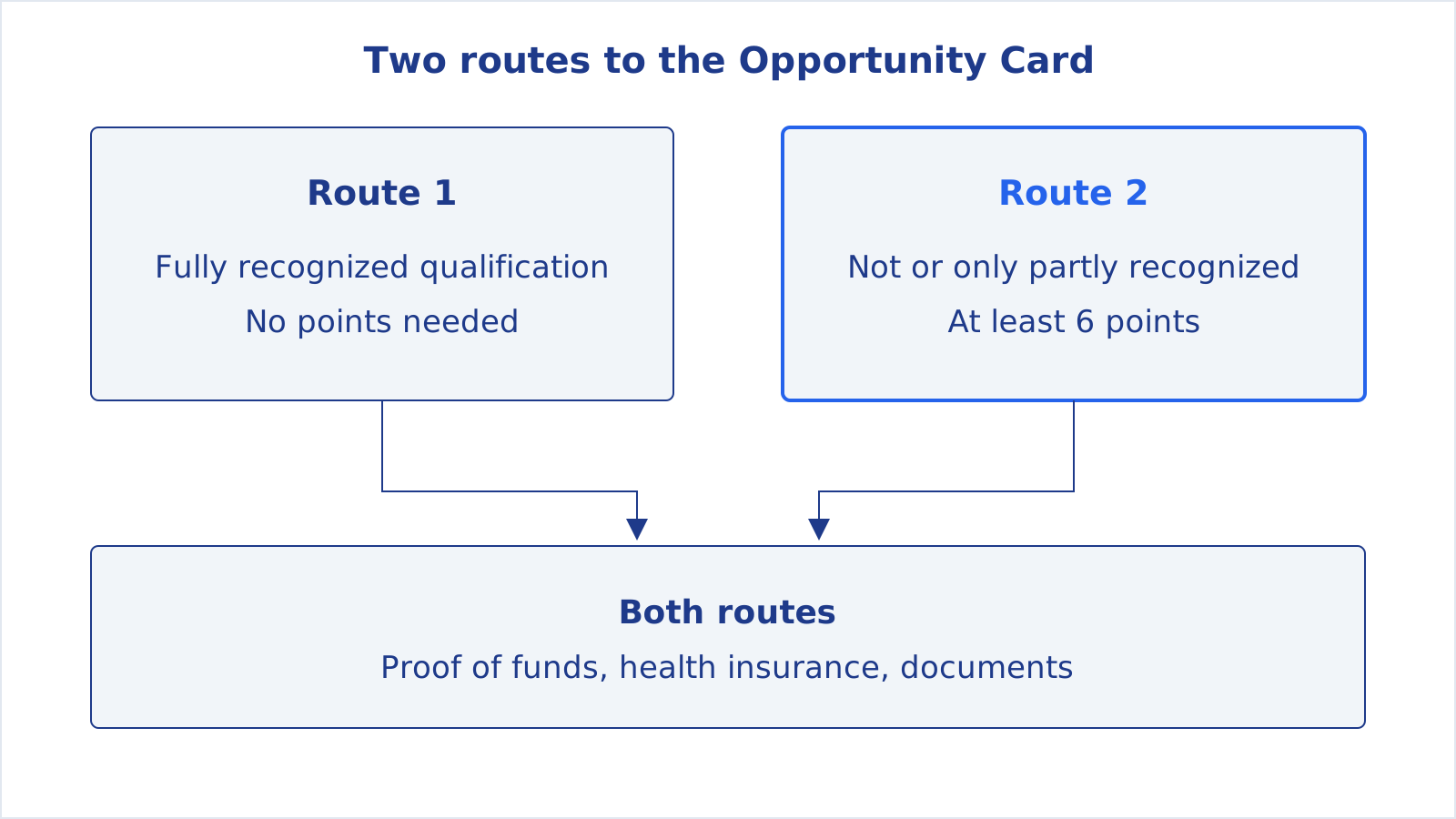
Route 1: a recognised qualification
For this route you prove that your qualification is German or fully recognised. The official page points to the anabin database for university degrees and institutions, and to the DAB database for vocational qualifications. If your degree is not evaluated there, it suggests you may be eligible for the points route, or you can apply for a Statement of Comparability.
If you want to work in a regulated profession such as medicine, the page notes that your degree must be recognised for Germany, and it points to the Recognition Finder on the "Recognition in Germany" portal.
Route 2: the points system
For the points route, the official page asks for a printout of your result in the Make it in Germany self-check, showing at least six points, plus individual proof for everything you entered in it, such as language certificates. It also asks for proof of basic German (level A1) or basic English (level B2), from a certificate provider the page names.
We are deliberately not reproducing the points table here. The values are set in German law and can change, so use the official self-check to count your own points and keep every certificate it asks about.
What the card lets you do in Germany
According to the Federal Foreign Office, the card allows work trials and secondary employment of up to 20 hours per week during your stay. In practice, that gives you two useful things: a way to cover part of your costs, and a way to show an employer what you can do before they commit to a full contract.
It does not, by itself, give you a full-time job. A signed offer is a separate step with its own rules, so ask the employer and the immigration authority about that next stage rather than assuming it.
What you need to apply from abroad
The same page lists the documents for an application made at a German mission. The exact list, fees and waiting times depend on where you apply, so use your own embassy or consulate page. As an example, the Federal Foreign Office page for Australia asks for:
- a completed and signed application form and a recent passport photo;
- a passport that stays valid for at least six months from your planned arrival;
- a cover letter that says which fields and jobs interest you, where you will apply, where you want to live and how you will support yourself;
- any evidence of further preparations to find a job in Germany;
- full health insurance covering the whole stay;
- proof of financial means, which that page lists as 1,091 euros per month at the time of writing;
- the documents for your route: qualification recognition proof, or the self-check printout and language certificate.
Note the line about preparations. The embassy asks what you have done to get ready to find a job, so a short, specific plan helps: target roles, target cities, a CV in German format and a shortlist of employers.
Check before you rely on this. The page we used is one embassy's version. Citizens of several countries can usually apply for a residence permit after entering Germany, but the same page warns of possible difficulties for the Opportunity Card, for example in Berlin. Contact the immigration authority or your embassy before you book travel.

Preparing a German-style CV
A job application in Germany, the Bewerbung, usually consists of a cover letter (Anschreiben), a CV (Lebenslauf) and references or certificates (Zeugnisse). The Lebenslauf often includes a photograph. Many guides, such as this German CV format guide, describe the standard CV as tabular, with dates on the left and the role on the right, in reverse-chronological order, with month-and-year dates.
Conventions vary by employer, industry and language, so treat these as defaults rather than rules. Here is a practical checklist:
- Match the language to the job post. If the posting is in English, an English CV is normal. If it is in German, write in German or ask a native speaker to review it.
- Use reverse-chronological order with month and year. Gaps are noticed, so add a short, honest line for study, caring responsibilities or a job search.
- Decide on the photo deliberately. It is common but, according to the guides above, optional. A professional photo is better than none only if it is good.
- Keep it to one or two pages. Put the strongest, most relevant experience first; our post on the resume skills section shows how to group skills so they are easy to scan.
- Explain foreign employers and degrees. A recruiter in Munich may not know your previous company or university. Add one clause: what the company does, or the degree level.
- Add language levels using the common framework. Write levels such as B2 or C1, and only claim what you could demonstrate in an interview.
- Write a tailored cover letter. See how to write a cover letter for a four-paragraph structure that fits one page.
For the ATS side of things, our explainer on what applicant tracking systems actually read applies in Germany too: plain headings and selectable text beat decorative layouts.
Where CareerUpAgent fits
CareerUpAgent does not handle visas and cannot tell you whether you qualify for the card. What it can do is the application work around the search. It finds jobs from many sources, scores how well each one fits your resume, and writes a tailored resume and cover letter for each application. Every morning its Agent prepares application drafts for your best new matches, and you review and send each one yourself.
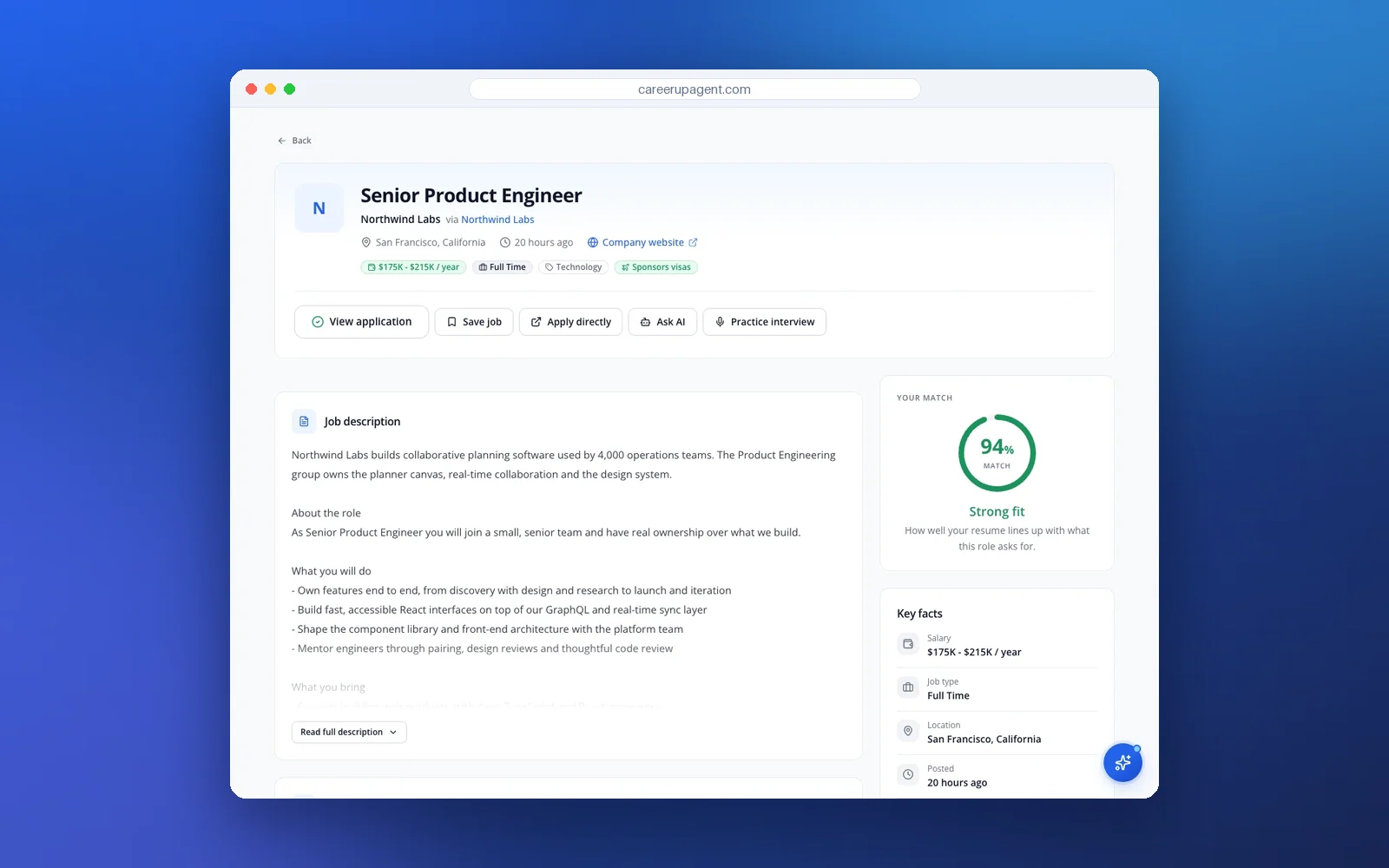
The job page above shows a visa badge next to the salary and job type. Use a badge like that as a pointer for your shortlist, not as a guarantee: confirm with the employer whether they hire from abroad and what support they offer. Also remember that the Opportunity Card is a permit to search, so an employer who cannot sponsor may still be able to interview you while you are in Germany.
If you want to see how your current CV reads against a specific posting before you spend a week rewriting it, try the free resume and job match checker or the ATS resume checker. No account is needed. Our post on tailoring your resume to a job description walks through the editing step by step.
A simple preparation plan
- Read the official pages. Start with Make it in Germany and your embassy's page, and note the date you checked.
- Run the self-check. Know which route you are on before you collect documents.
- Collect proof. Certificates, recognition printouts, language results and insurance quotes take longer than expected.
- Build a target list. Choose roles, cities and employers so your cover letter to the mission is specific.
- Prepare a base CV and a short cover letter template that you can tailor in minutes for each posting.
- Apply for jobs before you arrive. Where an employer is willing to interview by video, early conversations mean your year in Germany does not start from zero.
Ready to prepare your applications? Create a free CareerUpAgent account and see how a tailored resume and cover letter come together for a real posting. You stay in control of every application you send.