
Resume summary examples are easy to find. Examples that fit your job search are harder, because a summary only works when it says the right thing for the right posting. This guide shows what a summary does, three formulas you can fill in, before-and-after rewrites for three common roles, and when to leave the summary out entirely.
Key takeaways
- A resume summary is 2 to 4 sentences at the top of your resume. Its job is to make the reader keep reading.
- Use a simple formula: who you are, your proof, your fit for this job.
- Rewrite the last sentence for every posting. That one change does most of the tailoring work.
- Skip the summary when you have nothing specific to put in it. A vague summary is worse than none.
What a resume summary does (and what it doesn't)
A resume summary, sometimes called a professional summary or profile, is a short block under your name and contact details. It answers one question for a busy reader: why should I read the rest of this?
It matters because of how little time the first look gets. An eye-tracking study by Ladders found recruiters spent an average of about 7.4 seconds on the initial screen of a resume, up from roughly six seconds in 2012, as reported by HR Dive. It is a single study, so treat the number as a rough guide, not a law. The point stands: the top of the page gets read first and fastest.
A summary is not a place for your life story, a list of personality traits, or claims nobody can check. It is also not a substitute for the rest of the resume. Everything in it should be something the experience section proves.

The 3-part resume summary formula
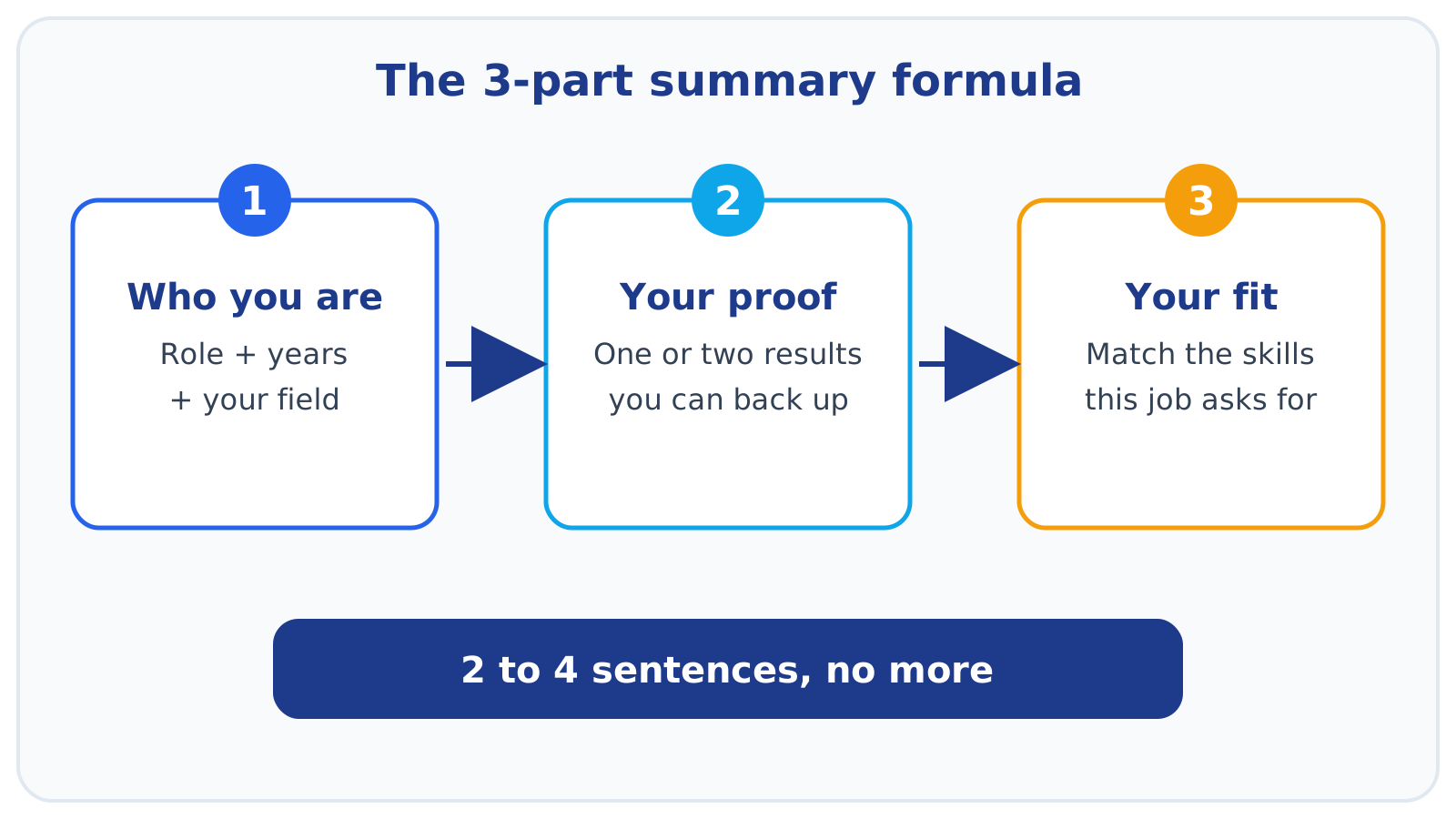
Most strong summaries, whatever the industry, follow the same order. Career centers and resume guides describe it in slightly different words, but the pieces are consistent: your role and experience, your strongest proof, and what you bring to this job. Handshake, for example, advises keeping a summary to three to four sentences, while Jobscan suggests two to five. Anywhere in that range is fine. Shorter usually reads better.
Part 1: who you are
Start with your role, your years of experience and your field. Use the job title the posting uses when it honestly matches what you do. "Customer success manager with six years in B2B software" tells a reader where to file you in about a second.
Part 2: your proof
Add one or two results you can back up in your experience section. A number is ideal, but only if it is real and you can explain it in an interview. If you do not have a number, use a concrete scope instead: the size of the team, the type of customer, the system you owned.
Part 3: your fit
Finish by connecting yourself to this particular job: the two or three skills or domains the posting asks for that you genuinely have. This is the sentence you change every time you apply. If a skill from the posting is not something you have done, leave it out. Mirroring the language of a job description is fine; claiming experience you do not have is not.
Resume summary examples: before and after
The examples below are illustrations written for this article, not real people. Swap in your own facts and numbers. In each case the "before" is the kind of summary that gets skimmed, and the "after" follows the formula.
Example 1: software engineer
Before: "Passionate and hardworking developer looking for an opportunity to grow in a dynamic company."
After: "Frontend engineer with five years building React and TypeScript dashboards for B2B products. Led the move of a design system used by four product teams. Looking to bring accessibility and performance experience to a product engineering role."
What changed: a role and a stack in the first sentence, one piece of scope in the second, and a fit sentence that names what the job cares about.
Example 2: marketing manager
Before: "Results-driven marketing professional with a proven track record of success."
After: "Content and lifecycle marketer with seven years in SaaS. Grew a newsletter from a few hundred to several thousand subscribers and ran the onboarding emails behind a free-trial funnel. Seeking a lifecycle marketing role where email, analytics and experimentation drive pipeline."
What changed: "results-driven" and "proven track record" are claims. The rewrite shows two things the reader can ask about. (Fill in your real figures; vague "grew by a lot" is as weak as the original.)
Example 3: operations or finance, career change
Before: "Experienced professional seeking a new challenge in a different industry."
After: "Operations coordinator moving into data analysis after two years of building weekly reporting in SQL and Excel for a logistics team. Completed a part-time analytics certificate and applies the same habits: clear definitions, checked numbers, short write-ups. Looking for a junior analyst role."
What changed: the move is stated openly, the bridge skills are specific, and the reader does not have to guess why this person is applying.
When to use a summary, an objective, or neither
The summary is the default for people with relevant experience. An objective, which states the role you want and why you are a fit, can work better in a few cases. Virginia Tech's career office lists being new to the workforce, changing industries, or attending a career fair as situations where an objective can help, because it explains your direction when your history does not.
A practical rule:
- Summary: you have two or more years in a field and you are applying to jobs in it.
- Objective or "profile" that blends both: you are a recent graduate or switching fields and need to explain the direction in a sentence or two.
- Neither: your resume is already one page and the top experience entry says everything a summary would. A generic summary only pushes your best content lower.
If you are worried about automated screening, a summary is plain text, so it passes through parsing fine. What matters more is a clean layout and standard headings, which we cover in what applicant tracking systems actually read.
Common summary mistakes to fix
- Adjective stacking. "Motivated, dynamic, detail-oriented" says nothing a reader can verify. Replace each adjective with a fact.
- First-person filler. Write in implied first person ("Led a team of five"), not "I am a team player who..."
- Copying the job description. Mirror its key terms where they are true; do not paste its sentences.
- Too long. More than five sentences or six lines, and it stops being a summary.
- The same summary for every job. It is the cheapest part of the resume to tailor and the part most worth tailoring.
Tip: Write your summary last. Once the experience section is finished, you know which two or three results are strongest, and the summary becomes a matter of picking them.
How to tailor your summary in five minutes
- Read the posting and underline the must-haves. Look for the two or three skills or responsibilities that appear first or most often.
- Keep sentences 1 and 2. Your role and your proof rarely change between similar jobs.
- Rewrite sentence 3. Name the must-haves you really have, in the posting's own words where honest.
- Check it against your experience section. Every claim in the summary should have evidence lower on the page.
- Read it aloud. If it takes more than about 15 seconds, cut it.
The full process for the rest of the resume is in how to tailor your resume to a job description. And if your summary leads into a cover letter, keep the two consistent: the letter expands one idea from the summary, as in our 4-paragraph cover letter structure.
Where CareerUpAgent fits
CareerUpAgent scores how well each job fits your resume and writes a tailored resume and cover letter for each application, including a job-specific summary. You review and edit every draft yourself before anything is used. If you would like to see how a posting compares with your current resume before you rewrite anything, try the free resume-to-job match checker. To see the features, visit /features, or create a free account.
Sources
- HR Dive, "Eye tracking study shows recruiters look at resumes for 7 seconds" (Nov 2018), reporting the Ladders 2018 eye-tracking study: hrdive.com
- Handshake, "How to write a resume summary": joinhandshake.com
- Jobscan, "How to Write a Resume Summary": jobscan.co
- Virginia Tech Career and Professional Development, "Objective vs. Summary of Qualifications": tips.career.vt.edu