You have an offer, and it is not quite what you hoped for. Knowing how to negotiate a job offer comes down to a few steps in a set order: get the offer in writing, know your range, decide what matters to you, make one clear ask, and confirm what you agree. This guide gives you that order and word-for-word scripts you can change to your own voice.
We built it on the University of Montana Career Center's Salary and Benefits Negotiation Guide and added the scripts ourselves. We did not add statistics, because we would rather leave out a number than quote one we cannot source.
Key takeaways
- Negotiate after a formal offer, not before. Early on, the career center advises letting the employer raise pay first.
- Research the range from public sources such as the Bureau of Labor Statistics, Glassdoor or Salary.com, and the posting itself.
- Rank what you want (pay, vacation, flexibility, start date) before the call, so you know where you can bend.
- Make one specific ask with a reason, then stop talking and let them answer.
- Ask for time to think about any counteroffer, and get every agreed term in writing before you accept.

How to negotiate a job offer: the order that works
Most mistakes in negotiation are mistakes of order. People name a number before they have an offer, or they accept on the phone and think about it afterwards. The sequence below follows the University of Montana guide's key steps and its advice on counteroffers and written terms.
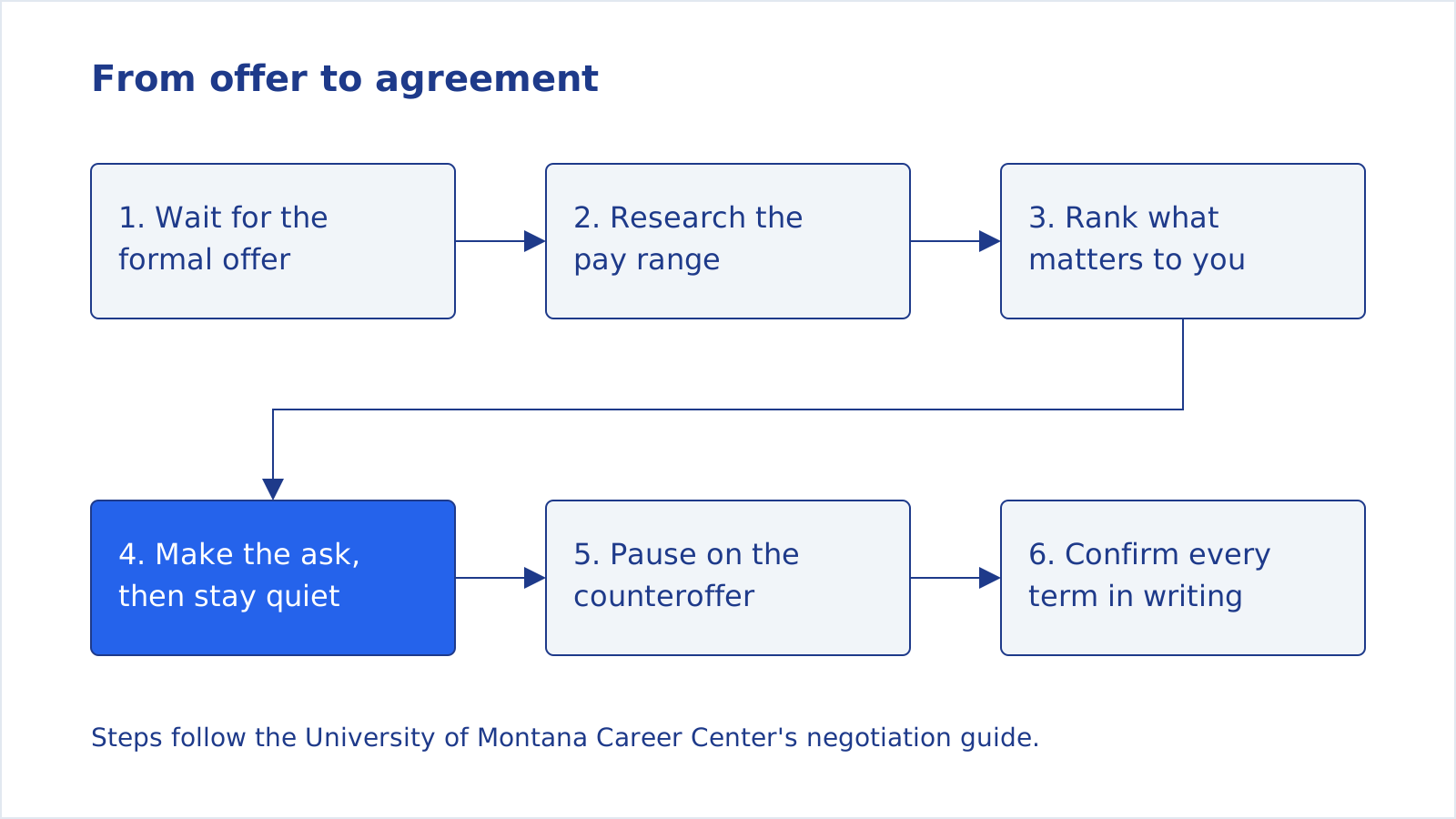
Each step gets a section below. If a recruiter asks about pay before you reach step one, our guide to the salary expectations answer covers forms, first calls and the pay-transparency laws.
Step 1: Reply to the offer without accepting it
The first message you send is not a negotiation. It says thank you, shows you are interested and buys time. The career center's advice is to wait for a formal offer before negotiating, and to ask for time to review any counteroffer. Naming a day in the same message is a sensible habit.

Script for the first reply
Thank you, I'm excited about the role and the team. Could you send the full offer in writing, including salary, benefits and start date? I'd like to review it properly and will come back to you by Thursday.
Choose a day that is soon enough to look interested and far enough away to do the work in the next step. If a recruiter pushes for an answer on the spot, say you want to give it a considered reply and repeat your day.
Step 2: Build your range from public sources
An ask needs a basis. The University of Montana guide points to Salary.com, Glassdoor and the Bureau of Labor Statistics for typical pay and benefits for a role, industry and location. Add the pay range in the job posting if there is one, and anything you know from people in similar roles who are willing to share.
Then write down three numbers: the figure you would be happy with, a figure you would ask for, and the lowest offer you would take. The guide calls the last one a walk-away point and tells you to define it before you negotiate. Do this on paper, in private, before any call.
Step 3: Rank what matters before you ask
The guide suggests listing your non-negotiables so you know where you can bend and where you cannot. Salary is only one line. It also lists health insurance, retirement plans, vacation time, flexible work options and bonuses as parts of the package.

| Part of the offer | What you can ask about | A way to say it |
|---|---|---|
| Base salary | The figure itself, or a review date | "Based on my experience with X, I was hoping for a figure closer to Y." |
| Bonus | How it is set and when it is paid | "Could you explain how the bonus is calculated and paid?" |
| Vacation and time off | Days per year, or unpaid leave you have already planned | "I have a trip booked in May. Could we agree that time now?" |
| Flexible work | Remote days, hours, location | "Could we agree two remote days a week from the start?" |
| Health and retirement | What is covered, and when it starts | "When does coverage begin, and what does the retirement plan include?" |
| Start date | More time before you begin, or an earlier one | "I'd need three weeks to wrap up here. Could I start on the 1st?" |
Not every item will move. Asking is a request, not a demand, and a polite no costs you very little.
Step 4: Make the ask (scripts for salary)
Name the figure, give the reason, and say you want the job. The guide's advice is to connect your skills and experience directly to what the company needs, and to remain silent after you state what you want. Silence feels long, but it hands the next move to them.
When the salary is lower than your range
I'm very keen on this role, and thank you for the offer. Given my five years running regional campaigns and the scope of the job, I was expecting a base closer to $X. Is there room to get there?
Use your real years and your real result, not ours. If you have no number to point to, a plain statement of what you will do in the first year works better than a vague one.
When you would take it, but want a little more
I'd be happy to accept if we can close the gap on salary. Could you do $X?
When they say the budget is fixed
I understand. If the base can't move, could we look at an extra week of vacation, a six-month salary review, or a sign-on bonus?
When you have another offer
I have another offer I'm weighing, but this is the role I'd prefer. Is there anything you can do on salary?
Only say what is true. Mention another offer only if you hold one, and give only figures you can stand behind. Inventing a competing offer is dishonest and puts the offer you already have at risk.
Step 5: Handle the counteroffer
The employer may agree, say no or come back with something in between. The University of Montana guide's advice for a counteroffer is to pause and thank them, then ask for a specific day to reply instead of answering at once. You can use something like this:
Thank you for coming back to me. I'd like to review it and make sure it's the right fit. Can I get back to you by Friday?
Compare the new figure against the walk-away point you set in step 2, then against your ranking from step 3. If the offer is above your walk-away point and covers the items you ranked first, accepting is a reasonable choice. If it is below, you have decided in advance what you do, so it is not an emotional call. You can also decline politely and keep the door open.
Negotiate by email if calls make you nervous. A written ask lets you choose every word, and the reply comes back in writing as well. If they ask to talk, use your notes and your script.
Step 6: Get every agreed term in writing
The career center advises getting the agreed terms and conditions in writing before you accept. After a call, send a short recap and ask them to confirm it, or wait for a revised offer letter.
Thanks for talking today. To confirm what we agreed: base salary of $X, a start date of the 1st, and two remote days a week. Could you send the updated offer letter so I can sign?
Read the revised letter against your notes line by line. Nothing is final until what you agreed appears on the page.
Keep competing offers and interviews in one place
If you are interviewing at several companies, offers rarely arrive at the same time. Keeping every application and its status in one list helps you see which processes are close to an offer and which you can still ask to speed up. In CareerUpAgent, the Applications page tracks each role through Draft, Ready to apply, Applied, Interviewing and Offered, with Rejected and Withdrawn for the rest.
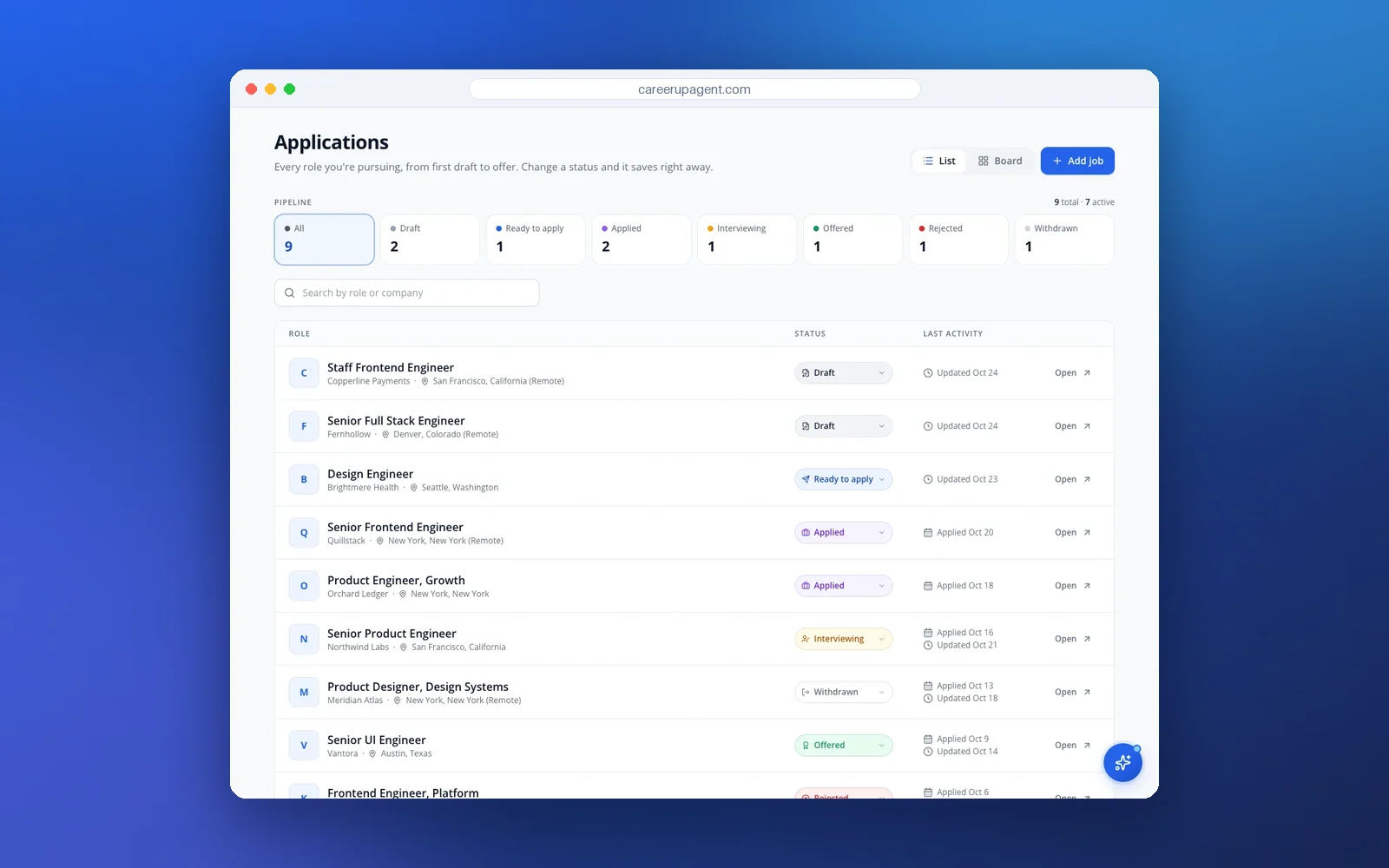
If you want a longer routine for keeping track, read our job search tracker guide. In our demo account the job listings show a salary beside each role, which can give you one data point for step 2. Treat it as one input beside the public sources above, not a verdict on what you should earn. See all features.
Common mistakes to avoid
- Naming a number before the offer. It can cap what you get.
- Accepting on the call. You can say yes tomorrow. You cannot unsay it today.
- Treating salary as the only lever. The package has several parts, and some may be easier for the employer to move.
- Apologizing for asking. State your reason and your figure in a normal tone.
- Skipping the written confirmation. A verbal promise is hard to prove later.
For the other half of the process, see our guides to questions to ask at the end of an interview and how to answer why do you want to work here.