You are moving from teaching to training, from retail to operations, from finance to product. Your career change resume has one job: make a hiring manager in the new field see someone who can do the work, even though your job titles say otherwise. That is a reframing problem, not a lying problem.
This guide gives you a four-step method, a way to choose between resume formats, a before-and-after summary rewrite and a short checklist. The advice draws on university career centers and US government career sites, named below.
Key takeaways
- Start from the job posting, not from your old job titles: list what the new employer wants first.
- Back every transferable skill with one real example from work, study, volunteering or a project.
- Most career changers do well with a combination (hybrid) format: skills up top, dated history below.
- Rewrite the summary and the top bullets of each role for the new field. Leave the facts alone.
- Tailor for every posting. A career change resume is never one-size-fits-all.
Why a career change resume needs a different approach
A standard resume lists what you did in the order you did it. For someone staying in the same field, that is a strength. For a career changer, it can put the least relevant information at the top. The University of Northwestern – St. Paul's career development handout puts it plainly: much of your experience is transferable, if it is presented the right way (University of Northwestern – St. Paul, Career Changers: Guide to Resume Writing).
The same handout warns that your resume may not contain the keywords the employer's software is looking for, and suggests pulling them from the job description and using them only where they are honest. How much an applicant tracking system really filters is a separate question, and our guide to what applicant tracking systems actually read covers it. The practical point stands either way: use the employer's vocabulary for things you have really done.

Step 1: Read the posting for what the employer wants
The University of Northwestern – St. Paul handout recommends an "audience analysis" before you touch the resume: read the job description closely (including the duties, not only the qualifications), look at the company website for mission, values and other postings, and, where you can, talk to people inside the organization.
In practice, take a posting you actually want and make two lists:
- Must-haves: tools, methods, qualifications and responsibilities named directly.
- Between the lines: what the duties imply, such as working with several teams, handling deadlines or explaining complex things simply.
Do this for three to five postings in the field. Words that repeat across them are the vocabulary of the role.
Step 2: List transferable skills, with proof
The same handout defines transferable skills as skills you have gained from any activity: jobs, classes, projects, hobbies or volunteering. Pull the skills you think you have from your list, then write an example of when you used each one.
If you are not sure which skills your old job really involved, the US Department of Labor's O*NET database breaks occupations down by tasks, skills and tools. The University of Illinois Urbana-Champaign suggests typing in a job title you have held and noting the tasks, skills and related careers that come up (University of Illinois Urbana-Champaign, Identifying Transferable Skills). It is a useful way to see your old work in a more neutral vocabulary. You can browse it at O*NET OnLine.
A simple table keeps you honest. For each skill the posting asks for, write the proof:
| The posting asks for | Where you have done it | Proof to put on the resume |
|---|---|---|
| Training and onboarding | Classroom teaching | Planned and ran lessons for [number] learners a term; adapted material for different levels |
| Stakeholder communication | Parent and school liaison | Regular updates to [who] on progress and issues |
| Reporting and data | Tracking assessment results | Built a spreadsheet tracking [what] and used it to change [what] |
The bracketed gaps are yours to fill with real numbers. If you do not have a number, describe the scope honestly: how often, for whom, with what result. Our guide to resume bullet points shows how to write them when the numbers are thin.

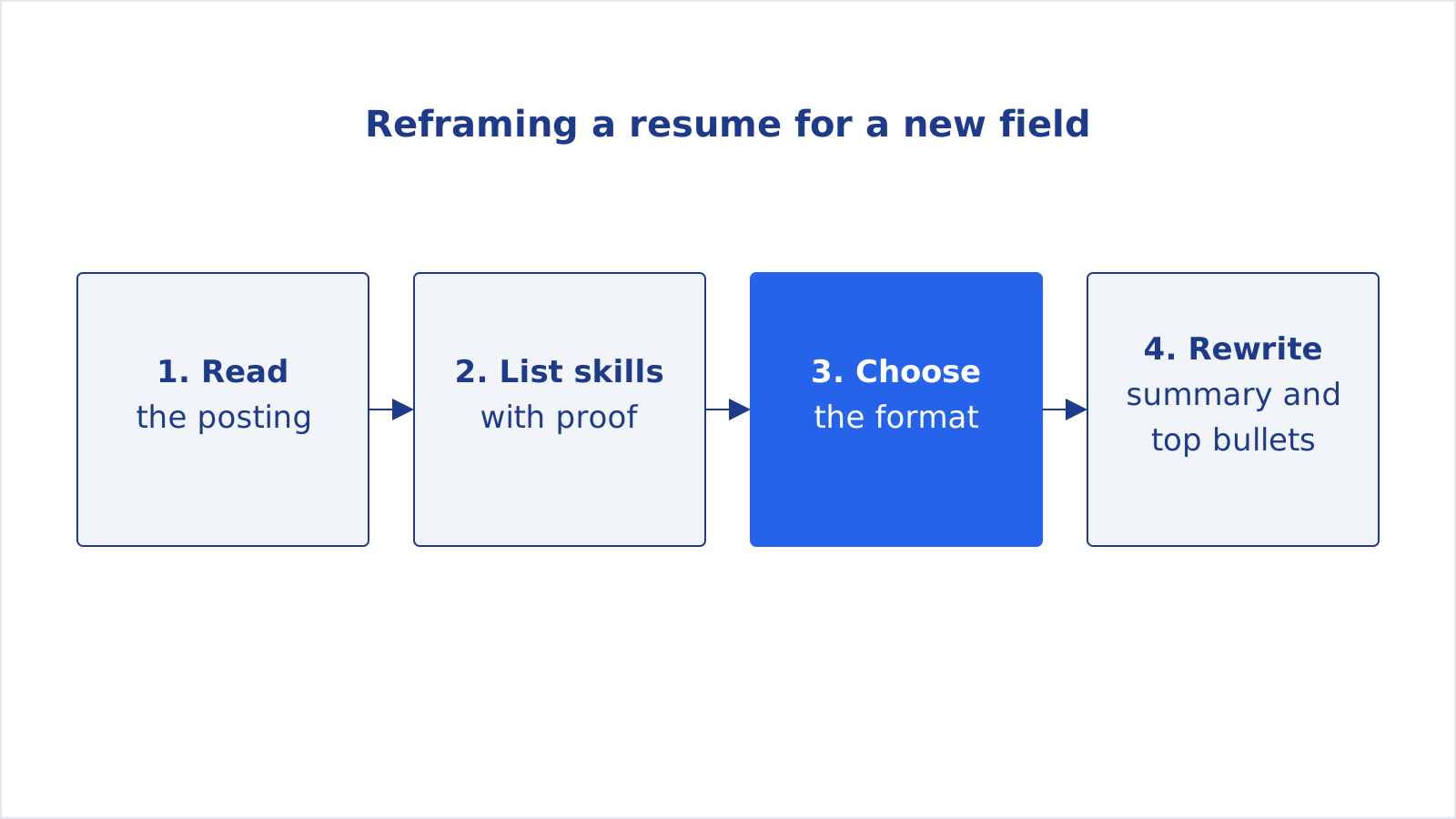
Step 3: Choose the format that shows your strengths
There are three common resume styles: chronological, functional and combination. CareerOneStop, which is sponsored by the US Department of Labor, describes each with its trade-offs (CareerOneStop, Resume styles).
| Format | What it does | Watch out for |
|---|---|---|
| Chronological | Lists jobs from newest to oldest. Most employers are used to it, according to CareerOneStop. | CareerOneStop notes it emphasizes a lack of related experience and career changes. |
| Functional | Groups skills and accomplishments by category rather than by job. | CareerOneStop says employers may view it with suspicion because it gives little information about specific employers and dates. |
| Combination | Mixes both: relevant skills and achievements first, then work history. CareerOneStop says it minimizes drawbacks such as gaps and a lack of directly related experience. | CareerOneStop warns it can be confusing if badly organized and takes more effort to prepare. |
The University of Northwestern – St. Paul handout agrees. It says a chronological resume is generally not recommended for career changers because it highlights experience rather than transferable skills, and a combination resume highlights transferable skills while still showing work experience. NJIT's career services also describe the combination resume as a way to overcome limits of the other two formats (NJIT Career Development Services).
Our recommendation follows from this: for most career changers, use a combination resume. Put a short summary and a skills section at the top, then your dated work history below, written to show the same skills. A pure functional resume gives the person screening it less to go on, and the resume builder Resume.io says functional formats often confuse applicant tracking software (Resume.io). A single column with standard headings and dated roles avoids that risk.
Put the strongest evidence first. The Northwestern – St. Paul handout gives an example: if you are moving into counseling and hold a relevant license, do not bury it on page two behind an old job history. Order sections by what the new employer cares about most.
Step 4: Rewrite the summary and the top bullets
The summary is where the reader decides whether your old job matters. It should name the target field, say what you bring from your background, and give one or two proof points. Our guide to resume summary examples goes deeper on the formula. Here is the shape for a career changer.
Before (describes the past job): "Dedicated secondary school teacher with [number] years in the classroom, passionate about helping students succeed."
After (aims at the new job): "Educator moving into corporate learning and development. [Number] years designing and delivering training for groups of [number] learners, building materials from scratch and measuring progress with data. Looking to apply instructional design and facilitation skills to employee onboarding."
The facts are the same (this is an illustration, not a real person's resume). What changed is the first line, which now names the target, and the vocabulary, which matches the field.
Do the same for bullets. Keep the three or four most relevant bullets per role at the top, and rewrite them with the posting's language:
- Old: "Taught year 9 science and managed a busy classroom."
- New: "Designed and delivered a [number]-week curriculum for [number] learners, using assessment data to adjust the plan each term."
Cut the details of duties that do not support the new direction. Do not cut the job itself or the dates: employers want a complete history, and gaps raise more questions than irrelevant duties do.
Where CareerUpAgent can help
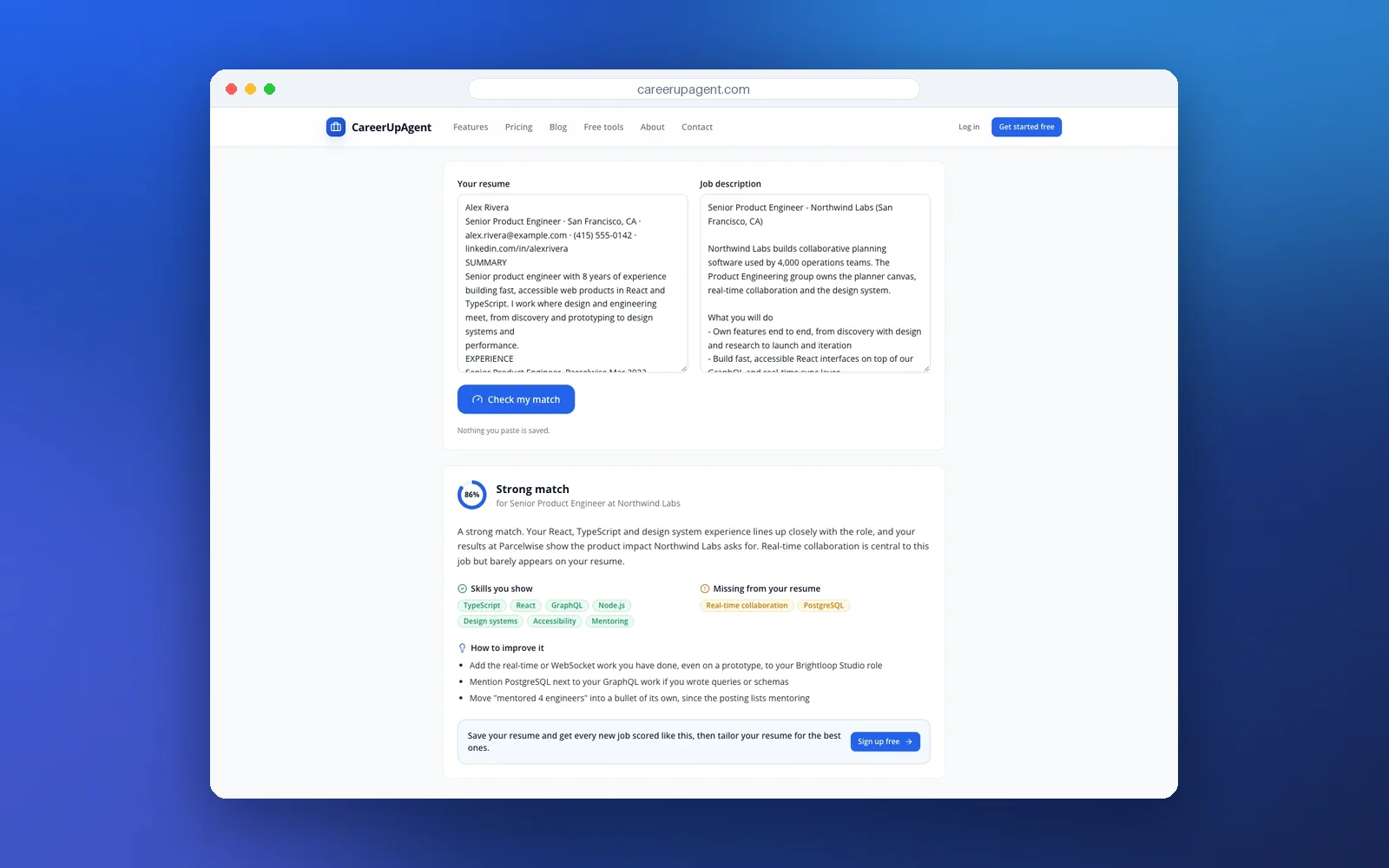
Steps 1 to 4 are the kind of work a tool can speed up, though you stay in charge. CareerUpAgent's free resume-to-job match checker compares a pasted resume with a pasted job description and shows a match score, the skills it found, the ones that look missing and suggestions to improve. For a career changer, the "missing" list is a useful prompt: for each item, ask yourself whether you really have the skill under a different name.
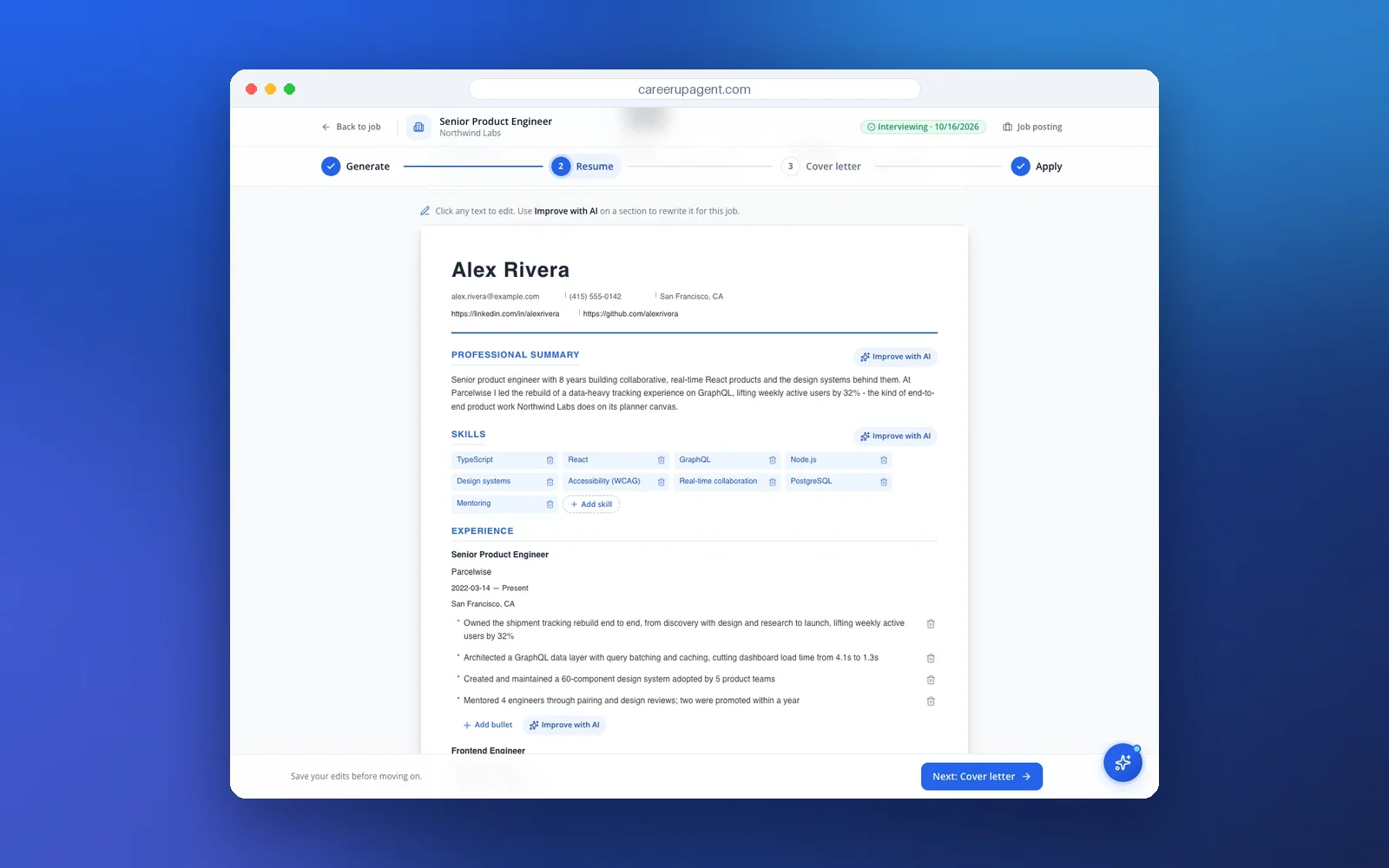
Inside the app, the tailored resume editor produces a job-specific summary, tailored skills and rewritten bullets for a saved job, with an "Improve with AI" button on each section. Read every line and edit it: the resume has to be true and has to sound like you.
After you have tailored a version, run it through the free ATS resume checker to see whether the text is readable and the sections are standard. For the next stage, see our guides on tailoring a resume to a job description and the resume skills section, and the cover letter where you can explain the move in your own words. The Northwestern – St. Paul handout calls a solid cover letter vital for a career changer.
Do not stretch the truth. Reframing means choosing which true facts to lead with and what words to use. It does not mean claiming a title, a tool or a result you did not have. Interviewers ask follow-up questions, and the resume is what they will ask about.
A checklist before you send
- The summary names the target role or field in its first line.
- The top third of the page contains the skills the posting asks for most.
- Each transferable skill has at least one example behind it.
- Dates and employers are complete and correct.
- Keywords from the posting appear where they are true.
- Single column, standard headings, easy to read on a phone.
- A cover letter explains why you are moving, in two or three sentences.